Cua Driver SDKs Bring Background Computer Use In-Process
- Source
- cua.ai
- Author
- Cua
- Date
Context
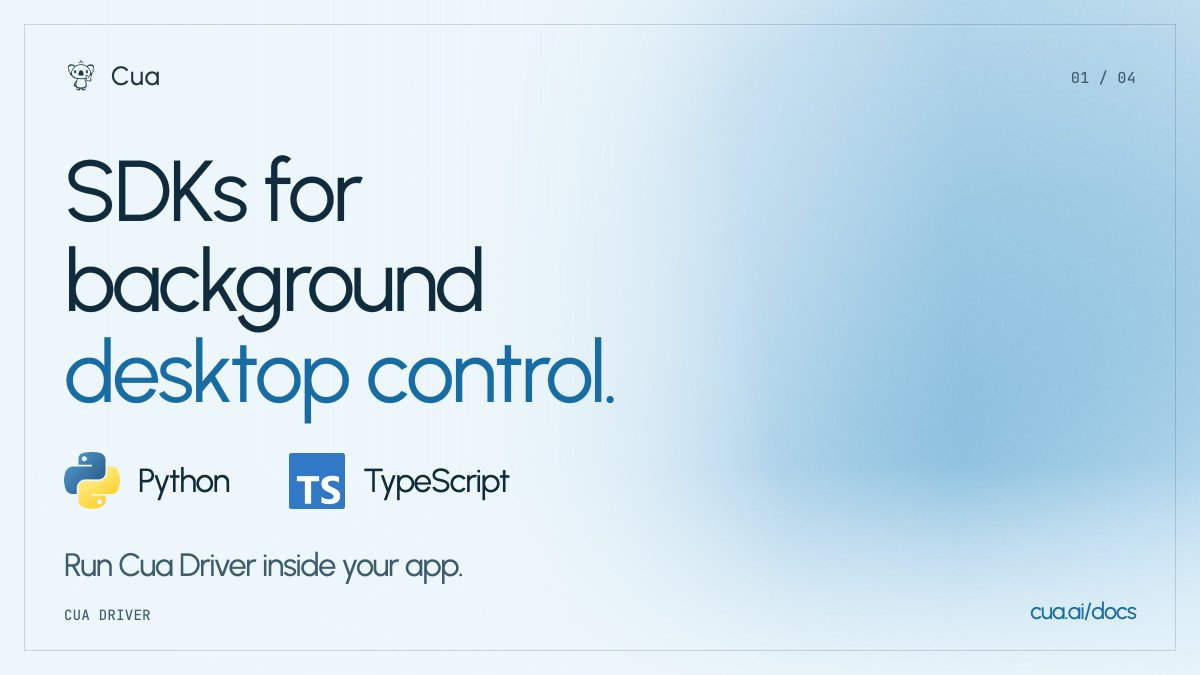
Cua's Python and TypeScript SDKs let an application call Cua Driver, the company's desktop-automation engine, straight from its own code. In the SDK guide, CuaDriver.create() is the default entry point. Where the platform allows it, the Rust driver runs inside the app's own process with no daemon, socket or separate executable, and the app owns the operating-system permissions, sessions and shutdown. Cua announced the SDKs as bringing background computer use directly inside an app.
macOS is the exception, and the guide explains why. A driver loaded into a Python or Node process has no AppKit host, so it cannot draw the cursor that shows where the agent is working, and macOS would attribute the Accessibility and Screen Recording permissions to Python, Node or the IDE instead of to CuaDriver.app. So on macOS, create() connects to or starts the CuaDriver.app daemon, and falls back to the in-process driver, with a one-time warning, only when that app is not installed. Developers can force in-process mode with an embedded flag. Other platforms always run in process.
Background use means delivering input without moving the user's pointer or taking focus, which Cua's repository says works when the app and platform support it. The guide's example snapshots a window, clicks a button in background mode using an element from that snapshot, then takes a second snapshot to confirm the counter changed. Its rules make verification the developer's job: a returned click does not prove the interface changed, a token is valid only for the snapshot it came from, background delivery never retries in the foreground on its own, and an action can reach the operating system even when the call times out, so a retry should wait for an independent check.
The guide also covers the opposite arrangement, in which a signed desktop app hosts a private driver daemon and hands its connection to an outside agent so the agent works under the app's permissions. OpenClaw 2.0's computer-use support uses the SDK rather than an MCP hand-off: Cua says OpenClaw keeps its own agent tool and action contract while its bundled provider calls the Cua Driver SDK, which Cua describes as deeper than an external MCP connection.
- AI agent — An AI system that doesn't just answer once but works toward a goal in a loop — taking actions, reading the results, and deciding what to do next.
- token — The chunk of text a model reads and writes in — roughly three-quarters of a word — and the unit AI usage is billed in.
- MCP — The Model Context Protocol — an open standard that lets any AI assistant plug into any tool or data source without custom integration code.


Checking sign-in…
Loading comments…