Gemini 4 Neon benchmarks: near-frontier scores at lower cost
- Source
- x.com
- Date

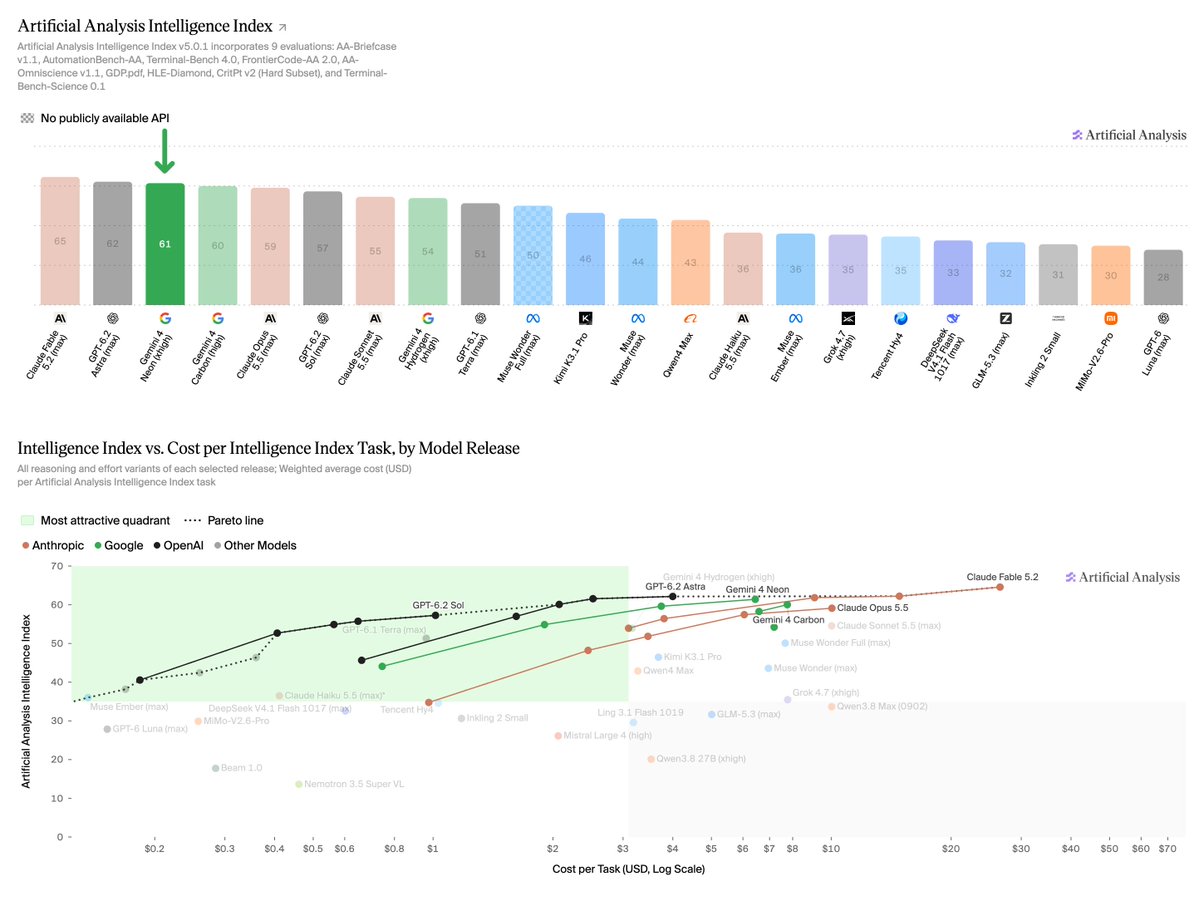
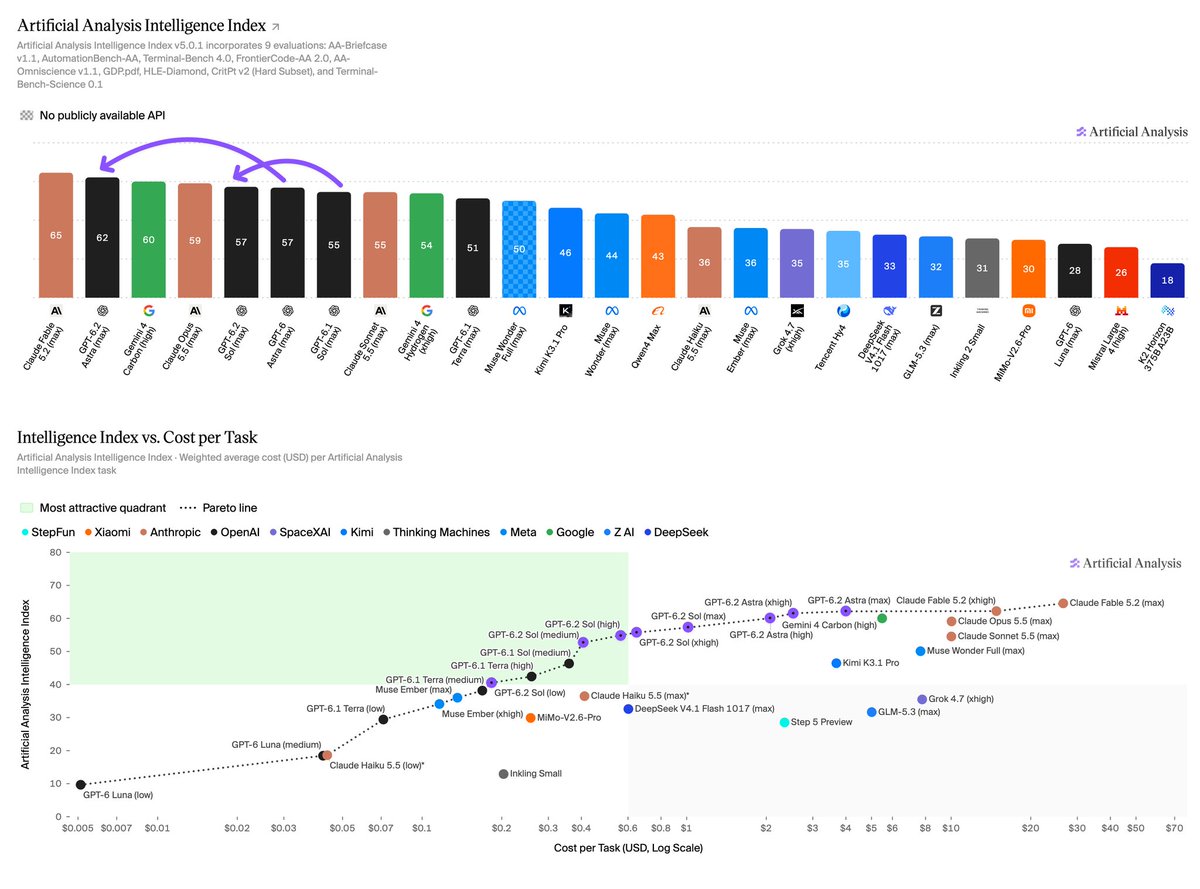
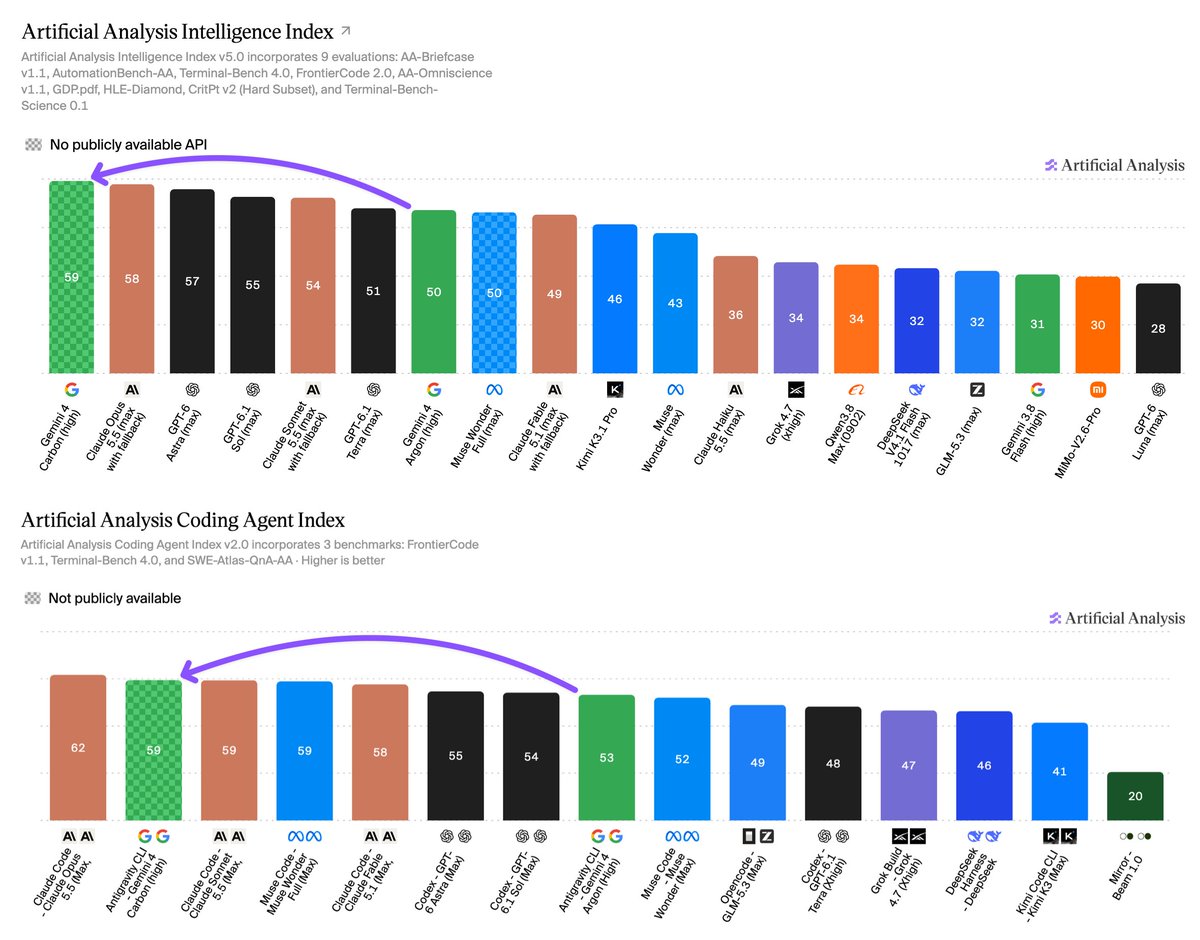
Google continues to accelerate its release cadence with Gemini 4 Neon, delivering a small Intelligence gain over Gemini 4 Carbon at a ~17% lower Cost per Task @GoogleDeepMind has released Gemini 4 Neon, its fourth model in just seven weeks. Neon (xhigh) scores 61 on the Artificial Analysis Intelligence Index, 1 point ahead of Gemini 4 Carbon (high) and 3rd overall, behind GPT-6.2 Astra (max) and Claude Fable 5.2 (max). At high effort, Neon matches Carbon (high) at less than half the Cost per Task using Carbon’s standard (non-discounted) pricing. Key takeaways: ➤ Slight improvement in Intelligence for lower Cost and Time per Task: Neon (xhigh) scores 61 on the Intelligence Index, 1 point ahead of Carbon (high), with small improvements in agentic knowledge work, visual reasoning and coding. It costs $6.44 per task, ~17% less than Carbon ($7.76 at non-discounted pricing), and takes ~21 minutes per task, ~40% less than Carbon (~36 minutes). Neon uses ~15% more output tokens per task, so the lower cost comes purely from its 25% lower token prices ($3/$15 vs $4/$20 per 1M input/output tokens), and the lower time from its higher output speed (~110 vs ~57 output tokens per second) ➤…
Context
Artificial Analysis, an independent group that runs AI models through its own benchmarks, finds that Google's new Gemini 4 Neon is only slightly more capable than Google's earlier Gemini 4 Carbon, so its case rests on lower prices, faster answers and better-presented work. In its results post, Neon at xhigh, the highest of its four effort levels, which set how much work the model puts into each answer, scores 61 on the Artificial Analysis Intelligence Index, a composite of many evaluations. That is one point above Carbon at high effort and third overall, behind OpenAI's GPT-6.2 Astra and Anthropic's Claude Fable 5.2, both at max. At high effort, Neon matches Carbon's score at less than half Carbon's cost per task, counting Carbon at its standard price.
Neon's savings come from price and speed, not from doing the work with fewer . At xhigh it costs $6.44 per task against $7.76 for Carbon, about 17% less, and takes about 21 minutes per task instead of about 36. Yet Neon produces about 15% more output tokens per task. Artificial Analysis attributes the whole cost gap to Neon's 25% lower prices, $3 per million input tokens and $15 per million output tokens against Carbon's $4 and $20, and the time gap to Neon's output speed of about 110 tokens per second against about 57. Those Carbon figures use its standard price. Google is discounting Carbon to $2 and $10 until November 30, which leaves Neon's prices 50% higher, so the measured saving reflects Carbon's standard price rather than what Carbon costs during the discount.
The clearest gains are in visual reasoning and in how results are presented, and the best effort level depends on the task. On GDP.pdf, one of those visual reasoning tests, Neon at high scores 33.4% against Carbon's 28.4%, in line with the best scores the group has measured, while Neon at xhigh scores only 28.0%. On AA-Briefcase, the group's test of agentic knowledge work rated with chess-style Elo scores, Neon at xhigh reaches 1700 overall and takes first place for presentation quality at 1771, 45 points ahead of the previous leader, Claude Sonnet 5.5 at max. On Google's Knowledge , which tests knowledge work over complex visual files, Neon scores 56%, two points above Carbon and close to the leader, Claude Fable 5.2 at max with 57%.
In coding, the group scores each model inside the agent tool that runs it. In Google's Antigravity CLI, Neon at xhigh scores 59 on the Artificial Analysis Coding Agent Index, against 55 for Carbon at high, and in line with Claude Code running Claude Fable 5.2 or Claude Opus 5.5, both at 58. Its average cost per task is $6.86, against $12.61 for Opus 5.5 and $15.47 for Fable 5.2. Because each score measures a model together with its tool, the comparison is between those packaged setups rather than the models alone. Google's own launch claims, including a different figure for Neon's savings over Carbon, are in its announcement.
- token — The chunk of text a model reads and writes in — roughly three-quarters of a word — and the unit AI usage is billed in.
- multimodal — A model that works with more than text — reading images, audio, or video, and sometimes generating them too.
- AI agent — An AI system that doesn't just answer once but works toward a goal in a loop — taking actions, reading the results, and deciding what to do next.
- eval — A repeatable test for AI quality — a set of tasks plus scoring — used the way software teams use test suites, because model output is too variable to judge by eyeballing.

Checking sign-in…
Loading comments…