GPT-6.2 Astra and Sol: Cheaper and Stronger, But Flat on Coding Agents
- Source
- x.com
- Date

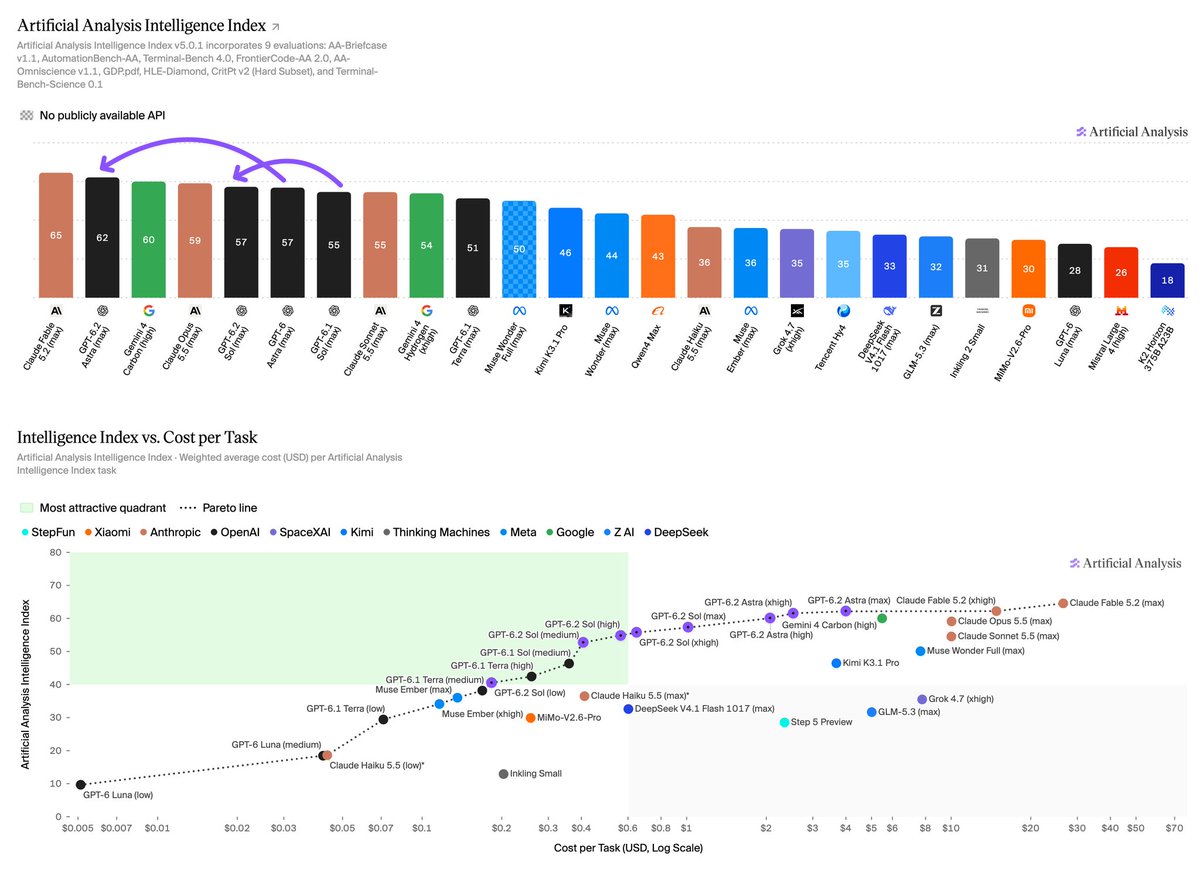
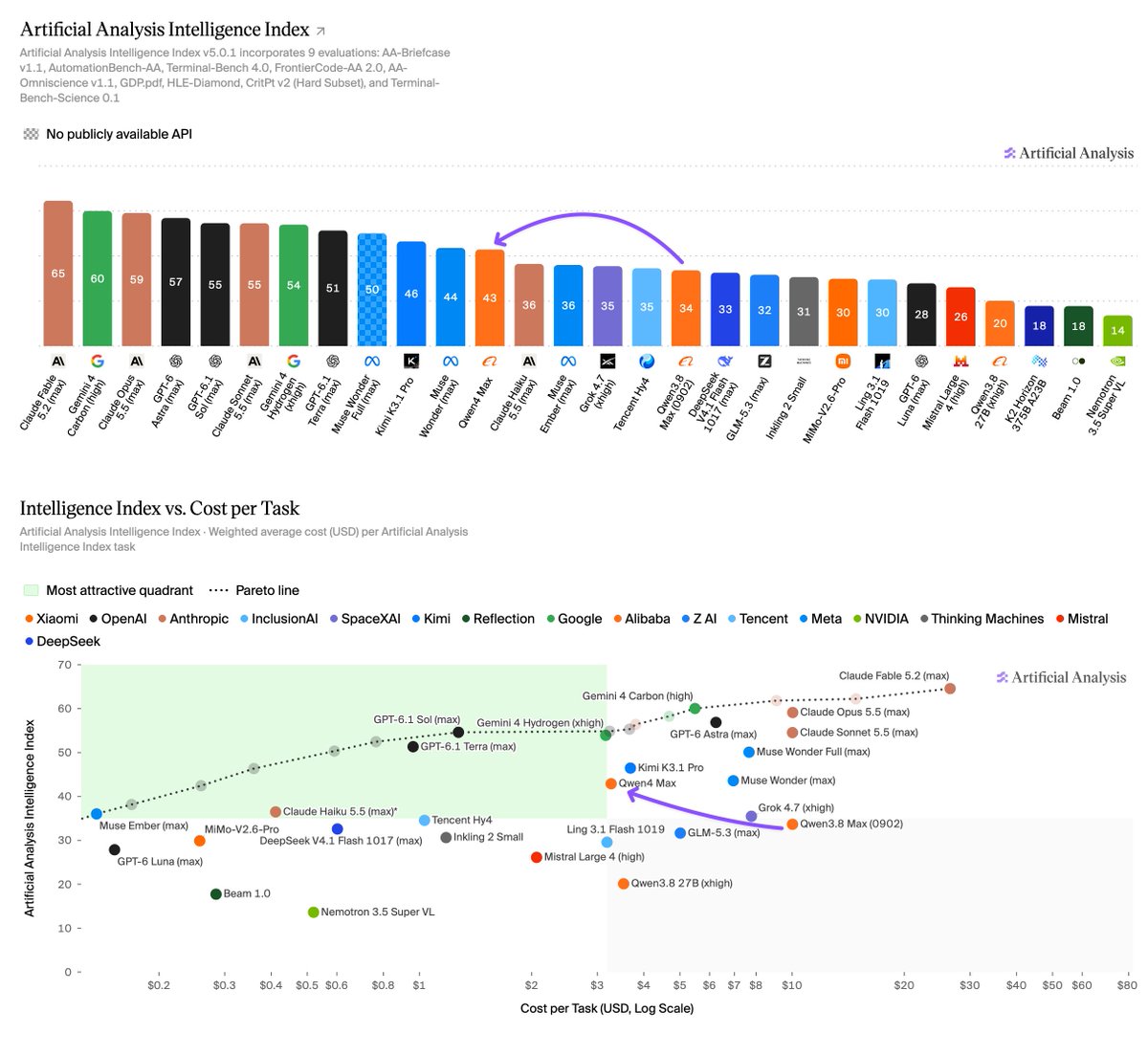
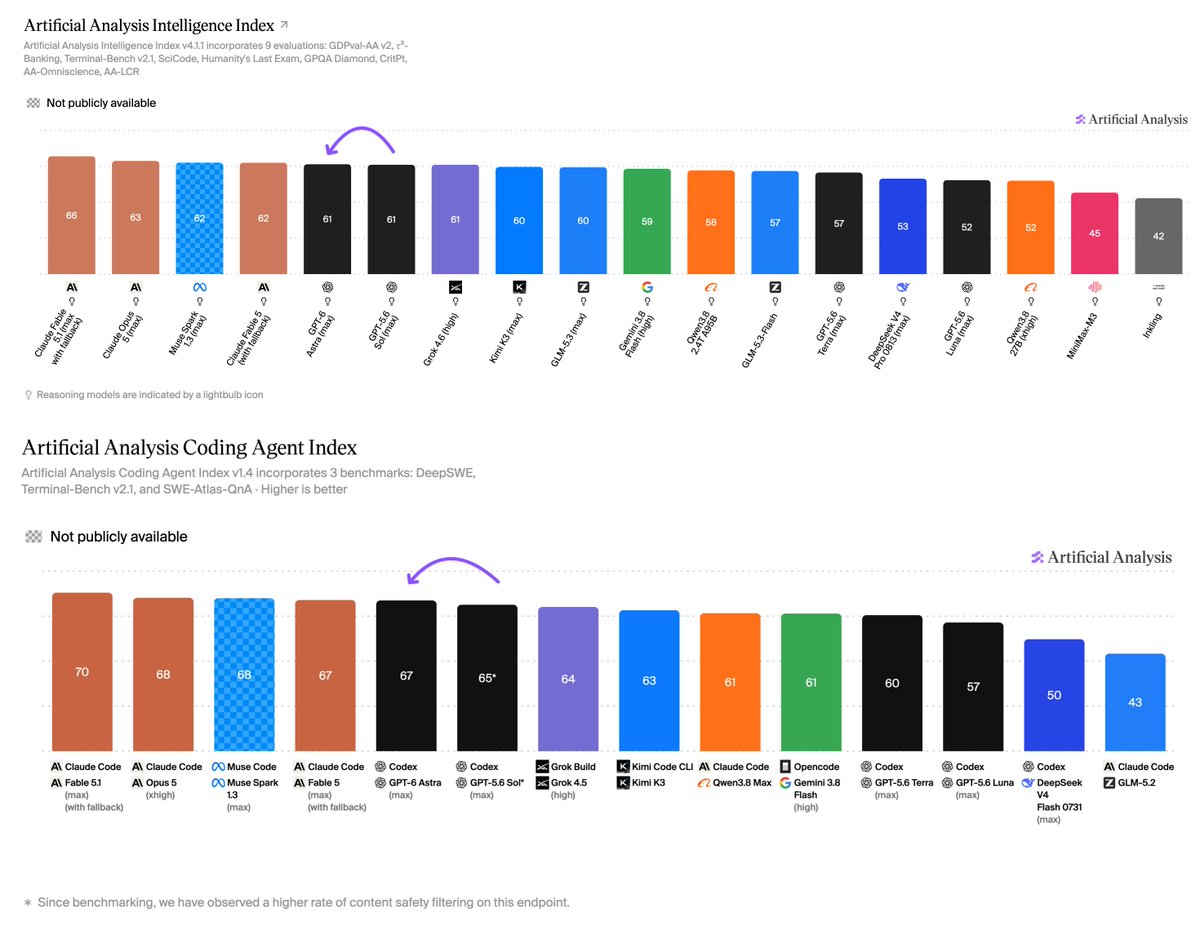
OpenAI’s release of GPT-6.2 Astra and GPT-6.2 Sol delivers the #2 model in the Artificial Analysis Intelligence Index and most of the Cost per Task Pareto frontier @OpenAI's GPT-6.2 Astra is priced at $8/$40, 20% below GPT-6 Astra, and cached input drops to $0.40 from $1.00 per million tokens. GPT-6.2 Sol pricing is unchanged from GPT-6.1 Sol, at $2/$10 per million input/output tokens. Key takeaways: ➤ Second in Intelligence Index: OpenAI now trails only Anthropic’s Claude Fable 5.2 in the Artificial Analysis Intelligence Index. GPT-6.2 Astra jumps 5 points from GPT-6 Astra, overtaking Gemini 4 Carbon (60) and Claude Opus 5.5 (59) at their top effort settings. GPT-6.2 Sol gains 2 points at 57, placing it on par with GPT-6 Astra at ~15% of the Cost per Task. ➤ Occupies most of cost and output token frontiers: OpenAI models now occupy most of the Cost per Task Pareto frontier, sharing the frontier with only Anthropic and Meta. OpenAI also dominates the Output Token per Task Pareto Frontier, with Claude Fable 5.2 being the only model from a non-OpenAI lab appearing on the frontier. ➤ Strengths in science and knowledge: OpenAI performs strongly in both of our key science-focused…
Context
Artificial Analysis, an independent firm that benchmarks AI models, finds that OpenAI's GPT-6.2 Astra gains on its broad intelligence measure but not on its test of coding agents. The Artificial Analysis Intelligence Index combines nine evaluations, among them terminal tasks, real-world coding changes, physics reasoning and factual knowledge, according to the chart attached to the post. GPT-6.2 Astra scores 5 points higher than GPT-6 Astra, which puts it second, behind Anthropic's Claude Fable 5.2 and ahead of Google's Gemini 4 Carbon (60) and Claude Opus 5.5 (59) at their top effort settings. GPT-6.2 Sol gains 2 points to 57, level with GPT-6 Astra at about 15% of its cost per task, the firm's measure of what a model spends to complete one index task, which reflects both its prices and how many tokens it uses.
Lower cost is the most consistent change in the results. Artificial Analysis lists GPT-6.2 Astra at $8 per million input tokens and $40 per million output tokens, 20% below GPT-6 Astra, with cached input falling to $0.40 from $1.00; Sol's price is unchanged from GPT-6.1 Sol at $2 and $10. OpenAI models now make up most of the firm's cost-per-task Pareto frontier, the set of models that no other model beats on both score and cost, which they share only with Anthropic and Meta.
Coding agents are the exception. The Coding Agent Index scores a model working inside an , the program that gives it tools and instructions, here OpenAI's Codex at maximum effort. On it, GPT-6.2 Astra is flat with GPT-6 Astra, and GPT-6.2 Sol is 3 points below GPT-6.1 Sol. Artificial Analysis attributes Sol's drop to a 14-point fall on SWE-Atlas-QnA-AA, where the new model is more likely than its predecessor to leave key facts out of its answers. The firm notes that several effort levels of both models still sit on the coding index's cost-per-task frontier, so on coding the case for the new models is lower cost, not better results. The post gives no coding scores for the new models, so their distance from the leaders is not stated. Early hands-on testing at Every pointed the same way: its testers found GPT-6.2 Astra performed similarly to GPT-6 Astra on most of their coding benchmarks but often seemed to stop too early on real builds.
- token — The chunk of text a model reads and writes in — roughly three-quarters of a word — and the unit AI usage is billed in.
- AI agent — An AI system that doesn't just answer once but works toward a goal in a loop — taking actions, reading the results, and deciding what to do next.
- agent harness — The scaffolding around a model that turns it into a working agent — the loop, the tools it can call, and the rules for when to stop.
- hallucination — When a model states something false with full confidence — inventing facts, citations, or APIs that don't exist.
Checking sign-in…
Loading comments…