OpenAI's Jalapeño inference chip posts results, deploys by year-end
- Source
- x.com
- Date

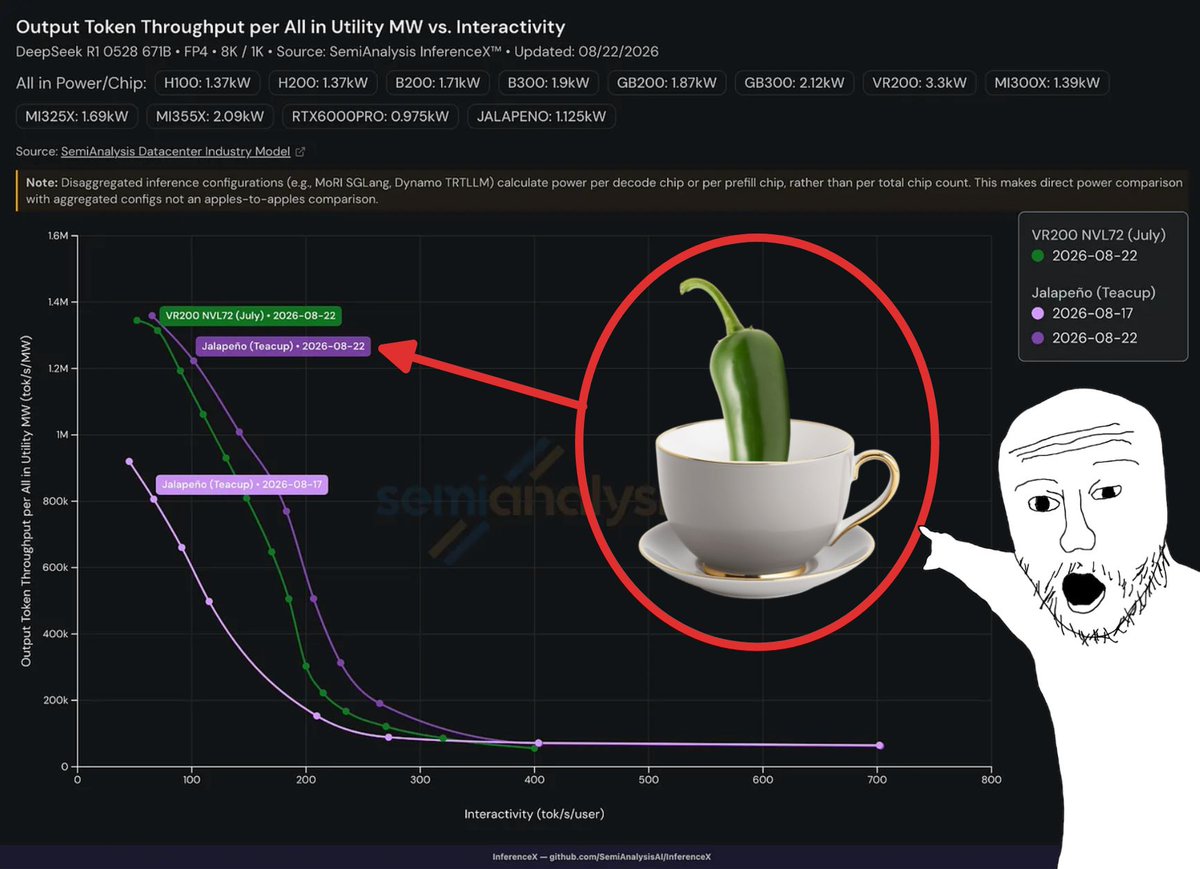
Since announcing Jalapeño, our first custom inference chip, we’ve been testing it and the system around it. The results show a major advance: more intelligence from every watt and faster responses, delivering both higher throughput and lower latency in one architecture without sacrificing efficiency.

Context
OpenAI's announcement says testing of Jalapeño, its first custom chip, shows more intelligence per watt and faster responses, with higher and lower in one architecture. The phrase targets a familiar trade in serving AI models. Batching many users' requests together raises the total number of tokens a chip produces, but each user waits longer for their own. Hardware and serving setups are usually tuned toward one end of that curve. OpenAI's claim is that a single Jalapeño design does well at both ends. The post itself contains no figures, and its attached ten-second video shows the chip being lowered onto a board, followed by the tagline.
The numbers come from SemiAnalysis, a chip research firm that OpenAI invited into its lab. Its article reports more than 700 tokens per second for a single user on DeepSeek R1 and says Jalapeño beats Nvidia's Blackwell on performance per watt across almost all of the curve, from low-latency to high-throughput settings. SemiAnalysis ties this to OpenAI keeping one pool of identical chips for every stage of a request, instead of dedicating some chips to reading prompts and others to generating answers. The entry on SemiAnalysis's full article explains that design. The same article adds the limits: OpenAI supplied the numbers, the workload was a short single-turn test rather than long agent sessions, and the results came from first-revision silicon.
For people who use ChatGPT or Codex, nothing changes yet. SemiAnalysis says OpenAI has engineering samples, with production scheduled to ramp gradually over 2027 and reliability testing with data-center partners running through January. If the claim holds on real agent traffic, OpenAI would get faster responses from the same power budget, which SemiAnalysis identifies as the company's binding .
- Inference — Using a trained model to produce an output from a supplied input.
- throughput — How much model output a provider can generate over time, commonly measured in output tokens per second.
- Latency — The time between asking for a result and having it, including the model's generation time, tool calls, retries and any queueing.
- Constraint — A requirement a setup must meet regardless of how well it performs otherwise, such as where documents may be sent or a date by which the work must be done.



Checking sign-in…
Loading comments…