Optimally Allocating Compute Between Inference And Training
- Source
- epoch.ai
- Author
- Epoch AI publications
- Date
Context
This 2024 essay by Ege Erdil, then a researcher at Epoch AI, argues that a lab minimizing its total compute bill should spend comparable amounts on training a model and on serving it (epoch.ai). It starts from a rough coincidence: Sam Altman had said OpenAI generated around 100 billion a day, about 36 trillion a year, while modern models are trained on the order of 10 trillion tokens, and a training token costs around three times as much as an token because training needs backward passes as well as forward ones. On that naive arithmetic, annual inference and training costs come out at the same order of magnitude, and the essay asks why neither dominates.
The answer is the training-inference tradeoff. A lab can get better performance either by spending more on training or by spending more each time the model runs. Overtraining a smaller model on more data makes every token cheaper to serve; prompting, web browsing and repeated sampling instead spend extra compute at run time. Citing Villalobos and Atkinson (2023), the essay takes as a rule of thumb that each technique can save about one order of magnitude of compute on one side in exchange for somewhat more than one order of magnitude on the other, and simplifies that to a one-for-one swap.
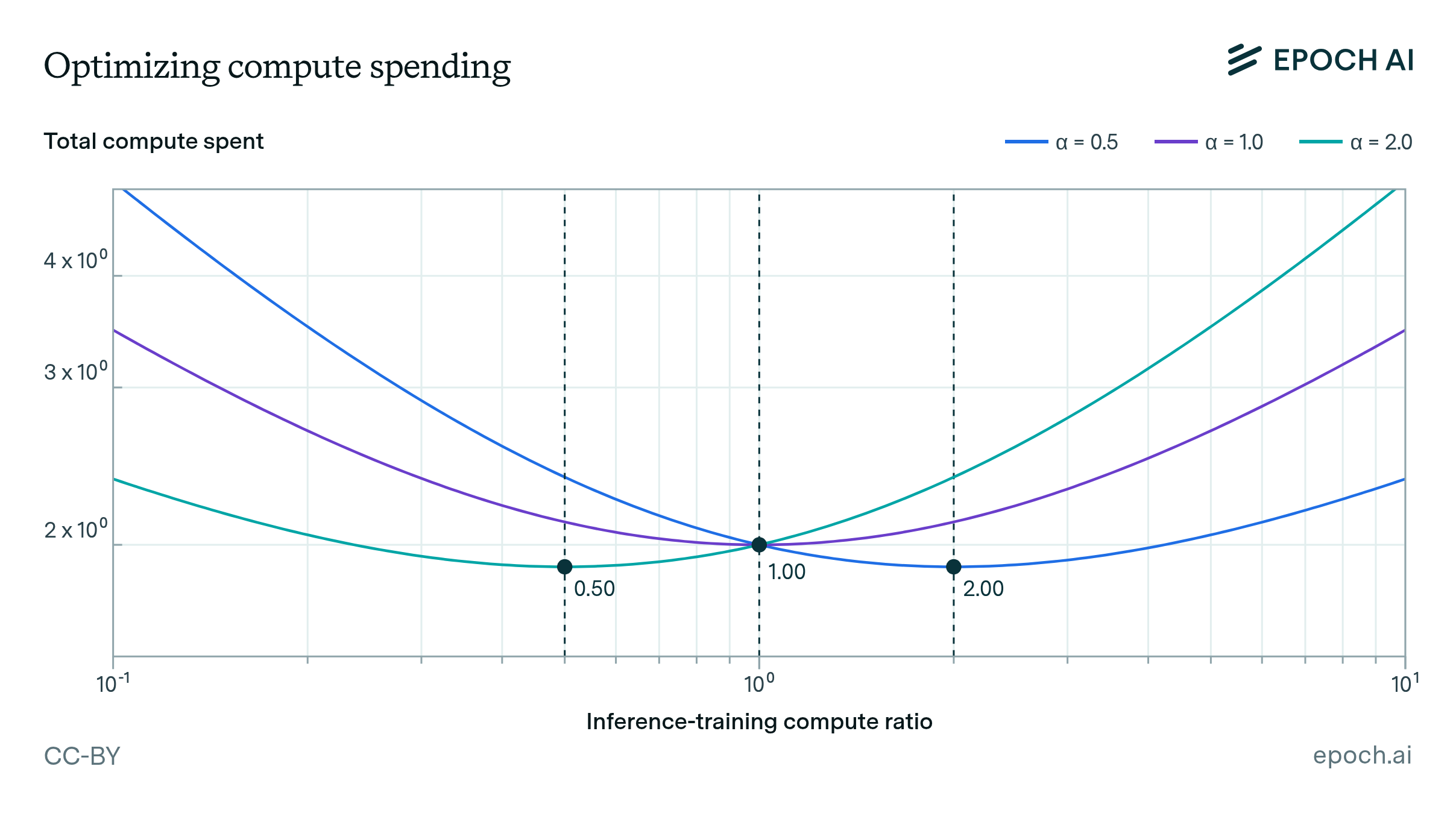
Given that swap, lopsided budgets are wasteful. In the essay's example, a lab spending 1 zettaFLOP on training and 100 on inference could train ten times harder and serve ten times more cheaply, keeping performance the same while spending 20 zettaFLOP instead of 101. More generally, if β orders of magnitude of training compute buy α orders of magnitude of inference savings, the cost-minimizing split puts a fraction α/(α+β) into training. The split is not very sensitive to the exact rate: for training and inference to differ by an order of magnitude, α would need to be below 0.1 or above 10, and Erdil says the empirical evidence does not support values that far from 1.
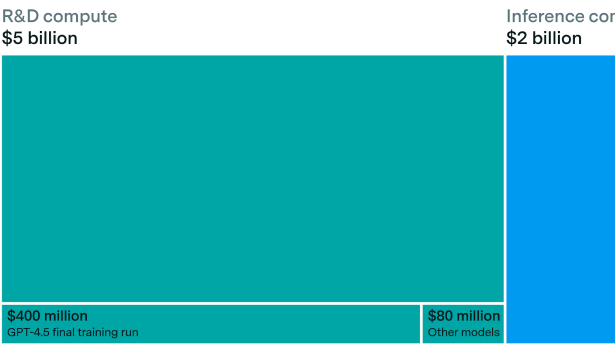
The essay names the main way this could fail: if every known inference-saving tradeoff is already used up and inference still dominates, there may be little left to trade. It also sets aside memory-bandwidth limits on inference, the falling cost of future compute, and its assumption that labs know demand in advance. Epoch's later breakdown of OpenAI's 2024 compute spending offers one real-world comparison: it estimated research and development compute well above inference spending, with most R&D compute going to research and experimental runs rather than final training runs, from investor figures it calls not completely reliable.
- Ege Erdil's starting point: Sam Altman's claim of about 100 billion tokens a day (36 trillion a year), against roughly 10 trillion training tokens at about 3x the per-token cost, puts OpenAI's inference and training spend on the same order.
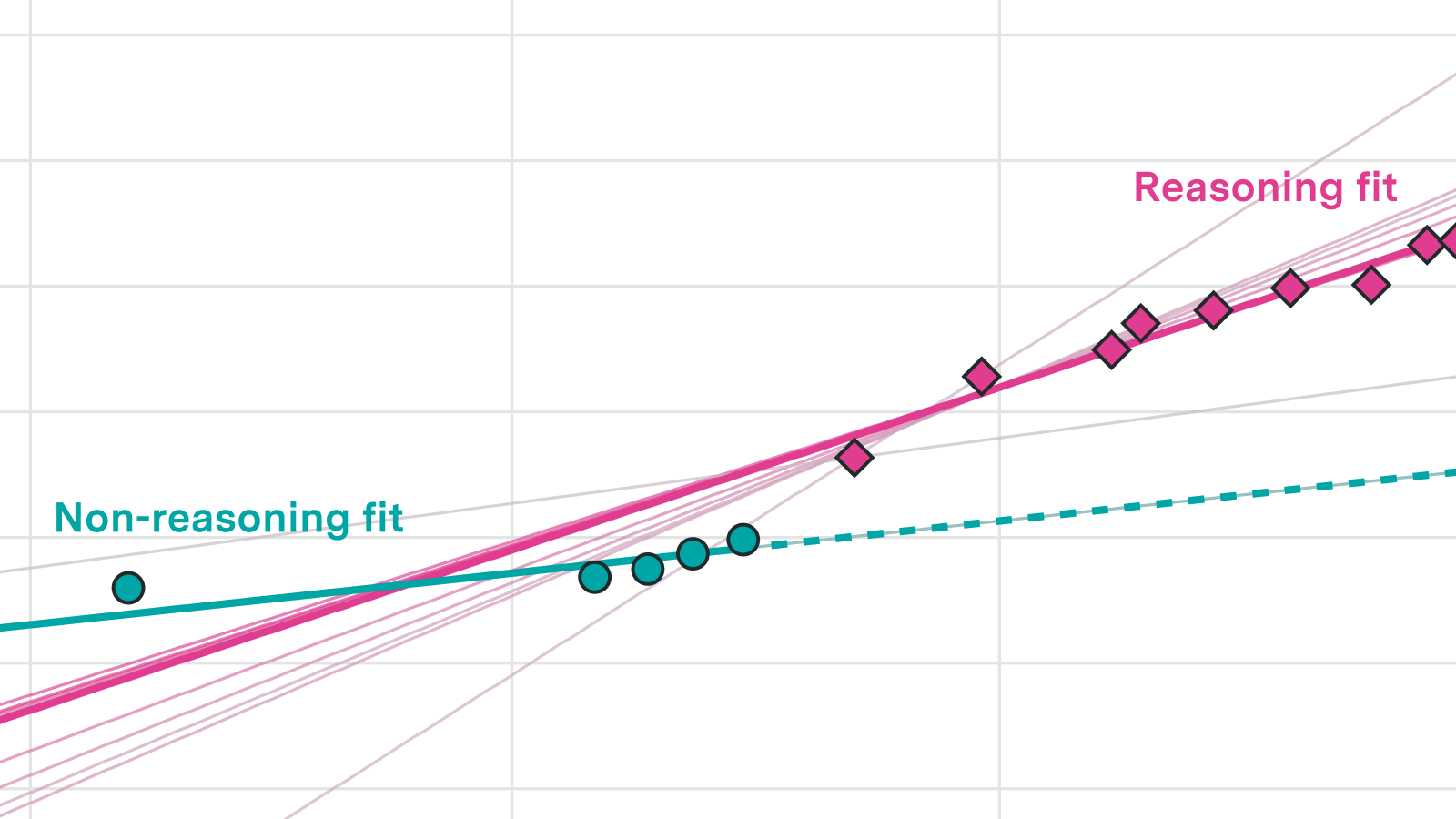
- The mechanism is the training-inference tradeoff: techniques like overtraining on bigger datasets, chain-of-thought, repeated sampling and MCTS playouts let a smaller model match a larger one, trading one kind of compute for the other.
- Cited estimates show the size of the trade varies by technique: repeated sampling with cheap verification spans about 3 orders of magnitude in training and 6 in inference, versus about 1.6 each for MCTS.
- The parity conclusion rests on an assumption: labs must be able to flexibly shift compute between training and inference while holding model performance constant.
- token — The chunk of text a model reads and writes in — roughly three-quarters of a word — and the unit AI usage is billed in.
- inference — Running a trained model to get answers — the phase where AI is actually used, as opposed to trained.
- chain-of-thought — Having a model write out intermediate reasoning steps before its answer, which markedly improves performance on hard problems.
Checking sign-in…
Loading comments…