Cua Open-Sources CUA-S1-FORMS, a Specialist Form-Filling Model
- Source
- Cua
- Date

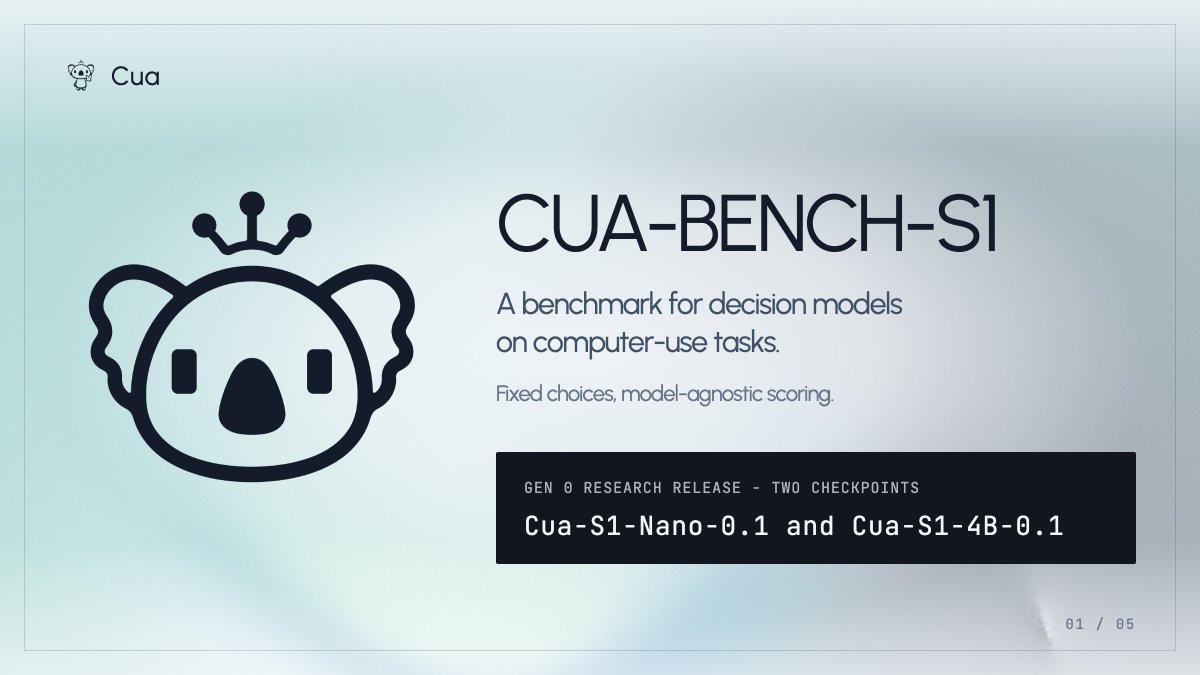
1/ Introducing CUA-S1: a family of System One Models, small, specialized, and built for computer use. Today we're open-sourcing CUA-S1-FORMS, the first in the family: https://t.co/J1frbEbZTQ

2/ A specialist in action. On the left, a small specialist decides how to fill the form in one pass. Cua Driver then carries out the actions in order. On the right, an LLM agent works through the form step by step using Cua Driver.

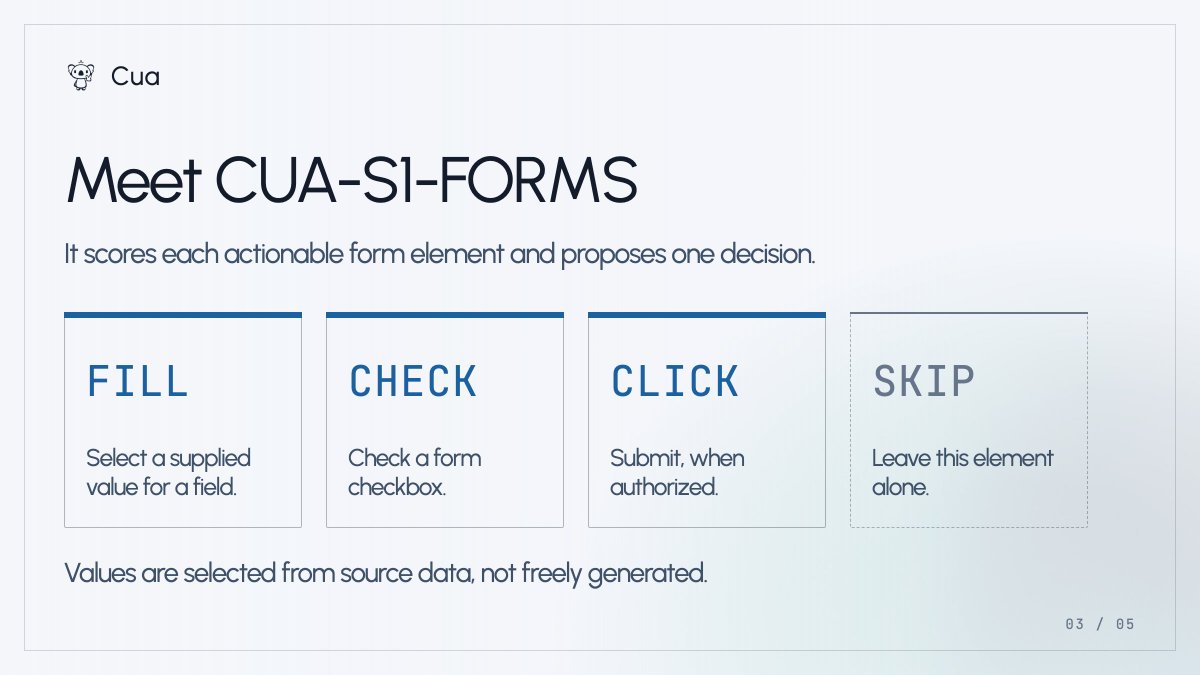
3/ CUA-S1-FORMS selects from known options: FILL, CHECK, CLICK, or SKIP. Field values come from the supplied document. The application validates and orders the plan: fields, checkboxes, then submit when authorized.
4/ Build a specialist for a bounded task. The MIT source includes synthetic-data generation, training, evaluation, and Cua Driver integration. Repo: https://t.co/kmZxjCE30w Model: https://t.co/nmLok1ieGv Dataset: https://t.co/g6MQ28cywv

- CUA-S1-FORMS is a small specialist that plans how to fill a whole form in one pass, choosing FILL, CHECK, CLICK or SKIP, while Cua Driver executes the actions; Cua contrasts it with an working through the form step by step.
- Field values come from a supplied document, and the application, not the model, validates and orders the plan: fields, then checkboxes, then submit only when authorized.
- The MIT-licensed release includes synthetic-data generation, training, and Cua Driver integration code alongside the model and dataset, pitched as a template for building specialists for bounded tasks.
- eval — A repeatable test for AI quality — a set of tasks plus scoring — used the way software teams use test suites, because model output is too variable to judge by eyeballing.
- AI agent — An AI system that doesn't just answer once but works toward a goal in a loop — taking actions, reading the results, and deciding what to do next.
- LLM — A large language model — the neural network behind tools like Claude and ChatGPT, trained on huge amounts of text to predict what comes next.
A reusable open-source recipe for training small task-specific action models for bounded, high-volume computer-use workflows, rather than relying on a general-purpose agent for every repetitive task.

Checking sign-in…
Loading comments…