Agnes 2.5 Pro Beta: big agentic gains, double the tokens
- Source
- x.com
- Publisher
- Artificial Analysis
- Date

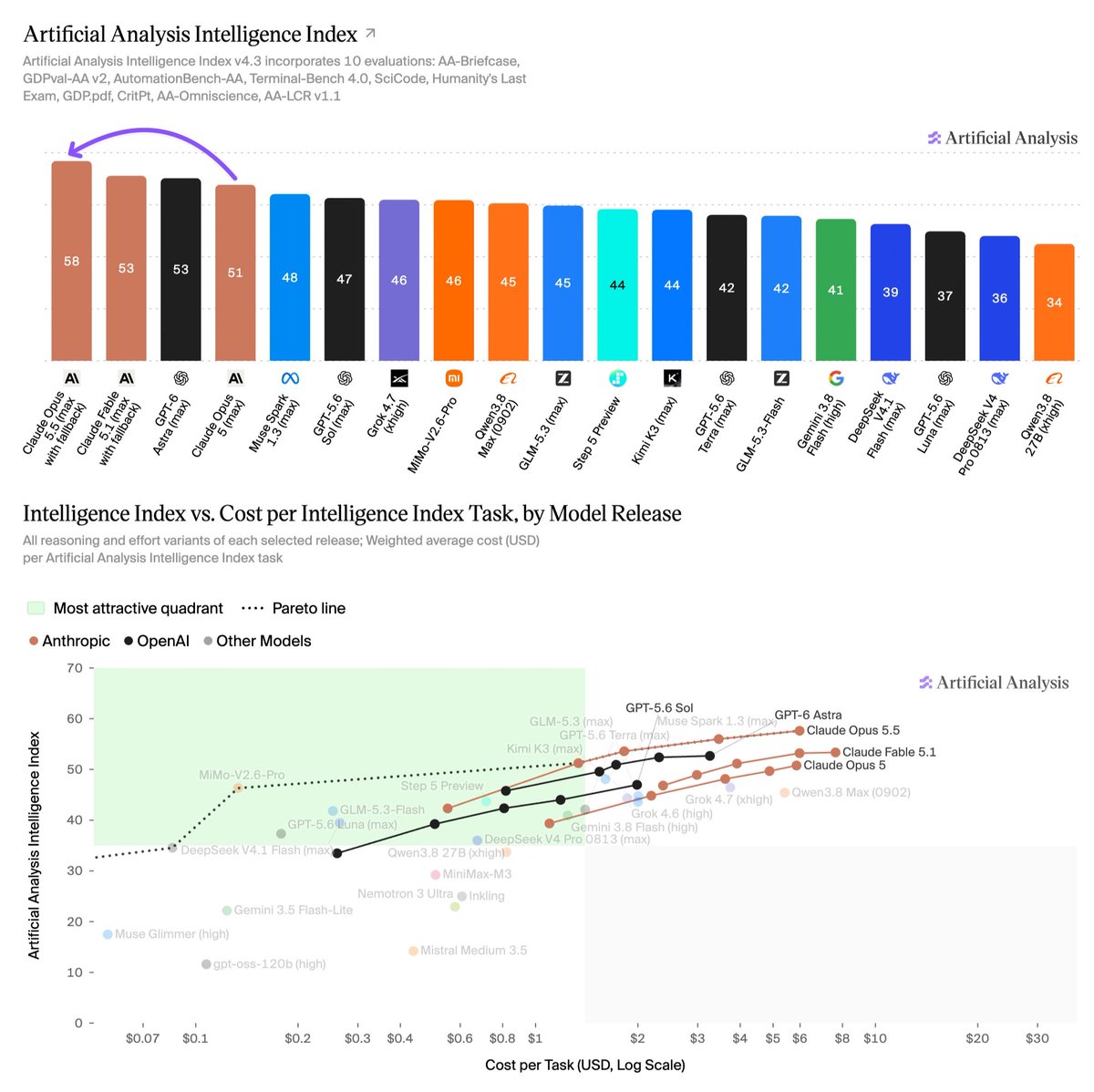
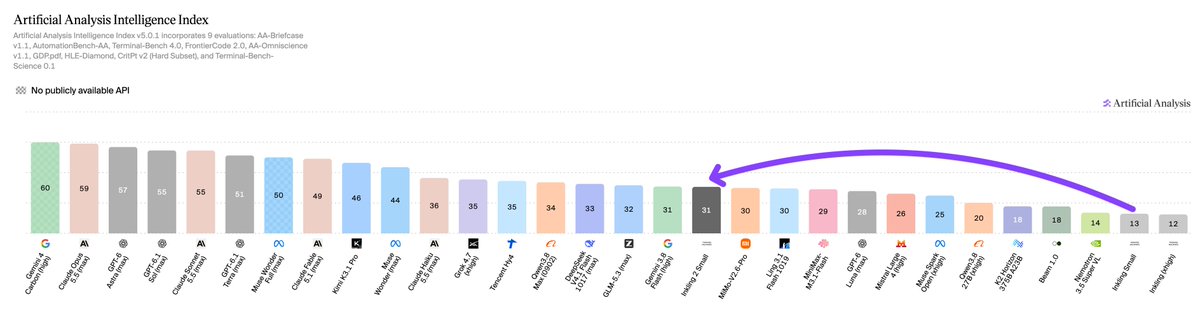
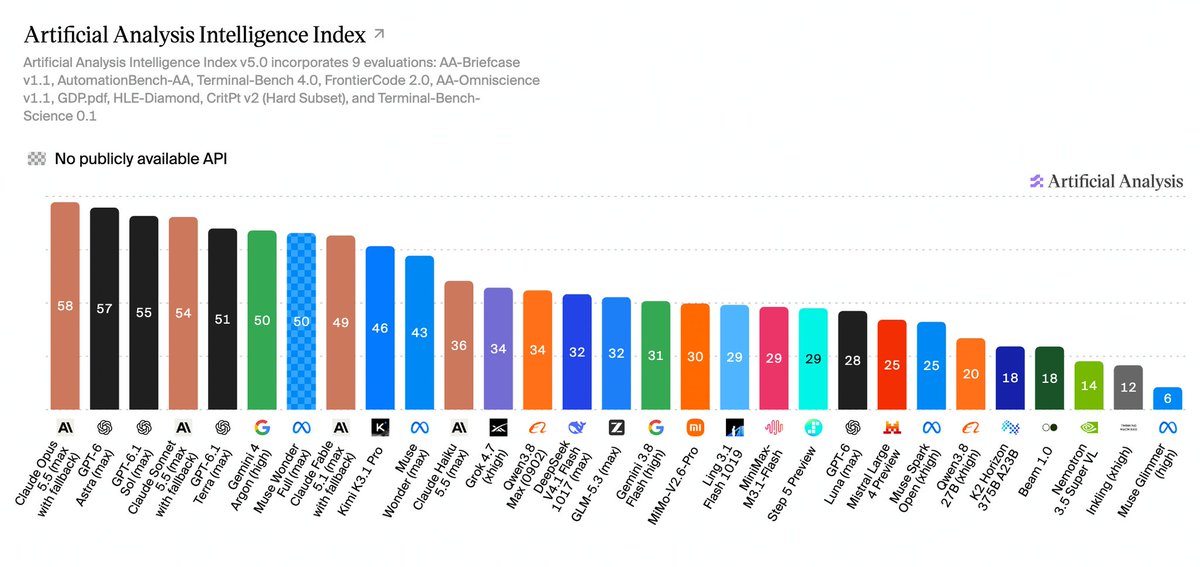
Agnes AI's Agnes 2.5 Pro Beta scores 49 on the Artificial Analysis Intelligence Index, up 9 points from Agnes 2.5 Pro Alpha, driven by large agentic gains but using ~2x the output tokens Agnes AI (@agnesai_sapiens) is a Singapore-based AI lab that trains full-modality foundation models and offers them through a free omni-modal API. At 49 on the Intelligence Index, Agnes 2.5 Pro Beta moves Agnes from mid-pack to the frontier-adjacent tier, just behind Gemini 3.5 Flash (high, 52) and GPT-5.6 Luna (max, 52) and ahead of MiniMax-M3 (45). Key results: ➤ Agnes 2.5 Pro Beta scores 49 on the Artificial Analysis Intelligence Index, a 9-point jump from Agnes 2.5 Pro Alpha (40). This places it just behind Gemini 3.5 Flash (high, 52) and GPT-5.6 Luna (max, 52), and ahead of MiniMax-M3 (45). ➤ Agentic capabilities drive the jump. The Artificial Analysis Agentic Index rises from 25 to 44, just behind Gemini 3.7 Flash (high, 45) and ahead of Gemini 3.5 Flash (high, 40) and MiniMax-M3 (36). τ³-Banking nearly triples from 12% to 36%, and GDPval-AA v2 rises from an Elo of 1171 to 1456 against a human baseline of 1000. ➤ Frontier reasoning evaluations improves more modestly. Humanity's Last…

Context
Agnes 2.5 Pro Beta, from the Singapore lab Agnes AI, gained most of its ground on tasks where a has to carry out work, and it used about twice as many output , the units of text a model generates, to do it. Artificial Analysis, which runs its own evaluations of AI models, scores it 49 on its Intelligence Index, up from 40 for the earlier Agnes 2.5 Pro Alpha. That places it just behind Google's Gemini 3.5 Flash and OpenAI's GPT-5.6 Luna, both at 52, and ahead of MiniMax's MiniMax-M3 at 45.
The evaluator's agentic index, which covers those work-style tasks, rose from 25 to 44. On τ³-Banking the score nearly tripled, from 12% to 36%, and on GDPval-AA v2 the model's Elo rating rose from 1171 to 1456, where a human baseline sits at 1000. Reasoning tests moved less: Humanity's Last Exam went from 34% to 38% and GPQA Diamond from 88% to 91%. The improvement has a running cost. The Beta model used 50,000 output tokens per index task against the Alpha's 24,000, so the same work produces roughly twice as much billable output.
One improvement is not a gain in knowledge. AA-Omniscience is a knowledge test whose score rewards correct answers, penalizes wrong ones and does not penalize declining to answer. Agnes's score rose from -25 to -11 because the Beta model attempted only 45% of questions, against 94% for the Alpha. That cut its rate from 88% to 33%, but its accuracy, the share of all questions answered correctly, halved from 33% to 17%. The model makes fewer false claims mainly by declining to answer more often. All of these figures come from Artificial Analysis's own runs of a beta model.
- Model — A computational system that uses learned patterns to produce an output from information supplied to it.
- Token — A piece of text, such as a word, part of a word or a punctuation mark, that a language model represents as numbers and handles as a unit.
- Hallucination — Generated content that is false or unsupported, even when it sounds plausible.