AI Engineer World's Fair 2026 Recap
- Source
- latent.space
- Author
- Richard MacManus
- Date
Context
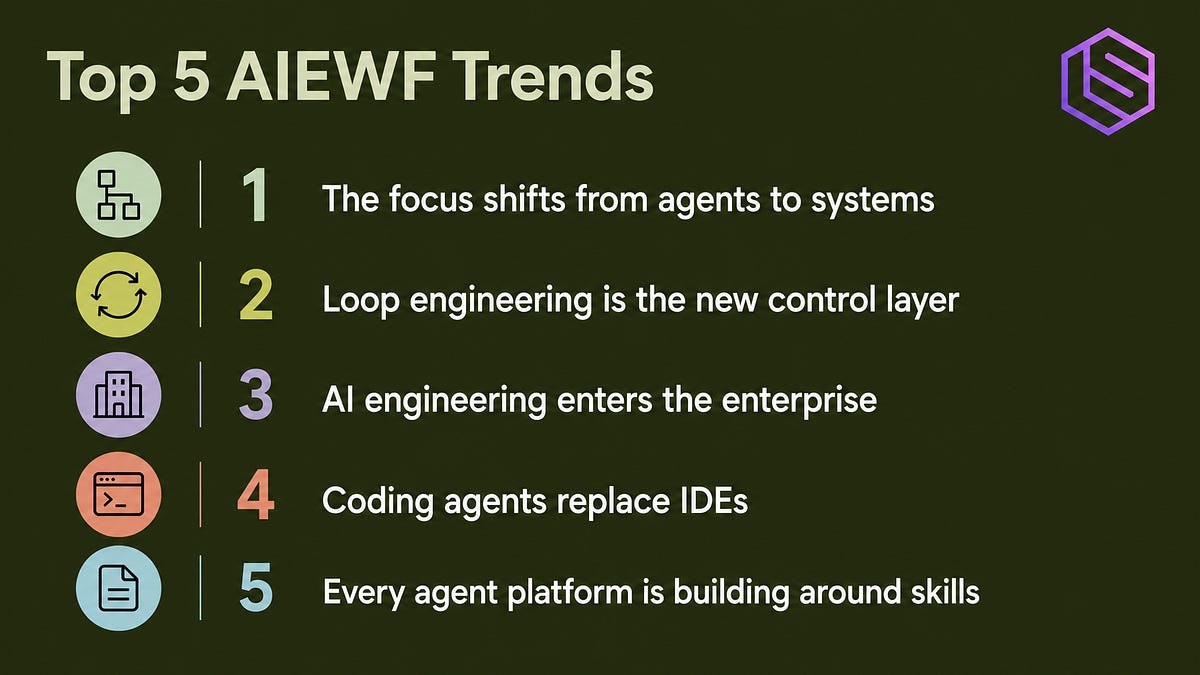
The AI Engineer World's Fair recap describes shifting toward the software that surrounds an agent: how it retains information, receives permission to act and checks its results. In the author's conference account, these concerns increasingly shape the engineering work around autonomous execution.
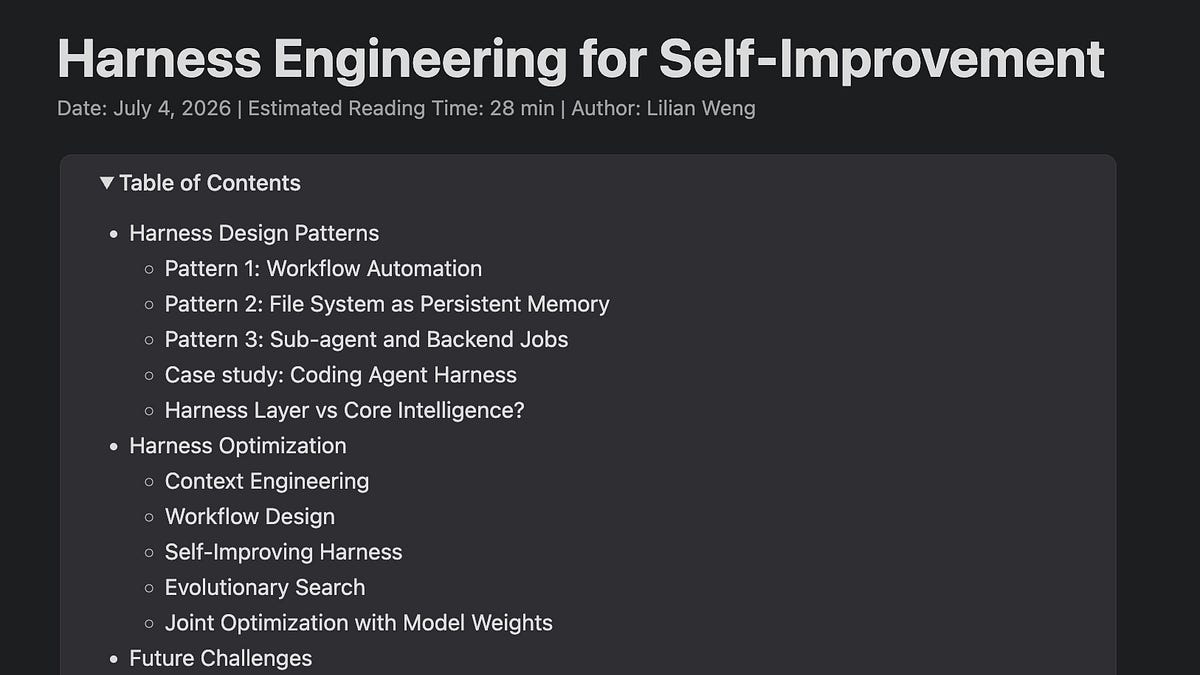
The recap illustrates the change with two essays by AI researcher Lilian Weng. Her 2023 article described agents through planning, memory and ; her 2026 harness essay gives equal weight to the surrounding system that manages workflows, , permissions, evaluation and persistent state. Speakers paired this with an outer loop in which engineers set direction and review agents' work. That gives teams specific parts of the system to evaluate and monitor.
- Inner loop versus outer loop is now the working vocabulary: agents run execution in the inner loop while humans set direction, evals, and feedback in the outer one. OpenClaw's Peter Steinberger and Addy Osmani both describe their job that way.
- Dex Horthy's objection to loop hype is precise: Kubernetes is built on control loops too, but those loops are deterministic. An LLM loop has no such guarantee, so the discipline has to come from the structure around it.
- Compare Lilian Weng's 2023 anatomy of an agent (planning, memory, tool use) with her 2026 essay. The unit of engineering moved from the agent's insides to the workflows, context, permissions, evaluation, and persistent state around it.
- Anthropic's Thariq Shihipar described models as grown rather than designed, with a capability overhead where the model gets smarter in spiky, unpredictable places. That unpredictability is the argument for building monitoring into agent systems.
- Cursor's test for a successful enterprise engagement is blunt: the customer does not switch the agents off after the consultants leave. Adoption is still concentrated among early adopters, so finding internal champions is the real bottleneck.
- attention — The mechanism that lets a model weigh which earlier words matter for the word it's currently processing — the core operation of a transformer.
- tool use — A model's ability to call external functions — run code, search the web, edit files — instead of only generating text.
- agent harness — The scaffolding around a model that turns it into a working agent — the loop, the tools it can call, and the rules for when to stop.
- context window — The maximum amount of text a model can consider at once — its working memory for the current conversation or task.
“agents can run much more of the inner execution loop, but that outer loop is still engineering.”
Addy Osmani

Checking sign-in…
Loading comments…