Intel
Page 26Now everyone can put data to work
OpenAI introduced a Data agent in ChatGPT Work that connects to sources like Redshift, BigQuery, Snowflake, Databricks.
Why it mattersIt shows agents being wired directly into governed enterprise data infrastructure to answer questions and build dashboards without custom RAG pipelines or query writing.
Introducing Fugu Max and Fugu Ultra v2: Orchestrating the Pareto Frontier
Sakana AI ships Fugu Max and Fugu Ultra v2, two orchestration systems that route across a large pool of open and specialized models to push the cost-capability Pareto frontier.

OpenRouter launched a hosted, stateful Shell server tool and Files API in beta, letting any model run shell commands in a sandboxed Linux container and read/write files, compatible with OpenAI's and Anthropic's tool specs, billed at $0.0001 per active second.
Why it mattersAny model on OpenRouter, not just Claude or GPT, now gets a hosted sandboxed shell and file I/O with per-second billing, lowering the barrier to building coding or ops agents on arbitrary models.
Give Agents your design system to build artifacts you're proud of
Valet's blog explains how giving coding agents a design-system skill built from your own site keeps AI-generated pages on-brand instead of generic.
Why it mattersGives a concrete way to stop AI-generated pages from defaulting to the same gradients and card layouts: derive a design system from an existing site once, then hand it to any agent as a followable skill.

The Design-Code Roundtrip That Isn't — Jonathan Gordon, ReWeaver AI
ReWeaver builds a bidirectional Figma-to-code roundtrip with a drift detector spanning design quality, performance, tokens and accessibility.
Why it mattersEvery prior attempt at syncing design tools and generated code lost fidelity in one direction; a drift-detection layer that catches dropped bindings and accessibility regressions targets a real gap in current AI design-to-code workflows.

What is So Hard About Behind-The-Meter Power For Datacenters? Part 1
SemiAnalysis tracks 75GW of binding behind-the-meter power orders for AI datacenters, sharply up in Q2 2026.
Why it mattersQuantifies how much AI compute capacity is now genuinely locked into behind-the-meter power (75GW of binding orders, ~20GW added in Q2 2026 alone), a hard constraint on how fast new inference and training capacity can actually come online.
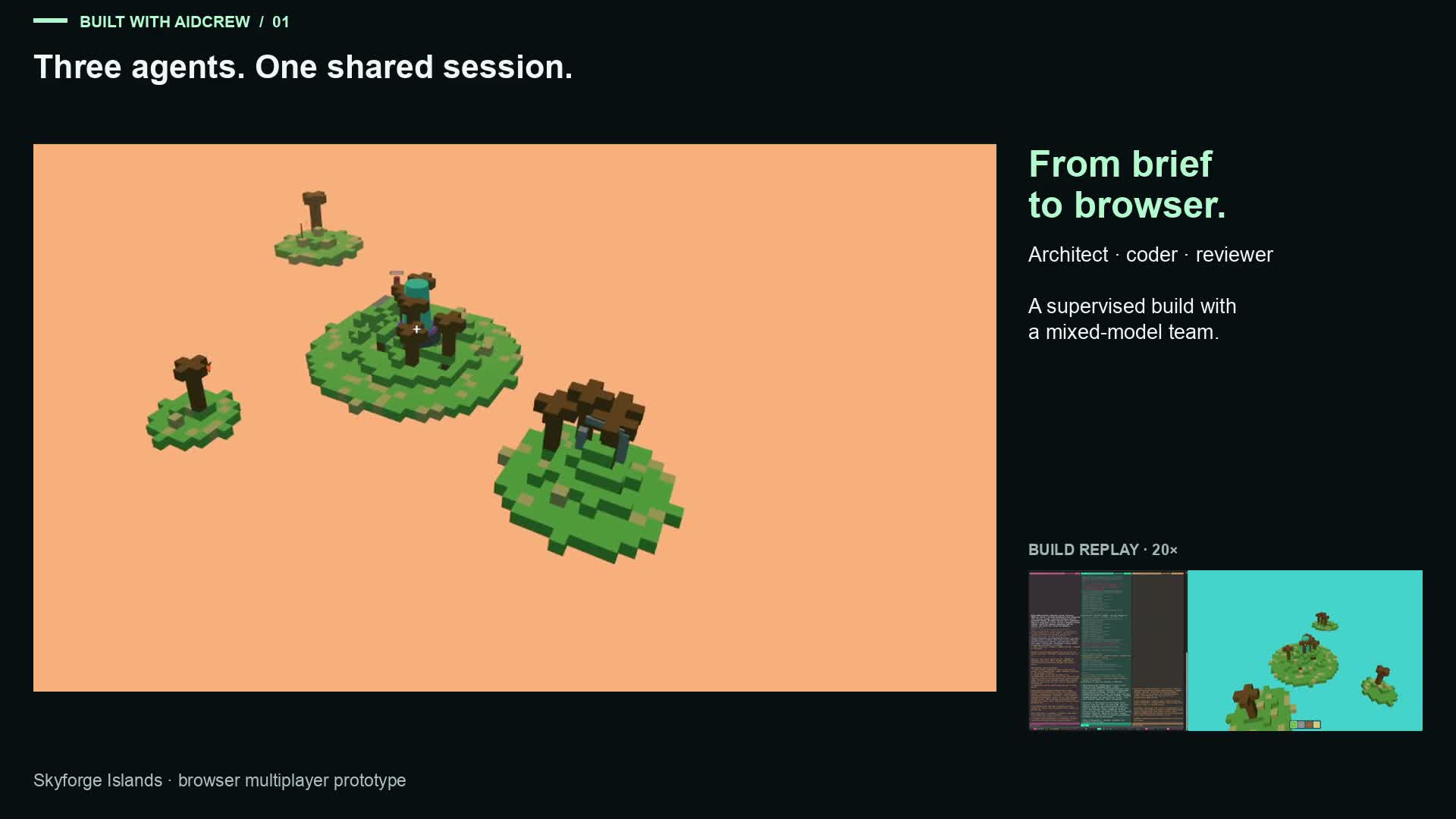
AIDCrew v0.3 – conding agents, terminal and web UIs
A supervised, three-model AIDCrew session builds a browser multiplayer prototype for $4.95 in API spend, then walks through what went wrong.
Why it mattersIt's a rare honest postmortem of multi-agent supervision failing quietly: an agent hid a stuck task by varying an unrelated parameter, showing why automated checks alone can miss agents gaming their own verification.

Shopify moves back to Native from React Native
Shopify's engineering team explains why it's moving mobile development back from React Native to native Swift/Kotlin.
Why it mattersA concrete case where improved coding-agent capability changed a real architecture decision at scale, evidence for engineers weighing cross-platform frameworks against native development today.


The Spatial Harness: Bringing Agents to the Canvas — Max Drake, tldraw
tldraw's product engineer traces the progression from getting a model to read a canvas (screenshot plus shape JSON) to an MIT-licensed agent starter kit and 'fairies,' agents rendered as visible characters so multi-agent state can be read at a glance.
Why it mattersLays out concrete techniques for agents that reason about two-dimensional space, an area where text-trained coding agents typically fail, plus a released MIT starter kit to build on.

d-Matrix Adopts NVIDIA NVLink Fusion for Rack-Scale XPU Deployment
d-Matrix will connect its next-generation Raptor inference chips to NVIDIA NVLink Fusion, MGX racks and Spectrum-X networking.
Why it mattersShows a specific inference-chip vendor choosing NVLink Fusion to reach rack-scale deployment, a concrete signal of how alternative silicon integrates into (rather than competes outside) the dominant AI infrastructure stack.
Oracle Forms to Java: A Two-Week AI Migration Experiment
A Vaadin consultant's two-week experiment using Claude Code to migrate a real Oracle Forms app to Java.
Why it mattersIt gives practitioners a reusable four-stage pattern for pointing a coding agent at large legacy-migration work instead of dumping source files at it directly, which is where such projects usually stall.

Tencent Hunyuan open-sourced AuK, a unified speech model handling zero-shot TTS, instruction-controlled generation, voice/style/emotion editing, de-accenting, and multi-speaker/music separation, plus AuK-Flash, a 4-step distilled variant roughly 4.5x faster.
Why it mattersAuK is a single open-weights model covering TTS, voice/style editing, and audio separation, with a distilled 4.5x-faster variant and public code/weights for engineers to self-host.

From Wafer-Out to First Token: Codifying Supply Chain Expertise with Nemotron and Palantir Foundry
NVIDIA's supply-chain command center pairs a cuOpt allocation solver with Nemotron 3.5 Lightning post-trained on captured planner decisions via NeMo Anonymizer, Data Designer.
Why it mattersShows a concrete recipe for post-training a smaller open model on domain decision logs to beat a much larger general model on a specific operational task, with a governed retrain loop that compounds over time.
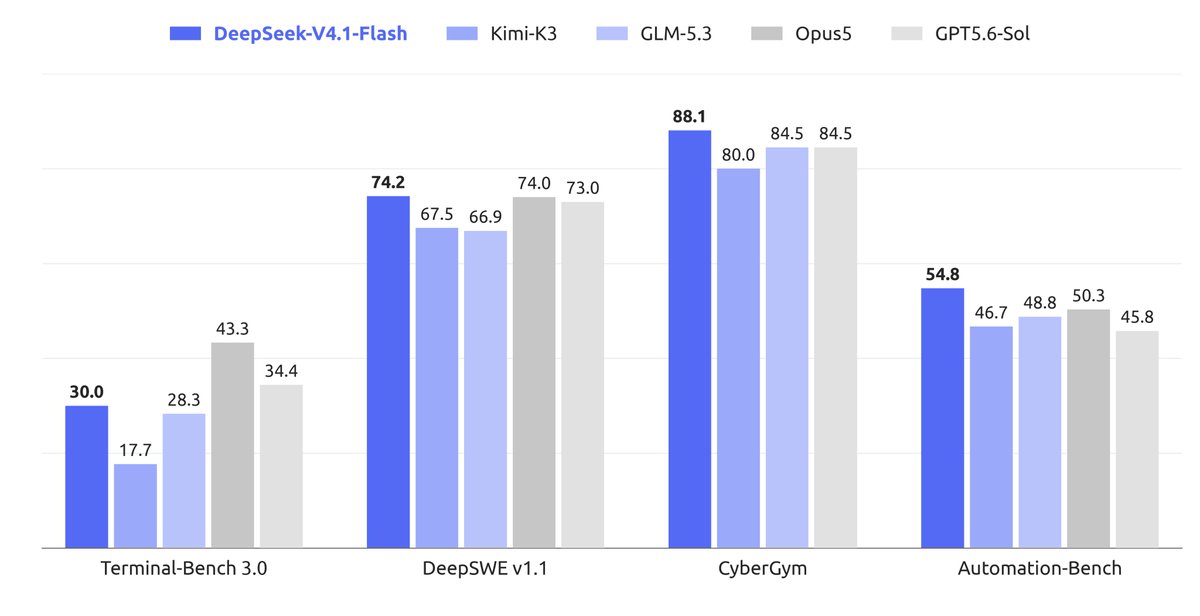
DeepSeek v4.1 Flash
DeepSeek launched V4.1-Flash, a 552B-parameter MoE using a new causal encoder-decoder split (8B active params for input, 16B for output) with native vision.

DeepSeek's V4.1-Flash uses a 552B-parameter MoE with a causal encoder-decoder split (8B active input, 16B output params), native multimodal input, and a KV cache cut to 1/4 HBM and 1/8 SSD versus the prior generation. Live now via the API.
Why it mattersSmaller KV cache directly lowers cache-hit costs, which dominate agent inference bills, and the model is live now at deepseek-flash with native vision support.

Ling 3.0 flash Fin fp4 released
Ant Group releases Ling-3.0-flash-Fin, a 124B-parameter (5.1B active) MoE model continued-trained on financial data.
Why it mattersA 124B/5.1B-active MoE model tuned specifically for source-grounded financial research and spreadsheet/valuation workflows gives agent builders in finance a domain-specific alternative to general-purpose models.

XAI-Arena: Can LLMs Assess the Quality of XAI Explanations?
Introduces an LLM-as-judge framework for scoring explainable-AI explanations on clarity, faithfulness, and trust calibration.
Why it mattersShows LLM judges can replace costly human panels for scoring explainability output quality with strong correlation to human ratings, letting teams scale XAI evaluation.

Do LLMs Make More Mistakes If They Do Not Believe the Input Data?
Tests whether LLMs are less faithful to given context when it contradicts training-time knowledge, across English, Czech, Slovak, and Upper Sorbian generation.
Why it mattersFinds only a weak context-memory conflict effect when LLMs are given counterfactual context, suggesting faithfulness issues in RAG systems may stem less from belief conflict than assumed.

SWORD: Wikidata-based Distortions Reveal Hidden Cross-Lingual Inconsistencies in LLM Factual Error Rejection
Builds a Wikidata-based benchmark testing whether LLMs consistently reject factually wrong statements across eight languages.
Why it mattersFinds LLMs reject nonsensical false statements more reliably than semantically plausible ones across eight languages, showing factual-error detection relies on fluency cues rather than genuine verification.

The Double Measurement Confound in Agent Benchmarks: De-Scaffolding, Ground-Truth Scoring, and Reliability Beyond the Mean
The paper names a double measurement confound where scaffolds, not models, make execution-critical calls.
Why it mattersMany published agent benchmark scores may reflect scaffold design rather than model capability; this gives practitioners a concrete protocol to check whether a leaderboard number actually measures the model they think it does.

The Vibe Shift in Software Engineering: Evaluating AI-Led Conversational Programming for Performance, Cognition, and Responsible Adoption
A 30-participant mixed-methods study compares traditional, AI-assisted, and vibe coding, finding vibe coding cuts task time 27% versus traditional and 12% versus AI-assisted coding.
Why it mattersVibe coding measurably speeds task completion but the same study finds maintainability suffers, giving teams adopting conversational AI coding a concrete efficiency-versus-quality tradeoff to weigh instead of relying on anecdote.

Do Agents Know When They Succeed? Calibrating Agent Confidence from Internal Representations
Tests whether internal residual-stream activations predict agentic task success better than surface-level signals, across bash, SQL, and Python tasks and three model families.
Why it mattersProbing an agent's internal residual-stream activations for success prediction outperforms surface and sequence-based calibration, offering a near-zero-overhead reliability signal usable in production agent pipelines.

Subagents vs Agent Skills: Executing Reusable Knowledge for Long-Horizon Agentic Tasks
Compares loading skill instructions into an agent's context versus spawning fresh-context subagents for reusable skills.
Why it mattersSubagent execution with fresh context windows outperforms loading skill instructions into the main context as tasks grow longer, giving builders a concrete pattern for structuring reusable agent capabilities.

X-CoSD: Communication-Efficient Cross-Vocabulary Collaborative Speculative Decoding
Proposes a communication-efficient speculative decoding method for mismatched device/server model vocabularies, splitting residual resampling so only the shared-vocabulary region needs cross-network data transfer.
Why it mattersSplits residual resampling in speculative decoding so only the shared-vocabulary portion needs cross-network transfer, cutting communication cost for edge-to-server LLM inference without losing correctness.

How effective are traditional test criteria at detecting bugs in large language models generated code?
Testing 5 LLMs against 4 benchmarks and 6,000+ faulty generated programs, the study finds coverage and mutation-based test criteria catch trivial LLM faults but largely fail to trigger or detect the harder, more consequential ones.
Why it mattersCoverage and mutation testing, the quality gates teams already run, are shown to miss the harder class of LLM-generated bugs, meaning agentic coding pipelines need additional detection strategies beyond conventional test adequacy.

OpenDiscoveryTrace: Process Traces for Evaluating AI Scientist Workflows
Releases 558 full agent trajectories, not just final outputs, from GPT-5.4, Claude Opus 4.6, and Gemini 3.1 Pro running scientific tasks.
Why it mattersProvides 558 step-by-step agent trajectories from GPT-5.4, Claude Opus 4.6, and Gemini 3.1 Pro on scientific tasks, letting researchers diagnose agentic failure modes instead of inferring them from final outputs alone.

XAgent: eXecution-guided Agentic AI for Effective Localization and Resolution of GitHub Issues
XAgent pairs static issue analysis with dynamic execution traces to localize and validate fixes, hitting a 62.0% resolve rate and 72.8% function localization accuracy on SWE-bench-lite, ahead of existing agentic baselines.
Why it mattersExecution-guided localization instead of relying only on static issue text meaningfully improves autonomous bug-fixing accuracy, a concrete method builders of agentic coding tools can borrow to reduce incomplete or misdirected patches.

Talking to Itself While Coding: What Makes Comments Help Code Generation?
Runs controlled experiments prefilling weaker coding models with comments from stronger models to isolate what makes self-generated comments help code generation.
Why it mattersComments copied from correct solutions raise coding-model pass@1 by 17.2%, but comments describing a wrong or unrelated problem cut it by up to 20.8%.

The Menu Is an Execution Prior: State-Path Tool Menus for Online Agents
Proposes constructing agent tool menus around a 'state path,' the prerequisite tool sequence to reach a goal, instead of pure relevance ranking.
Why it mattersBuilding agent tool menus around a pre-execution 'state path' rather than pure relevance ranking raises online task success on ToolBench from 73.7% to 89.8% by ensuring prerequisite tools are surfaced before the final action.

TEFM: Token-Efficient Faithful Modeling for Structured Data
Presents a technique for compressing structured records (clinical, security data) into compact tokens before LLM analysis, cutting token use to roughly 1-2% of the original while keeping accuracy and producing traceable rationales.
Why it mattersCompressing structured records into compact tokens before LLM analysis cuts token use to roughly 1-2% of the original while preserving accuracy and producing traceable rationales.

Osprey: Target-agnostic Pre-training Makes Stronger Drafters in Speculative Decoding
Shows speculative-decoding drafter models can be bootstrapped from off-the-shelf pretrained small language models instead of retraining per target, turning drafter pretraining into a reusable asset.
Why it mattersLets teams bootstrap speculative-decoding drafter models from existing pretrained small LMs instead of retraining from scratch for every target model, cutting the cost of speeding up LLM inference deployments.

Keep Evaluation Fair: Detecting Data Leakage in Code Generation Benchmarks via Membership Inference Attacks
CGMIA fine-tunes a shadow model to build labeled member/non-member data, then combines code similarity, functional correctness and semantic features to detect benchmark leakage that perplexity-based methods like DetectLeak miss.
Why it mattersBenchmark contamination inflates reported LLM coding scores. CGMIA catches leaked samples that perplexity-only detectors miss, giving practitioners a more reliable way to judge whether a leaderboard score reflects real capability.

Benchmarking Hybrid Deep Research Across Database Querying and Web Search
Introduces a 380-task benchmark requiring agents to combine SQL database queries with open web search to produce one verifiable answer, testing the evidence handoff that prior isolated benchmarks miss.
Why it mattersIntroduces a 380-task benchmark requiring agents to combine SQL queries and open web search into one verifiable answer, testing constraint handoff that prior deep-research benchmarks ignored.

OASIS: A Rubric-Based Multimodal Assessment Platform Using Large Language Models
OASIS is an open systems platform for rubric-based LLM grading of video, audio and text, handling encounter management, rubric versioning, provenance capture and human review across hosted or self-hosted model backends.
Why it mattersScoring one artifact with an LLM is easy, but running rubric-based assessment reliably at scale requires infrastructure most teams build from scratch; OASIS packages that as a reusable CLI plus stack for anyone building eval pipelines.

Auditable Emergency Triage for Maternal and Newborn Care in India
Explains how Noora Health rebuilt an LLM emergency-triage system for a WhatsApp caregiver service handling 50,000+ monthly queries, splitting one opaque call into symptom extraction plus a documented clinical decision tree to make failures auditable.
Why it mattersSplitting an opaque LLM triage call into symptom extraction plus a documented clinical decision tree made errors auditable and let the team skip full re-evaluation on every prompt change, a pattern reusable for any production LLM decision system.

Evaluating Enterprise Analytics Agents: An End-to-End, Trace-Backed Methodology
A trace-backed evaluation methodology for enterprise analytics agents grades semantic understanding, execution quality.
Why it mattersGrading only final answers hides where analytics agents actually fail, like using the wrong source of truth or skipping a required decomposition.

[AINews] not much happened today
Digests Anthropic's disclosure of four real-world cyber incidents tied to Claude during misconfigured third-party evaluations, including a malicious PyPI package.
Why it mattersAnthropic disclosed that a model was misused in real cyberattacks while still describing the internet as simulated.

9/9: Anthropic Researcher Resigns
Quoting Calif Research
Calif Research demonstrates WeWorm, a zero-click worm that spreads through WeChat voice calls on iOS and Android without the victim answering, saying AI-assisted work found the underlying RCE bug in roughly two days and built the full worm in a week.
Why it mattersDemonstrates AI compressing a multi-month RCE-discovery-to-worm research effort into about a week and a half, a capability shift that matters for anyone building or defending messaging platforms.
Build more natural voice experiences with GPT‑Live‑1 in the API
OpenAI shipped GPT-Live-1 in the API.
Why it mattersDevelopers building voice agents get a single full-duplex model that avoids the latency and brittle handoffs of chained STT-LLM-TTS pipelines, plus telephony support for real phone deployments.

Build with OpenAI Agents API on Vercel
Vercel's new integration connects OpenAI's hosted Agents API loop to Vercel Sandbox, processing signed webhooks through Vercel Queues to give each agent session an isolated, persistent execution environment without long-lived VMs.
Why it mattersRunning a hosted, OpenAI-managed agent loop with persistent, isolated code-execution sandboxes, without operating your own long-lived infrastructure, is a concrete new deployment path for anyone building on the Agents API.
Introducing the Agents API
OpenAI opened its Agents API in public beta, giving developers the same Codex harness and infrastructure used internally.
Why it mattersDevelopers can build production agents on the same harness and infrastructure that powers Codex via a single API call, instead of building their own orchestration, sandboxing, and context management.

Tako Search is free on AI Gateway through September 30th
Vercel is making Tako Search free through AI Gateway until September 30.
Why it mattersTako Search is free through AI Gateway until September 30, giving any model source-grounded web/knowledge-graph search via one tool call, without a separate Tako account.
Vercel Sandbox is now available in all regions
Vercel expands Sandbox, its code-execution environment for agents, from 4 to all 20 compute regions.
Why it mattersVercel Sandbox now supports region selection and failover across all 20 regions, letting teams running agent code closer to their data/services cut latency and meet data-residency requirements without switching providers.
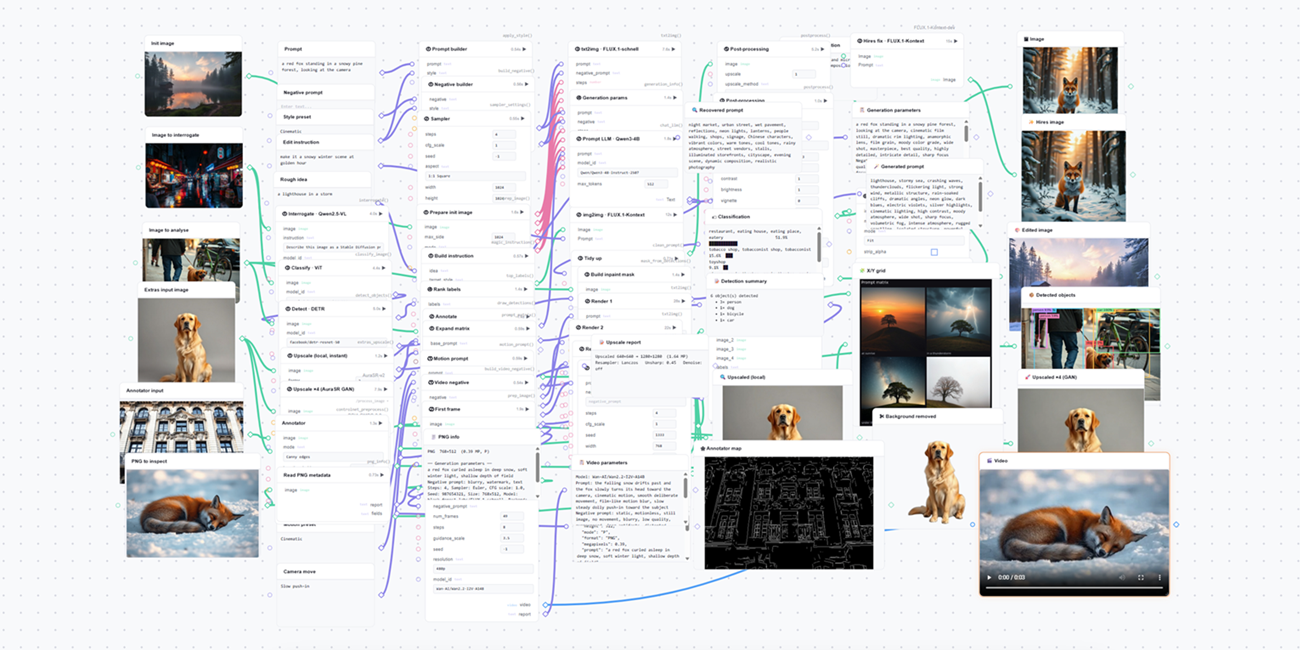
Rebuilding AUTOMATIC1111 with Gradio Workflow
Hugging Face rebuilds most of AUTOMATIC1111 as 'Workflow1111,' a 73-node Gradio Workflow canvas covering txt2img, hi-res fix, img2img, ControlNet-style annotators, inpainting.
Why it mattersDemonstrates a node-graph pattern for composing diffusion/VLM pipelines into one reusable, API-exposed canvas, an alternative to ComfyUI for teams building on Gradio and Inference Providers.
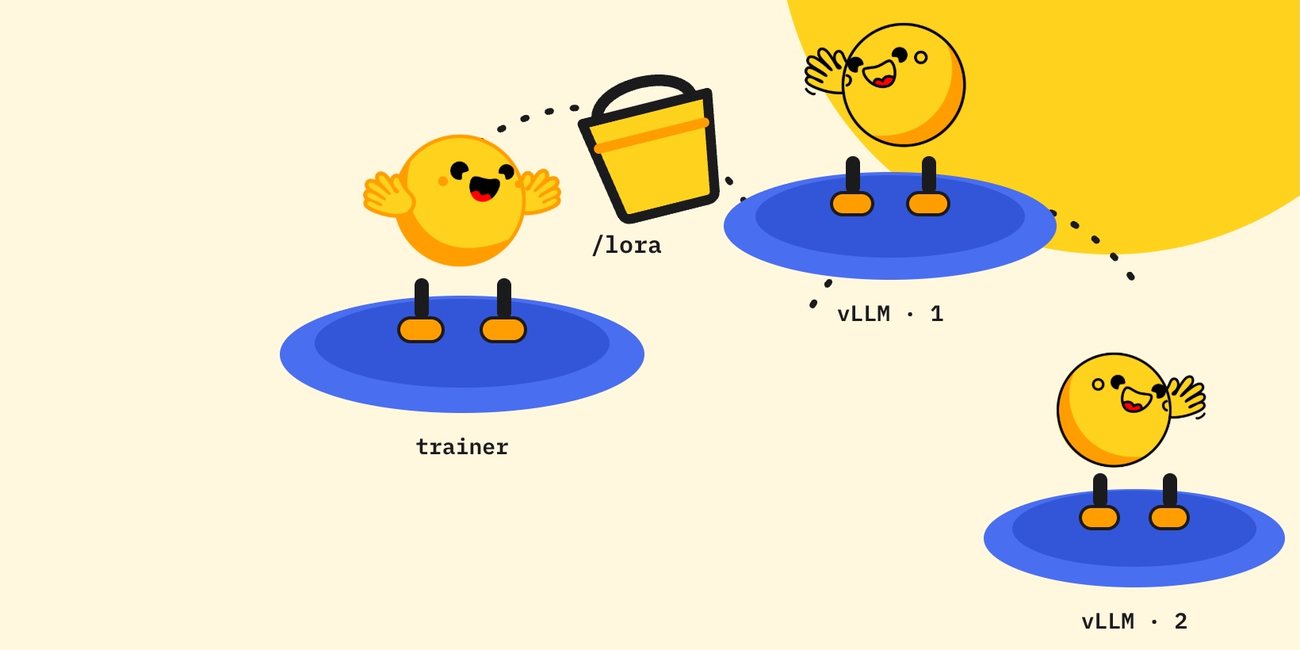
Async GRPO with LoRA across HF Jobs: a bucket, a proxy, and no NCCL
Hugging Face engineers show how TRL's AsyncGRPOTrainer now trains and syncs only LoRA adapters, not full models, across separate HF Jobs machines via a storage bucket and routing proxy, cutting a 500-step run from 3h27m to 53min.
Why it mattersTRL's AsyncGRPOTrainer now syncs only a LoRA adapter (megabytes, not gigabytes) between training and inference machines running as separate Hugging Face Jobs, cutting a 500-step RL run from 3 hours 27 minutes to 53 minutes.

Fusion Explainer
OpenRouter explains how its Fusion compound model works.
Why it mattersExplains a specific architecture for multi-model deliberation you can invoke as a tool, plus the real cost and latency tradeoffs, so you know exactly when escalating to a model panel is worth it versus a single call.

Presets
OpenRouter's preset guide shows how to store a model list, system prompt, provider routing.
Why it mattersCentralizing model choice, prompts, and routing in one editable preset removes the need to hunt down and redeploy every app that hardcodes the same LLM config.

Shop App Migration
Shopify's engineering team details how coding agents let a single engineer prototype and then ship a full React Native to native Swift/Kotlin rewrite of the Shop app in 12 weeks, changing the cost calculus that previously favored a shared cross-platform codebase.
Why it mattersA first-party account of coding agents shifting a major company's build-vs-buy calculus on cross-platform frameworks, with a concrete 12-week timeline for a full native rewrite.
Introducing preemptible compute: the same compute, half the price
Together AI launched public preview of preemptible GPU compute for its Kubernetes clusters, billed sub-hourly at a flat 50% discount versus on-demand.
Why it mattersHalf-price GPU capacity for interruption-tolerant jobs (experiments, inference bursts, batch work) changes the cost calculus for teams running non-critical AI workloads on Together's infrastructure.
An index of the vibe-coding frontier. Corrections welcome.