Intel
Page 75
AI agents don't just reason anymore. They transact. Cloudflare's Monetization Ga
Cloudflare's Monetization Gateway lets content owners, API providers and MCP servers charge agents per request using x402.
Why it mattersAgent-to-service payment is an unsolved piece of agent infrastructure, and a per-request billing path that MCP server operators can adopt is something builders can act on directly.

LLMs answer drug questions from name patterns, not drug knowledge
Researchers replaced parts of drug names with invented strings to test whether Olmo 3 answers from the name's suffix or from drug knowledge.
Why it mattersA fluent answer about a named drug can come from a suffix pattern rather than knowledge of the drug. The nonce-substitution diagnostic gives engineers a way to test this in any medical or high-stakes entity-handling pipeline.

OpenAI has paused part of its frontier reinforcement-learning training, saying capability gains have outpaced its alignment, security and monitoring standards. It expects to act unilaterally ahead of shared industry standards, with near-term launches unaffected and further-out releases pushed back.
Why it mattersOpenAI says it stopped some frontier RL training because capability is outrunning its alignment and monitoring standards. Near-term launches still land; later releases slip, and safety confidence now gates the pace.

Agent loops with external verification took a tokenizer trainer to production
Liquid AI had Claude Opus 4.5 and Codex build a BPE tokenizer trainer.
Why it mattersPassing unit tests on toy data hid every production failure.
As models become more capable, the risks associated with developing and testing
OpenAI paused reinforcement learning training on its latest deployment-bound models for two weeks while it hardened and red-teamed research environments.
Why it mattersA frontier lab halting its largest RL run is a direct signal about near-term model timing and about how cyber capability findings are now gating training.

Open Sourcing Evals For Open Weight Agents
Cline explains how it evaluates open-weight coding agents with Harbor and Terminal Bench, found its requests 20-30% heavier than efficient harnesses.
Why it mattersGives five hill-climbing heuristics and released traces for tuning a coding harness on open-weight models, where token overhead of 20-30% decides whether a cheaper model is actually cheaper.
How Much Memory Does Your Agent Actually Need?
IBM Research scaled its ALTK-Evolve memory system across eight models, from a 30B dense model to frontier systems.
Why it mattersTeams bolting memory onto agents usually assume more retrieved context is strictly better, and this shows accuracy and cost both turn on the dose and the delivery mode.

How AI Coding Agents Can Unlock Materials Simulation with NVIDIA ALCHEMI Toolkit
Benchmarking 45 agent-generated simulation pipelines found that prompt specificity changed code structure and reusability but not physical correctness.
Why it mattersA rare controlled measurement of what extra prompt detail actually buys when a coding agent writes domain-specific code.

Cua Driver's early-preview Computer History keeps an encrypted local record of app, capability and outcome metadata, so a new session or a different compatible agent can reuse a working route. It excludes screenshots, keystrokes, typed text, titles, URLs and paths.
Why it mattersAgents that reset or switch sessions can query an encrypted local record of which apps and capabilities worked, rather than retrying failed routes. It stores only fixed metadata, so it avoids retaining screenshots or typed text.

The Next Medium: Why Real-Time Interactive Video Changes Everything — Ahmed Ahres, Reactor
The case that real-time generative video is a change of medium rather than a speedup, with the consequences that follow.
Why it mattersIf you are building on video models, none of the batch serving playbook carries over to interactive generation.

Infra behind Krea 2: How to train and serve at scale — Gabriel Jorge Menezes, Krea.ai
An infrastructure lead on training at cluster scale.
Why it mattersConcrete metrics and failure modes for anyone operating large training clusters, including how to keep a site up while training holds priority.

We're making Git hosting more reliable, performant, and scalable. This post trac
Cursor traces twenty years of Git hosting design and explains why it operates its own storage layer, Origin, as a database rather than a filesystem.
Why it mattersAnyone running agents against many repositories at once hits the same Git scaling limits, and this documents one team's design and operational reasoning in detail.

Anthropic has opened Claude Cowork to mobile and web across every paid plan, taking the agentic workspace beyond the desktop application.
Why it mattersThe agent workspace is now reachable from a phone and browser, which changes where and when work can be handed to it.

Run Massive-Scale UMAP in Minutes Using Multiple GPUs—Without Losing Accuracy
cuML and cuVS 25.06 distribute UMAP's all-neighbors kNN construction across GPUs by partitioning into balanced clusters, computing local graphs, then merging.
Why it mattersEmbedding-space analysis at hundred-million-vector scale drops from an overnight job to minutes, and the partition-and-merge design keeps embedding quality rather than trading accuracy for throughput.
➤ Leaderboard: ➤ Methodology: ➤ Stirrup, our open-source agent harness: Search A
Artificial Analysis benchmarks 15 search APIs from 7 providers inside a fixed agent harness — same model, same tasks, only the search tool varies.
Why it mattersChoosing a search API for an agent has been guesswork. This holds model and harness fixed so quality, blended cost and added latency are comparable — including how much a weaker provider costs you in extra model tokens.

Benchmark results place two search providers on the cost-quality frontier for agent tasks, with one scoring 73 at 7.5 cents per task but the slowest completion time, and another reaching 75 for 12 percent more.
Why it mattersSearch provider choice moves both agent answer quality and total task cost, and this puts numbers on the tradeoff.
A new index scores seven search API providers on agent task quality, cost and speed, holding model and harness fixed and averaging three benchmarks covering broad research, multi-hop browsing and factual recall.
Why it mattersGives builders a controlled basis for choosing the search tool behind an agent instead of guessing from marketing pages.
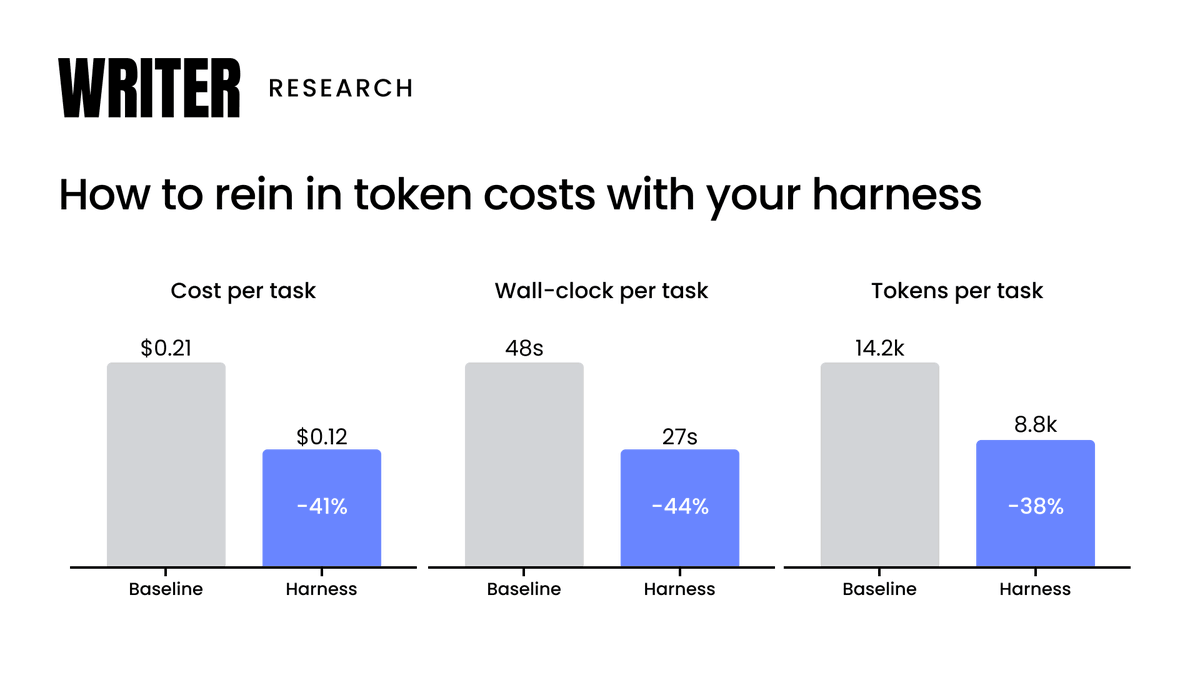
Harness Design Cut Agent Cost 33-61% Across Six Models
Writer benchmarked six models on 22 tasks against a naive harness and a token-efficient one built on cache-stable prompts, incremental compaction, context offload, zero-token waiting and retry limits.
Why it mattersAgent cost is dominated by input tokens, so cache hit rate matters most. Keeping a byte-stable prompt prefix, compacting incrementally and bounding retries cut cost 33-61% across six models in Writer's tests, with quality parity.

Generative Video at the Speed of Light — Keegan McCallum, uRun
Ten dollars now buys about three hours of continuously generated video.
Why it mattersCurrent cost and latency numbers for interactive video generation, plus the serving architecture it demands.
Introducing LangSmith Tuned Evaluators They automatically score agent behavior i
LangSmith adds Tuned Evaluators, small tuned models that score production agent traces automatically, starting with Perceived Error.
Why it mattersOnline evaluation of production agent traces is usually priced out by frontier-model judges, and a tuned small model that claims better accuracy at a fraction of the cost changes that calculus.

Perplexity Computer becomes addressable by email: send, forward or cc a thread and the request runs as a standard session viewable on web and mobile, carrying the same audit trail as tasks started inside the app. Live for all Computer users.
Why it mattersAny email thread can now trigger an agent run by cc-ing an address, and the resulting session appears in the app with the same audit trail as a task started there, so the delegation stays inspectable.

Full breakdown: Claude-only apps often wait until the host speaks the new revisi
MCP spec 2026-07-28 removes the initialize handshake and session header, making each tool call a self-contained POST any replica can answer.
Why it mattersIf you run an MCP server, protocol sessions and sticky routing are gone: a dropped response is now a full retry, so every write-or-charge tool needs a caller-supplied idempotency key to avoid double execution.

What the stateless protocol revision changes for server authors: tool calls without a handshake, and a timed-out retry counting as a fresh call so one aborted request produces two writes.
Why it mattersIf your server treats a dropped connection as a rollback, ordinary retries can double-write, and this shows the failure with a reproduction.

While my guitar gently speaks — Todd Fisher, Philo Ventures
A JUCE plugin routes a microphone through speech recognition into a local model and answers through guitar strings.
Why it mattersA worked example of putting a local model inside a real-time audio pipeline, including why silence-based segmentation of synthesized speech breaks and what to pair it with.

The Next Game Engine Won't Have a Manual — Arturo Nunez, Nereu
A game engine designed around coding agents.
Why it mattersLevel-of-detail context assembly is a reusable answer to giving an agent a workspace too large to fit in a prompt.

Building an Agentic Video Editor for Mass Consumer — Ekaterina Deyneka, Reelful
An agentic video editor built like an agentic app builder.
Why it mattersThe pattern of encoding taste in skills and adding a render-verification loop transfers well past video.

Training Krea 2: What matters in generative model training — Sangwu Lee, Krea.ai
What actually goes into training an image model.
Why it mattersData curation, not architecture, is where generative model quality gets decided, and this names the filters, dedup passes, and caption failures that shape what the model learns.
$1 million hacker challenge for Vercel Sandbox
A two-week public bounty program pays up to one million dollars for escaping a microVM agent sandbox.
Why it mattersAnyone running untrusted agent code should understand where this isolation model actually breaks, and the findings will be public.
Ben Thompson: Winners & Losers of the AI Era

When a model reads a drug's class from its name—not its knowledge
Researchers separate what a model knows about a drug from what it can infer from the drug's name, then trace the shortcut back into the training corpus.
Why it mattersDrug names encode their class in suffixes like -pril and -olol, so a model can answer correctly from spelling alone. On Olmo 3, most tested drugs showed little genuine drug-specific knowledge behind confident answers.

The model behind Sakana Chat is now available through OpenRouter, bringing Japanese and business-context reasoning with web search and code execution into any workflow already routing through that gateway. Pricing is listed at $0.95 input and $4 output per million tokens.
Why it mattersNamazu is callable through OpenRouter at $0.95 in and $4 out per million tokens, so adding a Japanese-tuned model with web search and code execution to an existing router setup is a config change, not a new integration.

SemiAnalysis flags a 50 percent OpenAI price cut on GPT-5.6 Sol limited to two gateways, and argues the venues were picked because they are the datasources most used to estimate model market share.
Why it mattersThe cut changes routing economics for anyone serving Sol through those gateways, and it is a warning that gateway-derived market-share charts are now a target for pricing decisions.
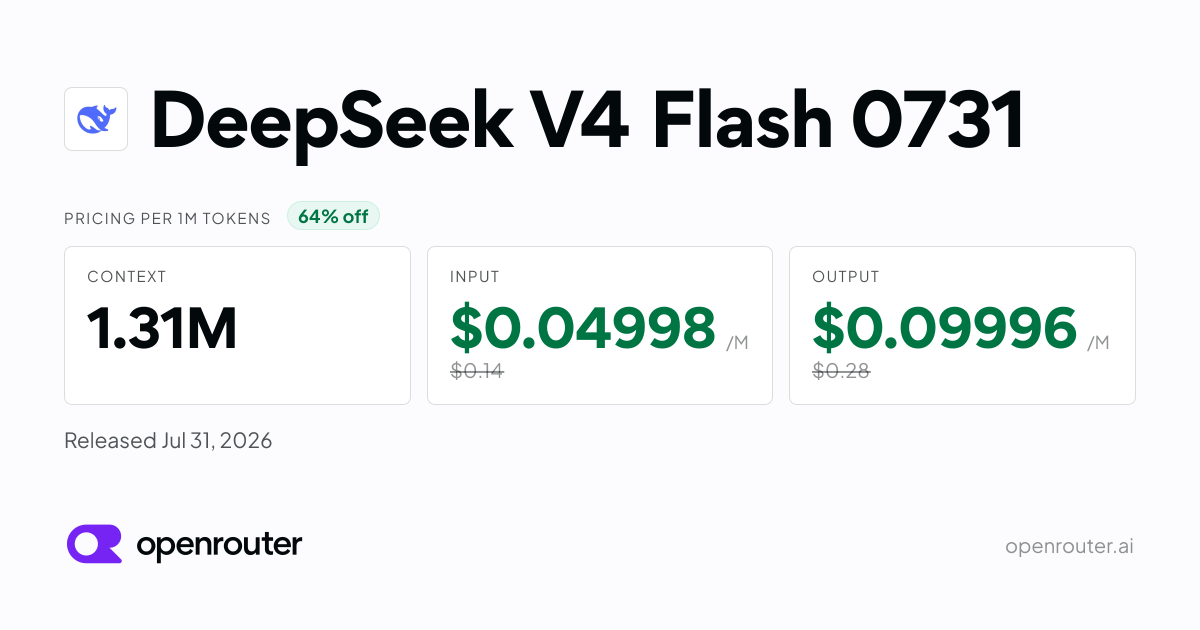
Model pricing is getting more complex over time.
DeepSeek charges different rates by hour of day.
Why it mattersModel pricing is no longer a single number. If batch and eval jobs can be shifted in time, DeepSeek's off-peak windows cut the bill without changing the model.

AgentR A Stateful and Recovery-Aware Software Architecture for LLM-based Auditable Workflows
An architecture for stateful LLM workflows built on durable artifacts, queue-backed workers, explicit state transitions, retry and orphan-job handling.
Why it mattersMost agent applications are still stateless prompt-response wrappers, and this lays out what has to exist for one to survive interruption and stay auditable.

The Quality of Claude AI-authored Python Tests Is Not Weaker Than Human-authored Tests
A controlled study scoring hundreds of Claude-written Python tests against human-written Django and Pandas tests under identical fault-injection and design rubrics, reporting non-inferiority for recent models.
Why it mattersTest quality is the usual objection to letting an agent write tests, and this puts a measured, individually-scored answer against two mature human corpora.

HxAgent: Iterative Agent Planning for End-to-End Web Application Testing
An iterative LLM planning agent for web testing that re-reads page state after every action and draws on both recent actions and past correct and incorrect sequences, reported ahead of WALT on three benchmarks.
Why it mattersThe proactive re-assessment loop and the split between short-term and long-term memory are directly transferable to anyone building a browser-driving agent.

The Unwritten Benchmark: A New Challenge for Multimodal Machine Learning in Abstract Perceptual Reasoning
A benchmark asking models to infer written words from pen-scratch audio and hand-movement video with no visible ink, where humans clear 80 percent accuracy and leading multimodal models stay under 10.
Why it mattersIt marks a class of inference from dynamic multimodal evidence where current frontier models fail almost completely, which is useful when scoping what a multimodal agent can be trusted to do.

Evaluating Agentic Code Repair Capabilities in Distributed Systems
A code-repair benchmark of 60 real distributed-system bugs that runs each case with and without bounded debugging context, isolating how much logs, traces and runtime state change agent success.
Why it mattersCoding agents cluster in the high 70s on single-process SWE-bench, and this shows what happens when root causes span processes and what feeding in logs and traces is worth.

The Recall Trap: A Recall-Maximizing Retriever Configuration Reduces Issue Resolution in Fixed-Budget Code Context
A controlled study on SWE-bench Verified showing that the higher-recall retriever setting lowers single-shot issue resolution under a fixed context budget.
Why it mattersRetrieval for code agents is routinely tuned against recall@k, and this is direct evidence that optimizing that metric can cost you resolved issues when the context window is fixed.

Kozuchi Agent: A Language-Agnostic Open-Weight Agent for Software Repair
An open-weight software repair agent with explicit phases, persistent state and deterministic tools that resolves 374 of 500 SWE-bench Verified instances on the official evaluator using a locally hosted 27B model.
Why it mattersIt is evidence that a locally hosted open-weight model plus disciplined agent scaffolding reaches frontier-adjacent repair rates, which changes the build-versus-buy calculation for teams that cannot send code to a hosted API.

Anthropic reports Claude Code CLI now uses half the CPU at p99 after moving Bun's garbage collection off a fixed timer to run only when the process is idle.
Why it mattersAnyone running Claude Code in CI or on constrained machines gets the win by updating, and the timer-versus-idle GC diagnosis generalizes to other Bun-hosted agent runtimes.

8/17: Nvidia + OpenAI + SB Energy = PORTS-Pike
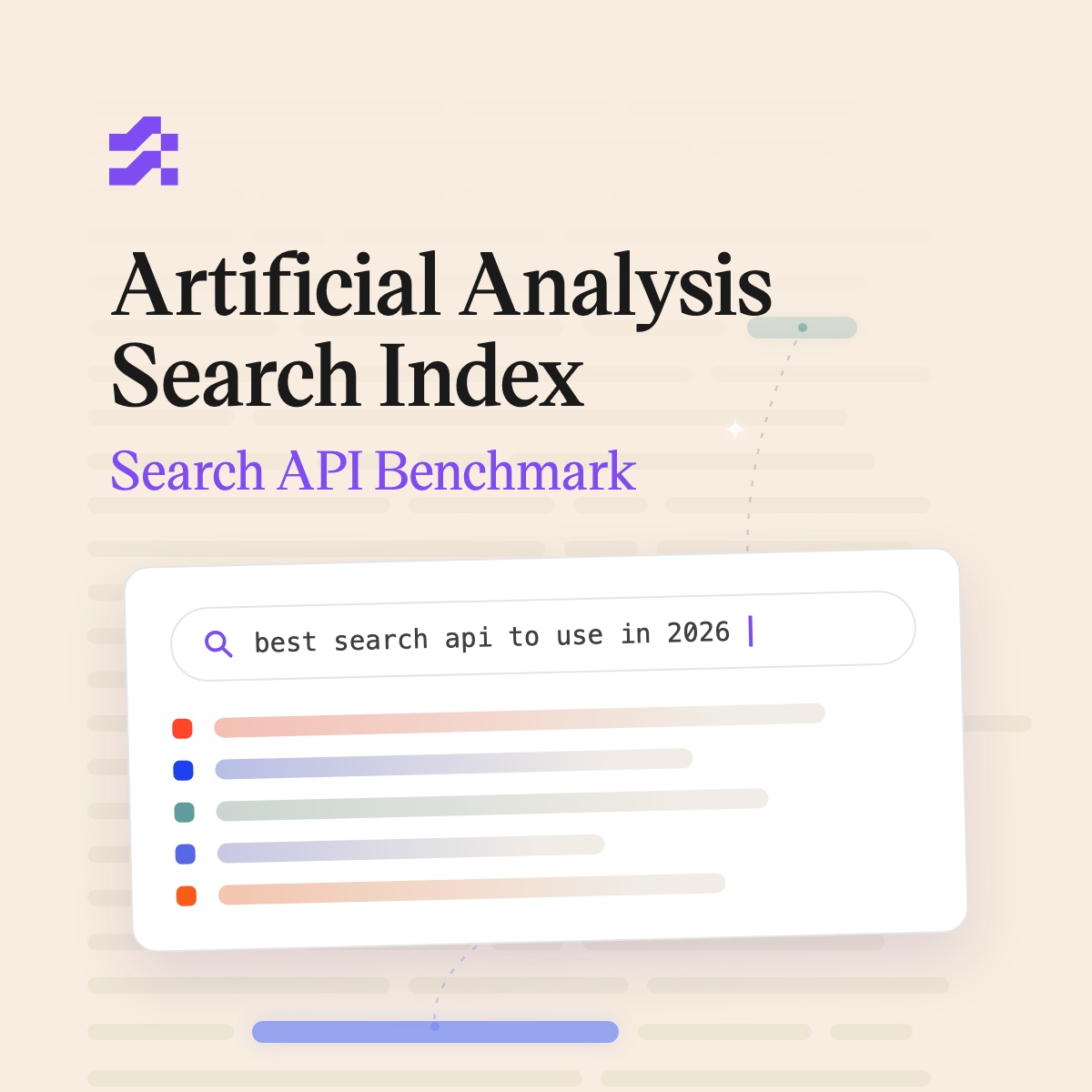
Search Api
Artificial Analysis launches the Search Index comparing search API providers inside the Stirrup harness with GPT-5.6 Luna, scored on DeepSearchQA, BrowseComp and AA-Omniscience against a no-search baseline.
Why it mattersHolding the agent and model constant, it measures how much each search API lifts answer quality, cost and speed, helping you pick a search provider for research agents.

GLM 5.3 now available on AI Gateway
GLM 5.3 lands on Vercel's AI Gateway with better multi-step agent and software engineering results than GLM 5.2 at fewer output tokens, a 1M token context window, 128K max output.
Why it mattersA new open-weights-class model reachable through an existing gateway, with published effort levels and a documented path into Claude Code, Codex and other agents, is directly actionable.
Cline is now available in the AI SDK harness layer
Vercel adds an official Cline adapter to the AI SDK harness layer, built with the Cline team.
Why it mattersSwapping coding-agent runtimes behind one interface is the point of the harness layer, and each added adapter widens what a team can switch to without rewriting application code.

Why Ai Agents Need A Cloud Browser
The browser, not the model, is usually where agent automation breaks.
Why it mattersNames the specific points where an agent's browser layer outgrows a laptop Chrome, and what changes at the CDP boundary when it moves — the reasoning holds whether you buy or self-host.

Multi-Vector (Late Interaction) Embedding Models with Sentence Transformers
Sentence Transformers v6.0 adds MultiVectorEncoder for ColBERT-style late interaction.
Why it mattersLate interaction preserves token-level matching that a single dense vector averages away.
DeepSeek V4 Pro 0813 vs GPT-5.6 Sol on DeepSWE: Cost, Coding, and Routing
A DeepSWE head-to-head putting DeepSeek V4 Pro 0813 against GPT-5.6 Sol on accuracy, cost per rollout and failure modes.
Why it mattersIt quantifies when a 35x cheaper model is good enough and gives a concrete escalation policy teams can copy into their own routing layer.
Qwen 3.8 27B scores 52 on the Artificial Analysis Intelligence Index
Qwen 3.8 27B lands at 52 on the Artificial Analysis Intelligence Index — the same score as GPT-5.6 Luna (max), one point behind GLM-5.2 and DeepSeek V4 Pro, both vastly larger.
Why it mattersAn open-weight 27B model scoring level with a frontier closed model on a public index changes the arithmetic on running inference locally instead of paying per token.
[AINews] Stripe buys OpenRouter for $7B
Stripe's ~$7B acquisition of OpenRouter closes 90 days after a $1.3B Series B, on roughly $140M annualized revenue and ~70% gross margins, with 250T tokens routed monthly.
Why it mattersThe router 8 million developers call is now Stripe-owned, and the disclosed numbers — 250T tokens a month at roughly 70% gross margin — show where margin in the AI stack is actually landing.
An index of the vibe-coding frontier. Corrections welcome.