GLM-5.2 launches with 1M context and MIT license
- Source
- x.com
- Date

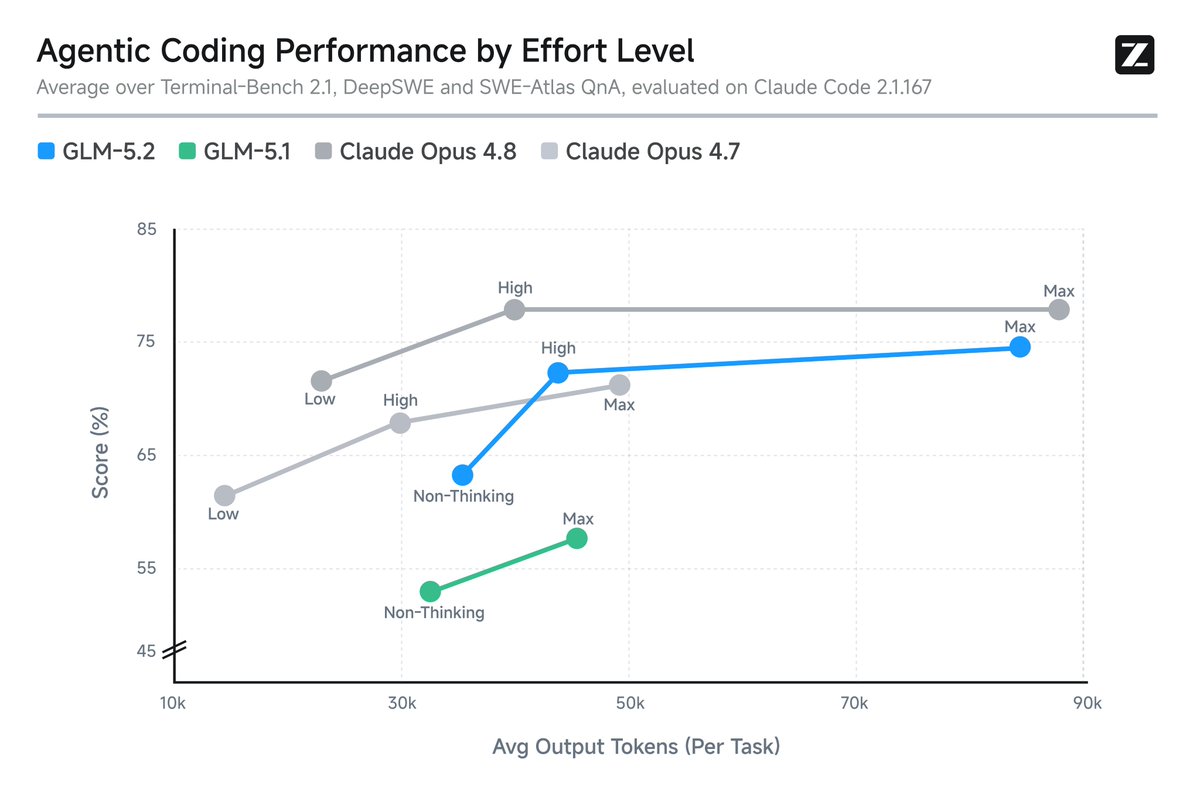
We're introducing GLM-5.2, our latest flagship model for long-horizon tasks. It marks a substantial leap in long-horizon task capability over its predecessor GLM-5.1 and, for the first time, delivers that capability on a solid 1M-token context. GLM-5.2's new capabilities include: Solid 1M Context: A solid 1M-token context that stably sustains long-horizon work Advanced Coding with Flexible Effort: Stronger coding capabilities with multiple thinking effort levels to balance performance and latency Improved Architecture: We propose IndexShare, which reuses the same indexer across every four sparse attention layers, reducing per-token FLOPs by 2.9× at a 1M context length. We also improve GLM-5.2’s MTP layer for speculative decoding, increasing the acceptance length by up to 20% Pure Open: An MIT open-source license — no regional limits, technical access without borders Supporting long-horizon tasks starts with making long context engineering-usable: the model must maintain quality across long, messy coding-agent trajectories, not just accept more tokens. A 1M context is easy to claim, but much harder to keep reliable under real engineering pressure. To this end, we substantially…


Context
GLM-5.2 is the flagship model Z.ai built for long-horizon tasks, and its launch post from Jie Tang argues that the hard part of a 1M-token is keeping it reliable through long, messy coding- sessions, not simply accepting that many tokens. To that end, the post says, Z.ai substantially expanded 1M-context training for coding-agent work, covering large-scale implementation, automated research, performance optimization and complex debugging. The model also adds several thinking effort levels for trading performance against latency, and it is released under an MIT open-source license that the post says has no regional limits.
Two architecture changes target the cost of running at that length. IndexShare reuses the same indexer across every four sparse layers, and Z.ai says this cuts per-token compute (FLOPs) by 2.9 times at a 1M context length. The post also says an improved MTP layer, used for , raises acceptance length by up to 20 percent. In speculative decoding the model drafts several tokens ahead and keeps the ones it accepts, so a longer acceptance length means more tokens produced per step. Both are the lab's own efficiency figures.
The benchmark claims place GLM-5.2 close to Opus 4.8 but mostly behind it. On FrontierSWE, which asks an agent to finish open-ended technical projects lasting hours to tens of hours, Z.ai reports GLM-5.2 trailing Opus 4.8 by 1 percent and ahead of GPT-5.5 by 1 percent and Opus 4.7 by 11 percent. On PostTrainBench, where an agent gets one H100 GPU and is scored on how much it can improve small models through post-training, it beats Opus 4.7 and GPT-5.5 and ranks second to Opus 4.8. On SWE-Marathon, with tasks such as building compilers and optimizing kernels, it trails Opus 4.8 by 13 percent and sits behind only the Opus series. The post's text gives these results as gaps rather than scores, without saying whether they are percentage points or relative differences, and all of them are Z.ai's own reported numbers.
Read that way, the supported claim is the one the post ends on: across these three benchmarks Z.ai calls GLM-5.2 the highest-ranked open-source model, while Opus 4.8 stays ahead on all three, with the largest stated gap, 13 percent, on SWE-Marathon. Three days earlier, Tang's availability announcement framed the release around open access and gave no benchmark figures. A later Tang post cites Artificial Analysis, an outside index, ranking GLM-5.2 as the top open-source model.
- context window — The maximum amount of text a model can consider at once — its working memory for the current conversation or task.
- AI agent — An AI system that doesn't just answer once but works toward a goal in a loop — taking actions, reading the results, and deciding what to do next.
- attention — The mechanism that lets a model weigh which earlier words matter for the word it's currently processing — the core operation of a transformer.
- speculative decoding — A speed trick where a small model drafts several tokens ahead and the big model verifies them in one pass, often doubling generation speed.

Checking sign-in…
Loading comments…