Meta's first streaming speech model undercuts the field on price
- Source
- x.com
- Date

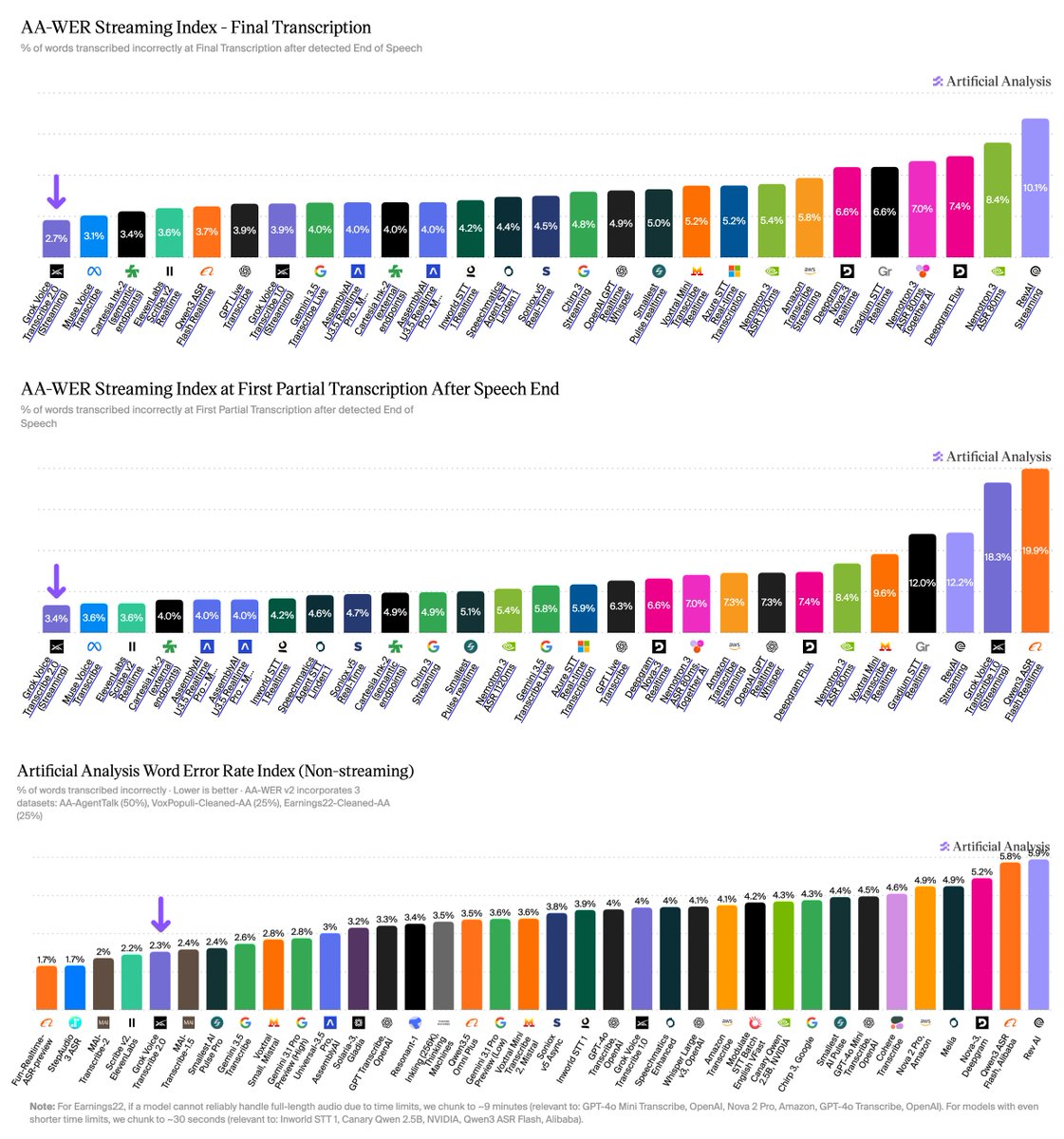
Meta has released Muse Voice Transcribe, taking the #1 spot for Final Transcript accuracy on AA-WER Streaming with 3.1% WER at 0.16s after end of speech Muse Voice Transcribe is the first streaming Speech to Text model developed by Meta Superintelligence Labs. Meta states that the model was trained on more than 70 languages, with 25 extensively verified, and supports audio inputs exceeding one hour without required post-processing. It processes audio in 80ms chunks and is available through the Meta Model API, Meta AI for Mac and Muse Code. Key takeaways ➤ Final Transcript: Muse Voice Transcribe achieves 3.1% WER at 0.16s after end of speech. It is more accurate and faster than Cartesia Ink-2 (semantic endpoints) at 3.4% and 0.43s, and more accurate but slower than Cartesia Ink-2 (external endpoints) at 4.0% and 0.07s. It is also more accurate, though slightly slower, than ElevenLabs Scribe v2 Realtime at 3.6% and 0.14s. ➤ First Partial Transcript: The model achieves 3.6% WER at 0.13s, just ahead of ElevenLabs Scribe v2 Realtime on accuracy and latency. It is more accurate and faster than Cartesia Ink-2 (semantic endpoints) at 4.9% and 0.17s, and more accurate but slower than…

Context
Meta's Muse Voice Transcribe ranked first for final-transcript accuracy in Artificial Analysis's streaming speech-to-text benchmark, and was the cheapest listed, but not the fastest. transcription turns speech into text while the audio is still arriving. The scores accuracy as word error rate (WER), the share of words transcribed wrongly, and speed as the delay after the speaker stops.
On the final transcript, Muse had 3.1% WER with text arriving 0.16 seconds after speech ended. ElevenLabs' Scribe v2 Realtime was slightly faster at 0.14 seconds but less accurate at 3.6%. Cartesia's Ink-2 was tested in two configurations, labeled semantic endpoints and external endpoints: the first was both slower and less accurate than Muse (3.4% at 0.43 seconds), while the second was the fastest at 0.07 seconds with 4.0% WER. On the first partial transcript, the early text produced before the final version, Muse had 3.6% WER after 0.13 seconds, just ahead of ElevenLabs on both accuracy and delay, while Cartesia's external-endpoints setting was again faster at 0.07 seconds with 4.0% WER.
Price is where the gap is widest. Artificial Analysis lists Muse at $0.18 per hour of audio, or $3 per 1,000 minutes, and says that is below Cartesia Ink-2 at $4 and less than half the $6.50 charged for both ElevenLabs Scribe v2 Realtime and Deepgram Flux. For a product that transcribes a lot of live audio, Muse offers the lowest error rate here at under half the price of two rivals, while applications that need text the instant someone stops talking may still prefer Cartesia's faster setting.
This is the first streaming speech-to-text model from Meta Superintelligence Labs. Meta says it was trained on more than 70 languages, 25 of them extensively verified, and handles recordings longer than an hour; those are Meta's claims, and the post does not say which languages the benchmark covered. The model is available through the Meta Model API, Meta AI for Mac and Muse Code.
- streaming — Sending a model's response token by token as it is generated, so the reader sees text immediately instead of waiting for the whole answer.
- benchmark — A standard public test set for comparing AI models — the shared scoreboards behind every "model X beats model Y" claim.
- chunking — Splitting documents into passages small enough to embed and retrieve individually — the step that quietly determines whether retrieval works at all.
Checking sign-in…
Loading comments…