DeepSeek V4.1 Flash Outscores V4 Pro at a Fraction of the Cost
- Source
- x.com
- Date
Artificial Analysis benchmarked DeepSeek V4.1 Flash against the company's own V4 Pro flagship and found the smaller model wins on its Intelligence Index despite using only 8 billion to 16 billion active parameters against V4 Pro's 1.6 trillion. It also costs roughly four times less per token, a gap wide enough to change which model a team defaults to for agentic and long context workloads. V4.1 Flash shipped yesterday with native vision support and a smaller KV cache, and this result is the first independent evidence that those architectural changes translate into a real performance gain rather than just efficiency. It resets the baseline other vendors get compared against: a model an order of magnitude smaller is now the one to beat on both price and reasoning benchmarks, not the flagship it was meant to complement.

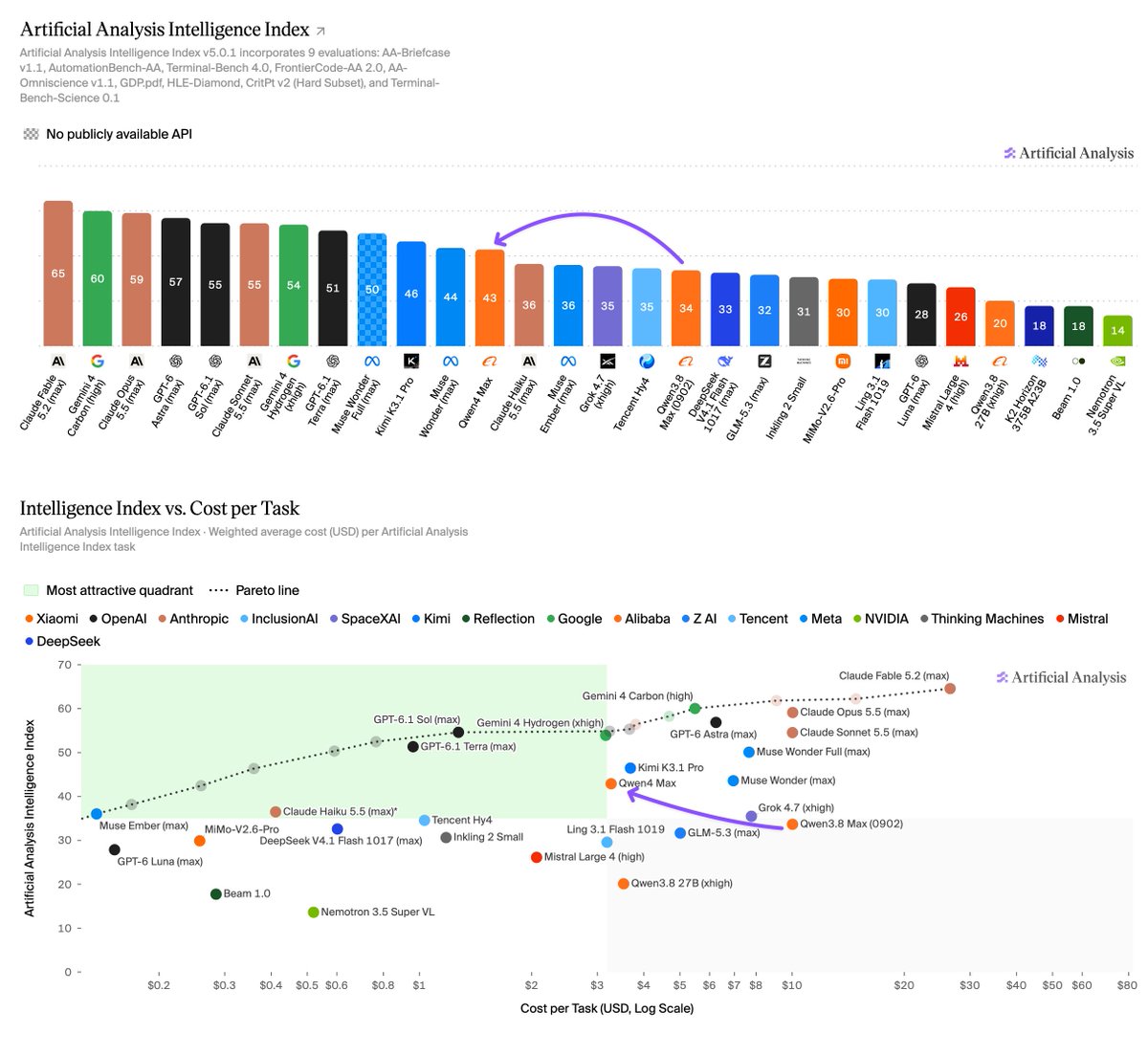
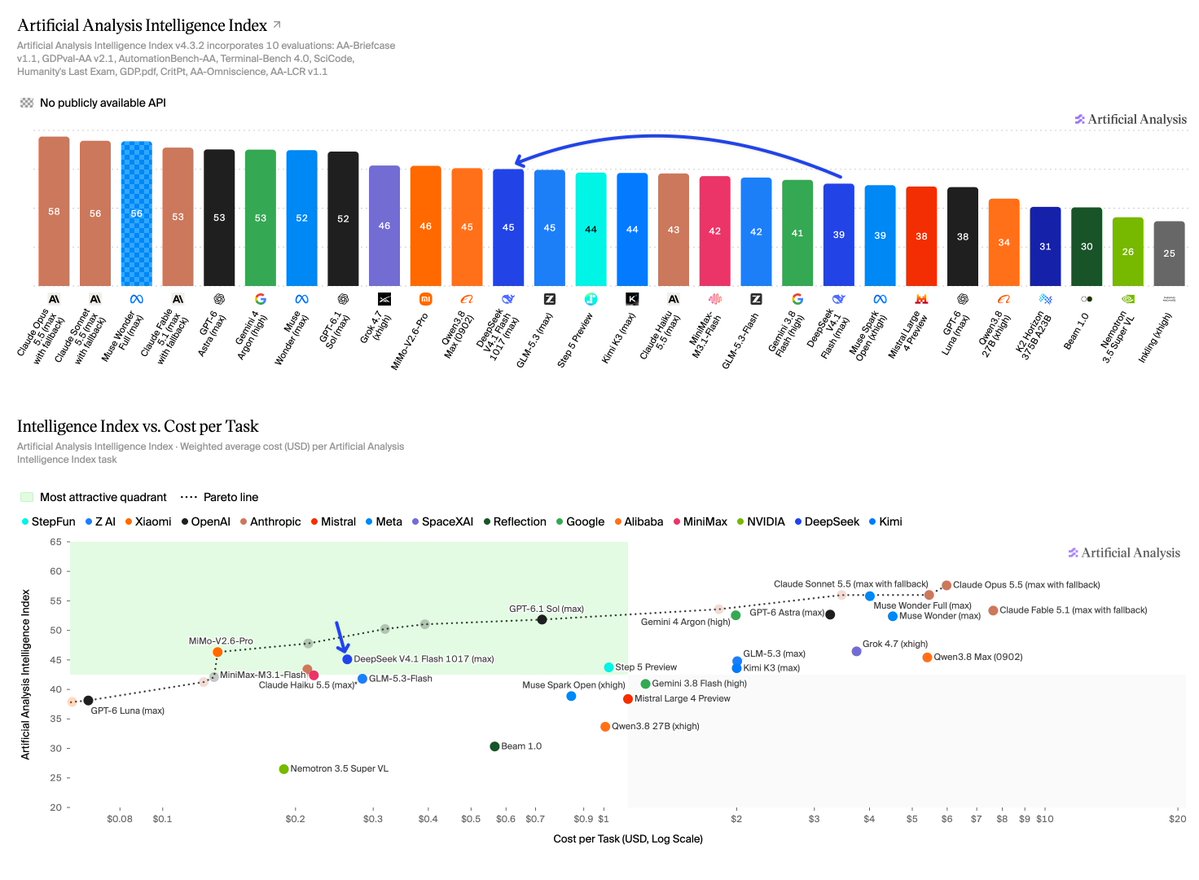
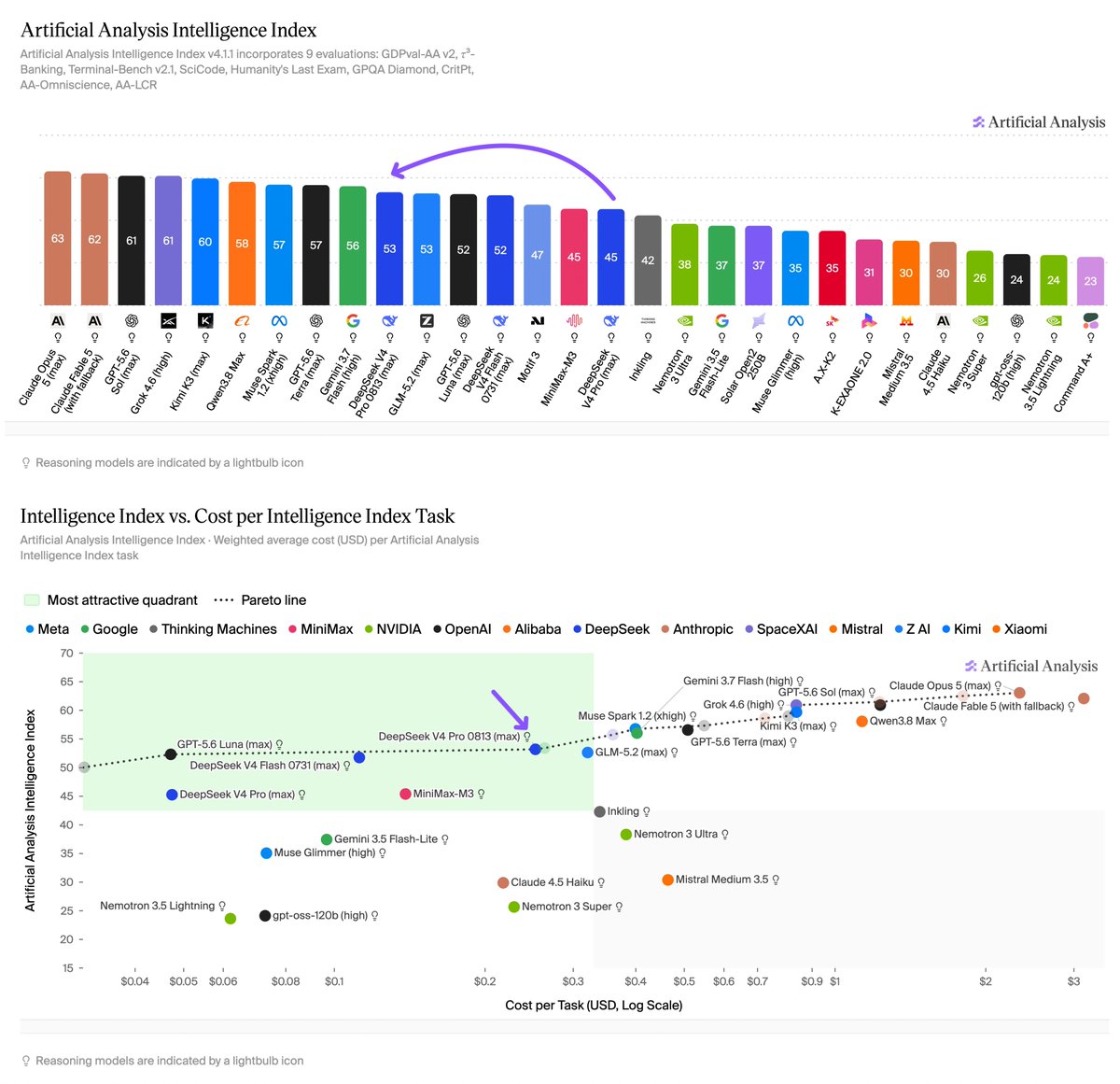
DeepSeek V4.1 Flash overtakes DeepSeek V4 Pro 0813 as DeepSeek’s new flagship model with a score of 40 on Artificial Analysis Intelligence Index. At just 552B parameters, it outperforms the Pro (1.6T) model while costing ~4x less per token, placing it just short of the Intelligence vs. Cost Pareto frontier because of its verbosity @deepseek_ai has released DeepSeek V4.1 Flash, the successor to DeepSeek V4 Flash 0731. This is a 552B model features a new causal Encoder–Decoder architecture, allowing it to have just 8B active parameters for input and 16B active parameters for output. On the first-party API, DeepSeek V4.1 Flash is priced at $0.30 per 1M input tokens and $1.20 per 1M output tokens, with cached input tokens priced at just $0.006 per 1M tokens, a 98% discount. Off-peak pricing provides a further 50% discount across input, cached input, and output tokens. V4.1 Flash is ~20% cheaper than DeepSeek V4 Flash 0731 and ~4x cheaper than DeepSeek V4 Pro 0813 while delivering a higher performance. Key results: ➤ DeepSeek V4.1 Flash makes gains in agentic capabilities and long context reasoning. DeepSeek V4.1 Flash scores 27% in Terminal-Bench v4.0, more than double DeepSeek…

Context
According to benchmarking firm Artificial Analysis, DeepSeek's new V4.1 Flash is now the company's strongest model, even though it is the cheaper line. It scores 40 on the Artificial Analysis Intelligence Index, ahead of the larger DeepSeek V4 Pro 0813, and DeepSeek's API charges $0.30 per million input and $1.20 per million output tokens, about four times less per token than V4 Pro. The gains show up on -style work: on AutomationBench-AA, which checks whether a model completes 657 tasks across business apps such as Salesforce, Jira and Gmail without tripping a guardrail, Flash scores 69% against V4 Pro's 57%, level with GPT-6 Astra.
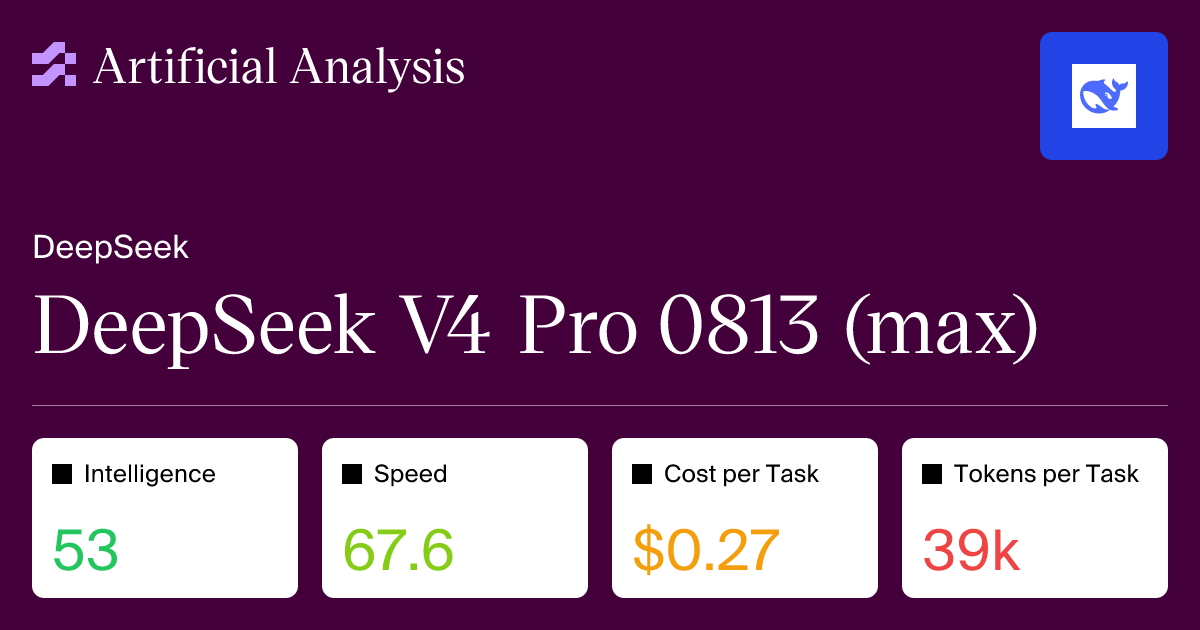
The catch is how much the model writes. Artificial Analysis measured about 89,000 tokens per Intelligence Index task, 62% more than V4 Pro and more than frontier models such as Fable 5.1 and Claude Opus 5. Because a model's bill depends on the tokens it produces as well as its price per token, the four-fold price gap narrows in practice: a full Intelligence Index task costs about $0.27 on Flash against $0.67 on V4 Pro, roughly 2.5 times cheaper. That verbosity is why the Artificial Analysis post puts the model just short of its intelligence-versus-cost Pareto frontier, the set of models that no other model beats on both score and cost at once. It is still far cheaper per task than rivals the firm compares it with, such as GLM-5.3 at $2.01 and Kimi K3 at $2.00.
Some figures in the post do not agree with each other, so a few details are unreliable. It gives the model's size as 552 billion parameters in one place and 763 billion in another, and its Terminal-Bench comparison lists the same 27% for both the new and old Flash while calling it more than double. The conclusions above rest on the cost, verbosity and AutomationBench numbers, which are stated consistently. DeepSeek's own launch thread is the company's account of the model; this post is the outside measurement.
- token — The chunk of text a model reads and writes in — roughly three-quarters of a word — and the unit AI usage is billed in.
- AI agent — An AI system that doesn't just answer once but works toward a goal in a loop — taking actions, reading the results, and deciding what to do next.
- context window — The maximum amount of text a model can consider at once — its working memory for the current conversation or task.
Checking sign-in…
Loading comments…