Ant Group open-sources a finance model and a financial search-agent benchmark
- Source
- x.com
- Date

We’re open-sourcing Ling-3.0-flash-Fin, a finance-enhanced model for real-world workflows, and FinFIRST, an expert-built benchmark for financial search agents. Two open releases, one goal: making financial AI more accessible and verifiable.

Context
Ant Group's Ling team released two things together, and the benchmark is the more unusual of them. FinFIRST grades how a financial search reached its answer, not only whether the final number matches. Each of its 123 tasks, written and verified by more than 50 finance professionals with support from the investment banking team at CICC, is broken into small criteria that pass or fail on their own: did the agent take the right figure for the right company, period, currency and unit, were its sources authoritative and current, and does its calculation hold up. Across the set there are 701 such criteria. Another model, GLM-5.1, does the grading; on a 50-task sample adjudicated by eight finance professionals, its verdicts agreed strongly with theirs (Cohen's kappa of 0.816).
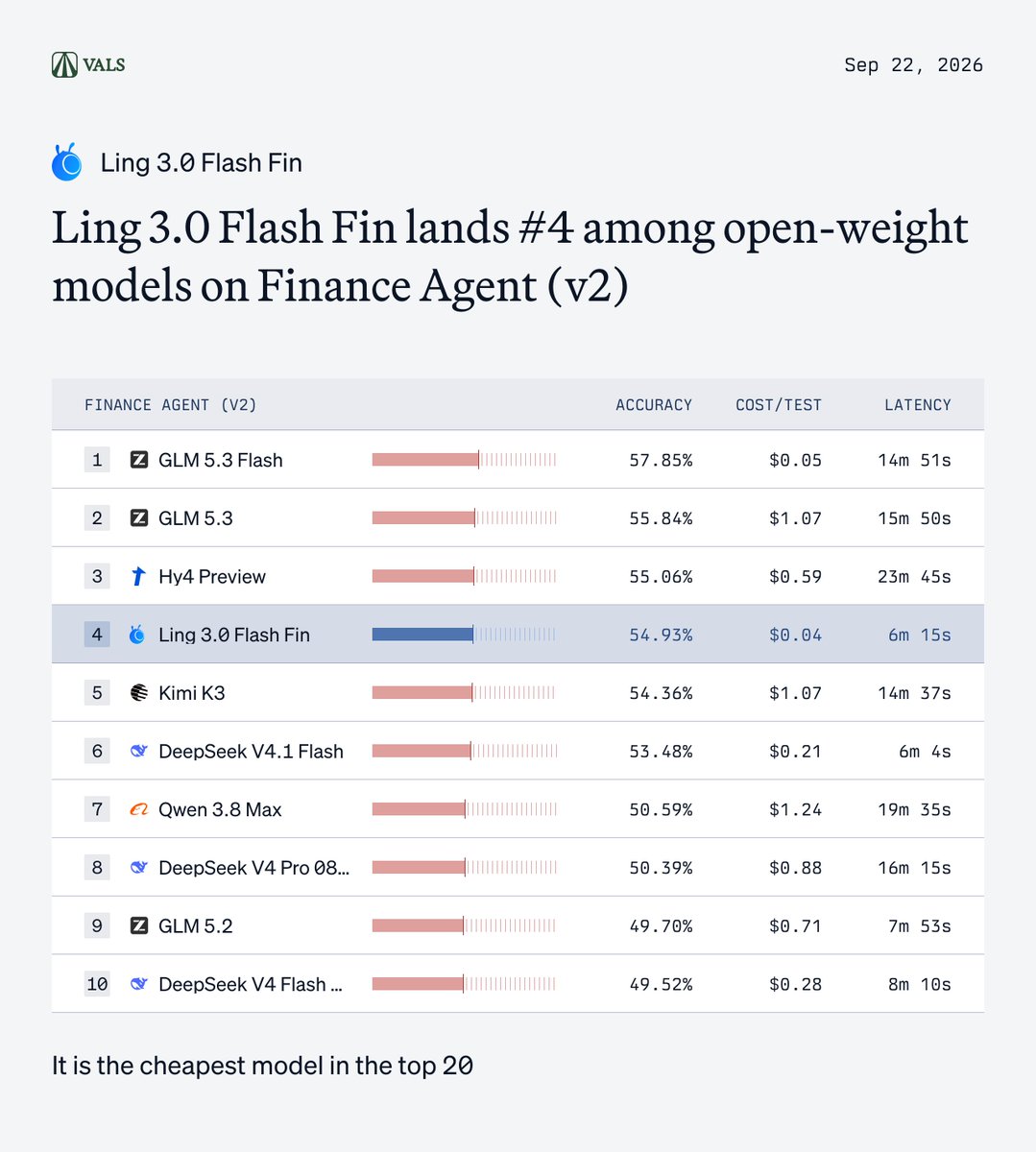
That design catches answers that look right without being supported. In Ant's run of 15 model configurations, 201 of 1,150 correct final answers lacked complete evidence, about 17%. Ant reports that its new model, Ling-3.0-flash-Fin, had the lowest such rate and the best source-verification score among the models it tested, while GPT-5.6-Sol had the highest share of tasks passing every criterion, at 71.54%. Ling-3.0-flash-Fin is Ling-3.0-flash with further training on financial data: 124 billion parameters, of which 5.1 billion are active for each . Ant built both the benchmark and the model, so the ranking is its own. In a later independent evaluation, Artificial Analysis gave it the same Finance & Accounting score, 24, as Ant's earlier Ling-3.0-flash-VL, a model that takes image and video input, with a higher rate on business knowledge questions (33% against 19%).
- AI agent — An AI system that doesn't just answer once but works toward a goal in a loop — taking actions, reading the results, and deciding what to do next.
- open weights — A model whose trained parameters are published for anyone to download and run — unlike API-only models you can access but never possess.
- token — The chunk of text a model reads and writes in — roughly three-quarters of a word — and the unit AI usage is billed in.
- hallucination — When a model states something false with full confidence — inventing facts, citations, or APIs that don't exist.

Checking sign-in…
Loading comments…