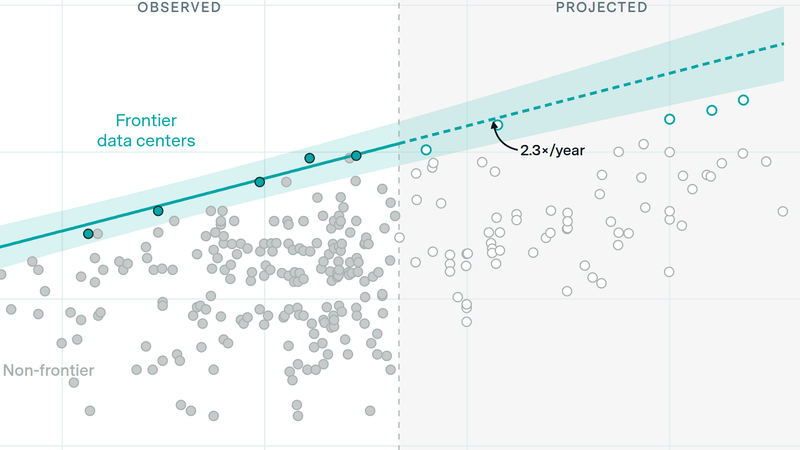
Frontier training runs may need 4-16 GW by 2030, so power supply could cap how fast the largest models scale. This informs expectations about future capability, cost and availability.
Key takeaways · AI-distilled
Epoch and EPRI forecast that the largest individual frontier training runs could draw 4–16 GW by 2030. They do not model supply bottlenecks in detail, and explicitly say this growth may not be feasible, especially at the upper end.
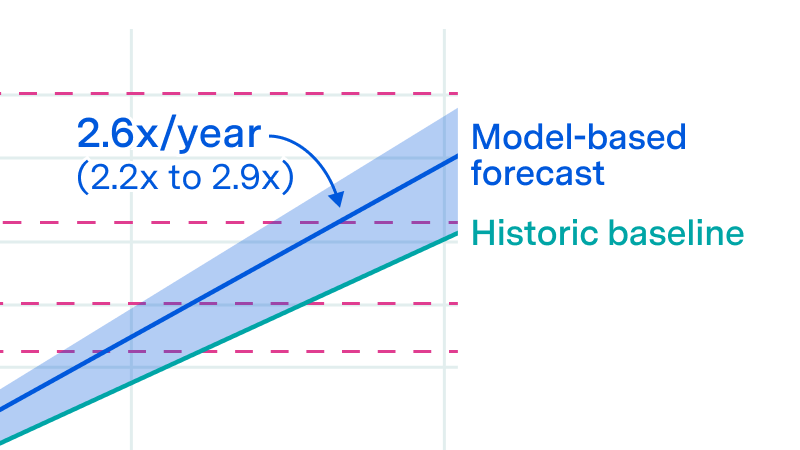
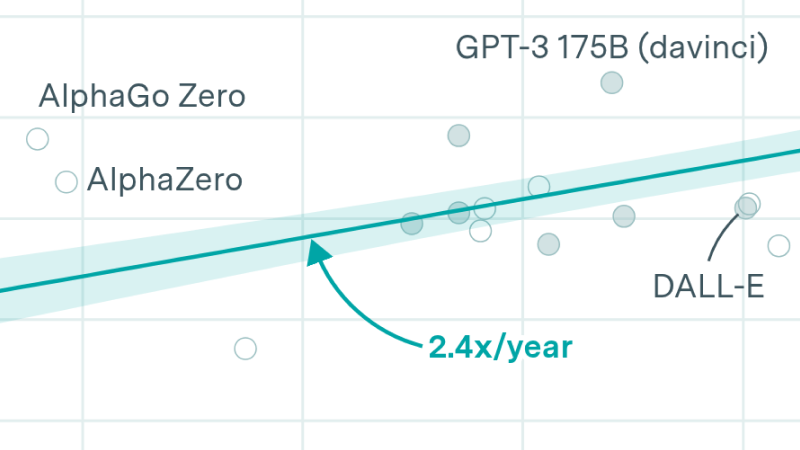
Historical training power grew about 2.2-fold annually while training compute grew 4–5-fold. Improving hardware efficiency and lengthening runs partly offset the power demands of greater compute.
The authors expect annual growth in run duration to slow from 26%–50% historically to 10%–20% through 2030. They caution that duration limits could instead slow compute scaling, rather than simply force larger power demands.
The report considers more than 100 GW of worldwide AI capacity and more than 50 GW in the US plausible by 2030. Those totals include inferenceRunning a trained model to get answers — the phase where AI is actually used, as opposed to trained.Full definition → and experiments across companies, not just one frontier training run.
Terms in this piece · Glossary
inference — Running a trained model to get answers — the phase where AI is actually used, as opposed to trained.