AA-AgentPerf debuts AMD MI355X results versus NVIDIA Blackwell
Source
x.com
Date
Post unavailable on X
The source post has been deleted, protected, or is otherwise unavailable.
Why it matters
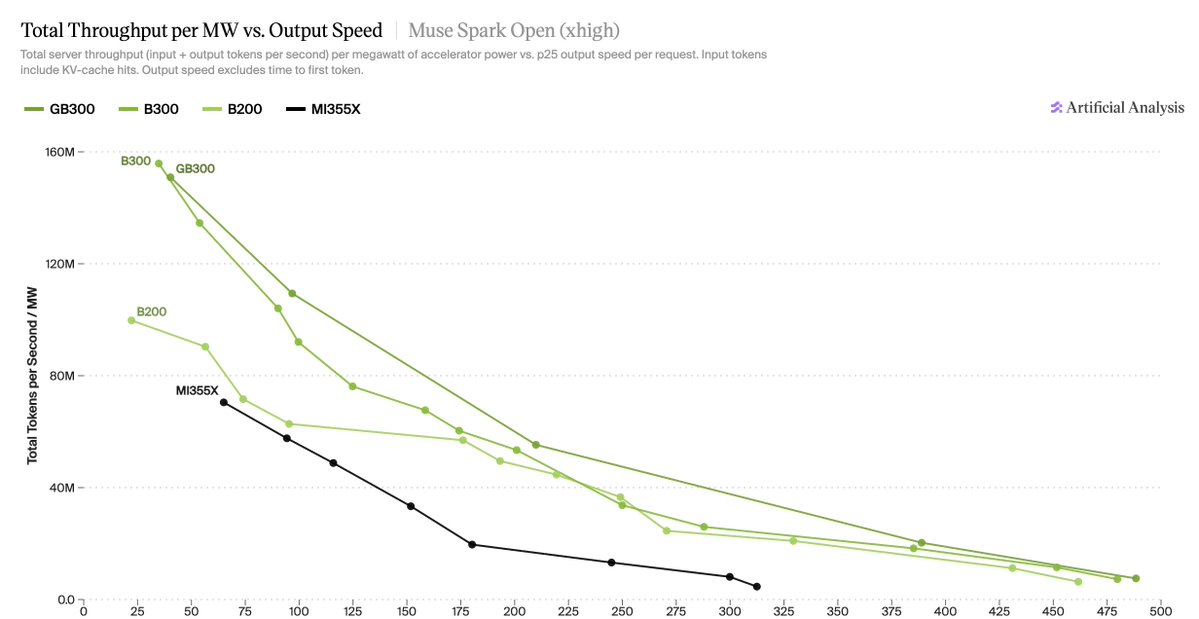
Shows how AMD's MI355X compares with NVIDIA Blackwell on realistic coding-agent traffic, including up to 40% more throughput per MW on DeepSeek V4 Pro. Useful when choosing or pricing inferenceRunning a trained model to get answers — the phase where AI is actually used, as opposed to trained.Full definition → hardware.
Key takeaways · AI-distilled
Artificial Analysis notes the MI355X matches B300's 288GB of HBM3E at 8TB/s and offers about 10 PFLOPS of dense FP4 (B300 about 13.5, B200 about 9), with board power up to 1,400W.
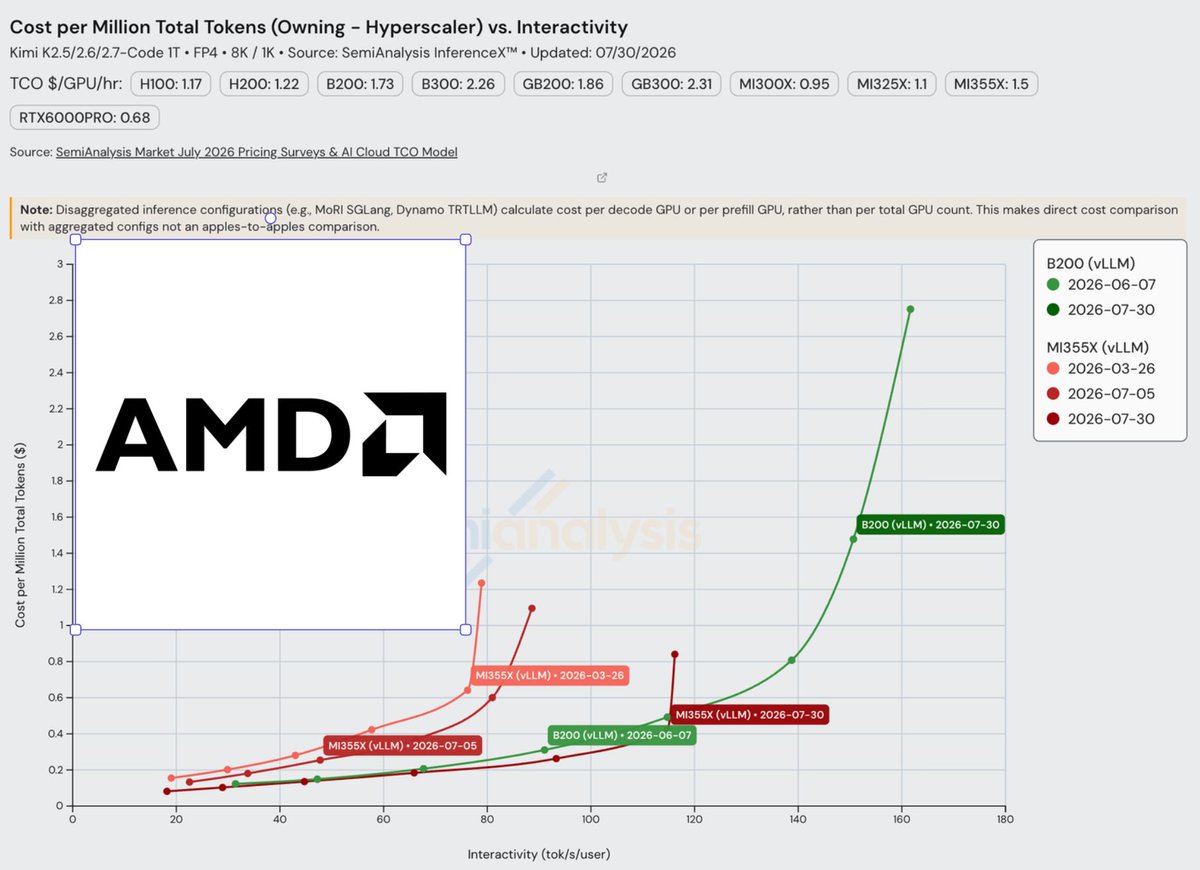
All MI355X results ran on ROCm nightly with dev builds of vLLM and SGLang on a single 8-GPU node, and the authors expect the numbers to change as AMD's serving software improves.
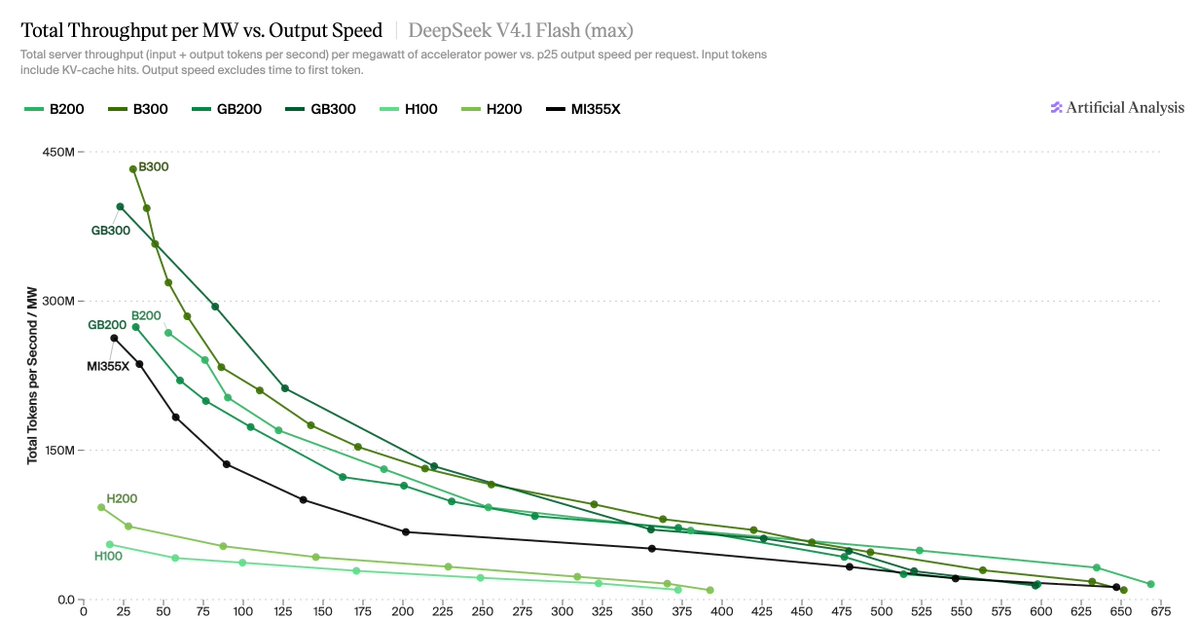
On DeepSeek V4.1 Flash, MI355X matched Blackwell for a single AI agentAn AI system that doesn't just answer once but works toward a goal in a loop — taking actions, reading the results, and deciding what to do next.Full definition → (647 tok/s vs 652 on B300) but fell behind under load, reaching about 128M tokenThe chunk of text a model reads and writes in — roughly three-quarters of a word — and the unit AI usage is billed in.Full definition →/s per MW at 100 tok/s per user versus about 220M on B300.
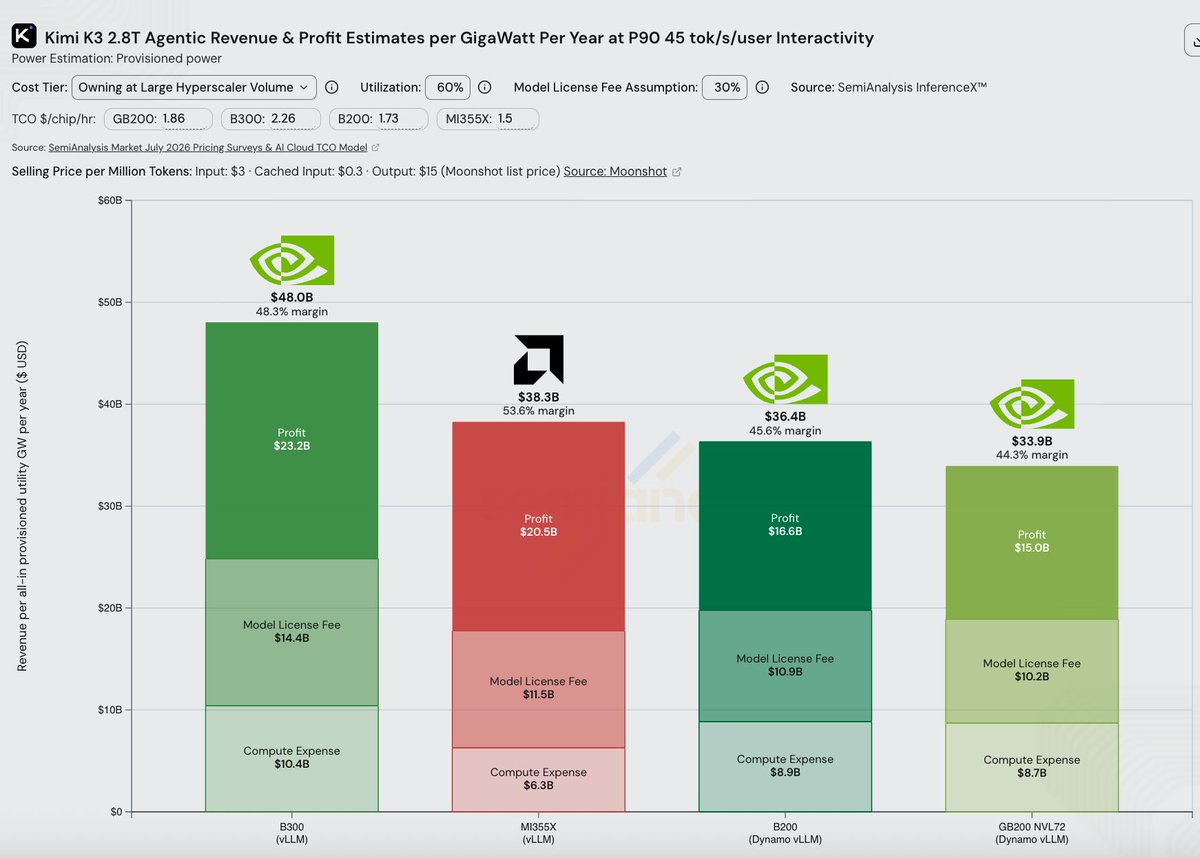
The gap was widest on the 2.8T-parameter Kimi K3: about 8M tokens/s per MW at 50 tok/s per user on MI355X versus about 24M on B300, though B300 used NVIDIA's multi-node configs.
On GLM-5.2/5.3, MI355X trailed both NVIDIA parts at 100 tok/s per user, with about 26M tokens/s per MW against about 42M for B200 and 44M for B300.
Terms in this piece · Glossary
benchmark — A standard public test set for comparing AI models — the shared scoreboards behind every "model X beats model Y" claim.
AI agent — An AI system that doesn't just answer once but works toward a goal in a loop — taking actions, reading the results, and deciding what to do next.
inference — Running a trained model to get answers — the phase where AI is actually used, as opposed to trained.
token — The chunk of text a model reads and writes in — roughly three-quarters of a word — and the unit AI usage is billed in.