Context Windows
- Source
- epoch.ai
- Author
- Epoch AI publications
- Date
Context
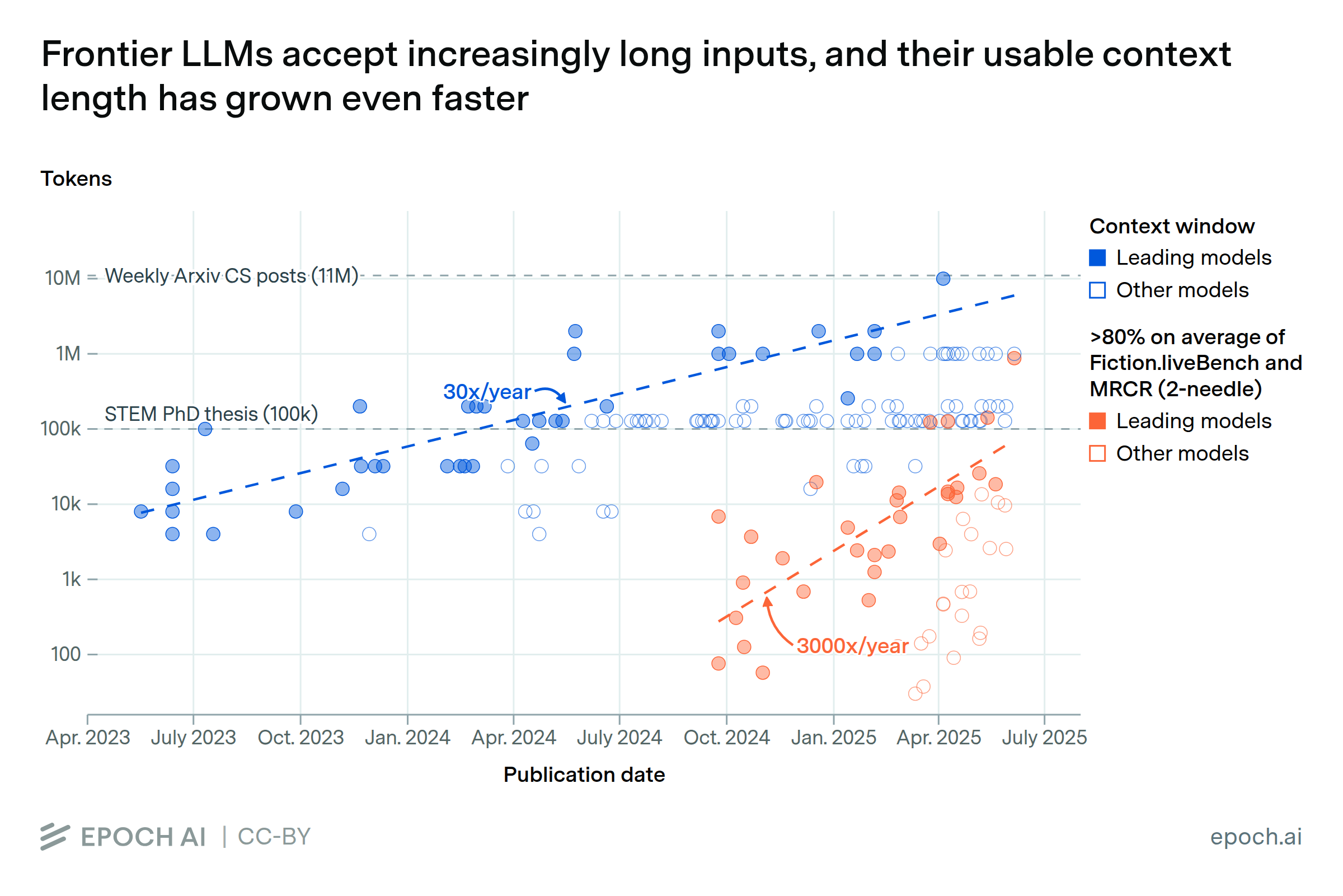
A is the maximum amount of text, counted in , that a model can take in for a single request. Epoch AI separates two questions that are often blurred together: how large those windows have become, and how much of that input a model can actually use well. Its June 2025 data insight finds that both are rising quickly, and that usable length rose faster in the period it could measure.
On size, the longest available windows have grown about 30x per year since mid-2023, with a 90 percent confidence interval of roughly 10x to 50x. To measure use, the authors take two long-context benchmarks, Fiction.liveBench, which tests understanding of long stories, and MRCR, which tests retrieving specific information that depends on its surrounding context. For each model they estimate the input length at which its accuracy would fall to 80 percent. For top models, that length rose by more than 250x over the nine months before publication.
Epoch is cautious about the second number. The data covers less than a year, so the growth rate is hard to pin down, and the annual growth rate from its fit has a 90 percent interval running from 200x to 20,000x. The authors also say many real long-context tasks are probably harder than these benchmarks. They chose an easier MRCR setting with two items to retrieve, and in the harder eight-item setting even the best model on their metric, Google's Gemini 2.5 Pro, scores above 80 percent only at the shortest 8,000-token length. A long window is therefore not proof that a model can reliably use everything placed in it.
- context window — The maximum amount of text a model can consider at once — its working memory for the current conversation or task.
- token — The chunk of text a model reads and writes in — roughly three-quarters of a word — and the unit AI usage is billed in.
- benchmark — A standard public test set for comparing AI models — the shared scoreboards behind every "model X beats model Y" claim.
- LLM — A large language model — the neural network behind tools like Claude and ChatGPT, trained on huge amounts of text to predict what comes next.

Checking sign-in…
Loading comments…