Coding Agent Index v2.1: Fable 5.2 and Opus 5.5 tie at 58
- Source
- x.com
- Date

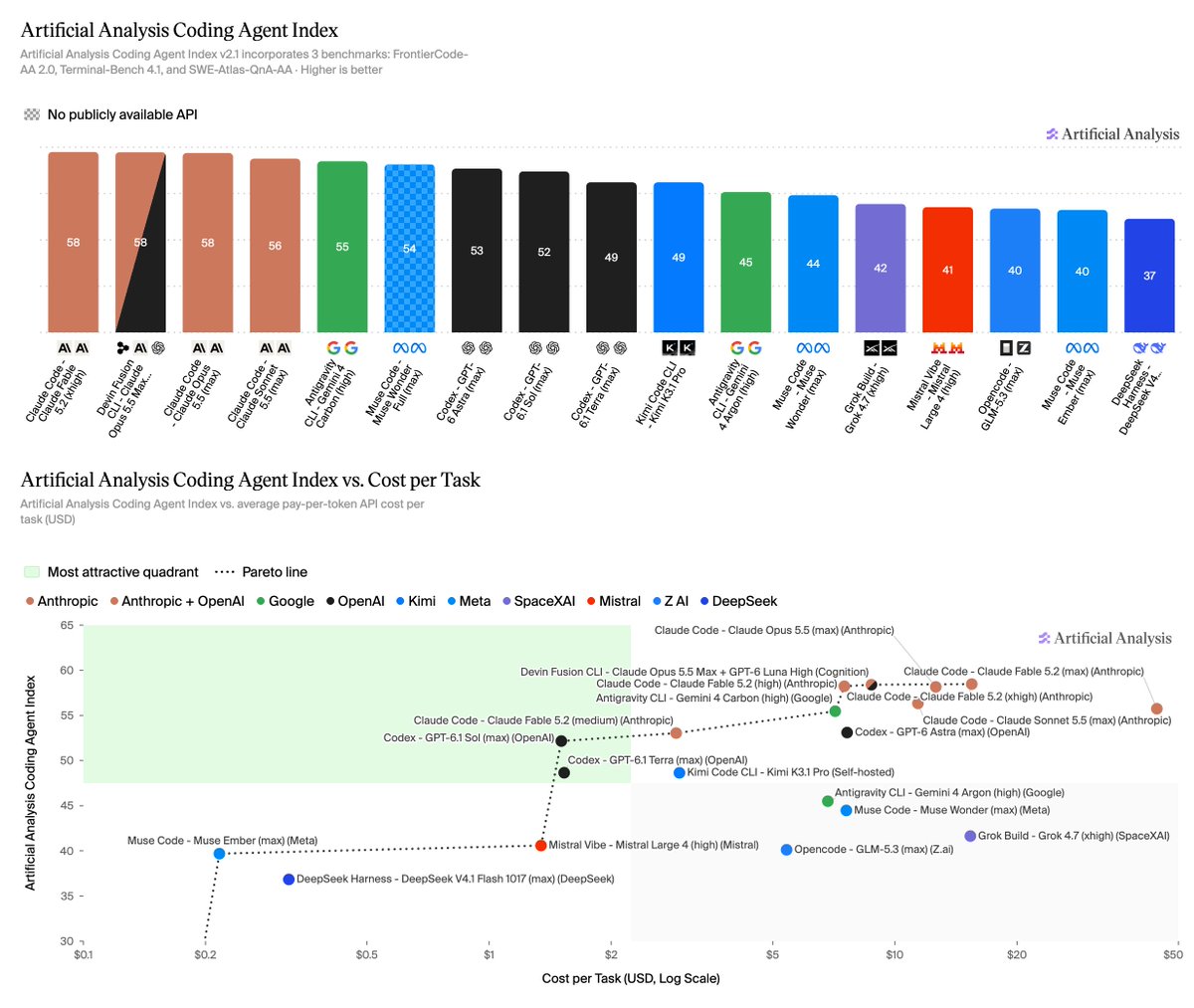
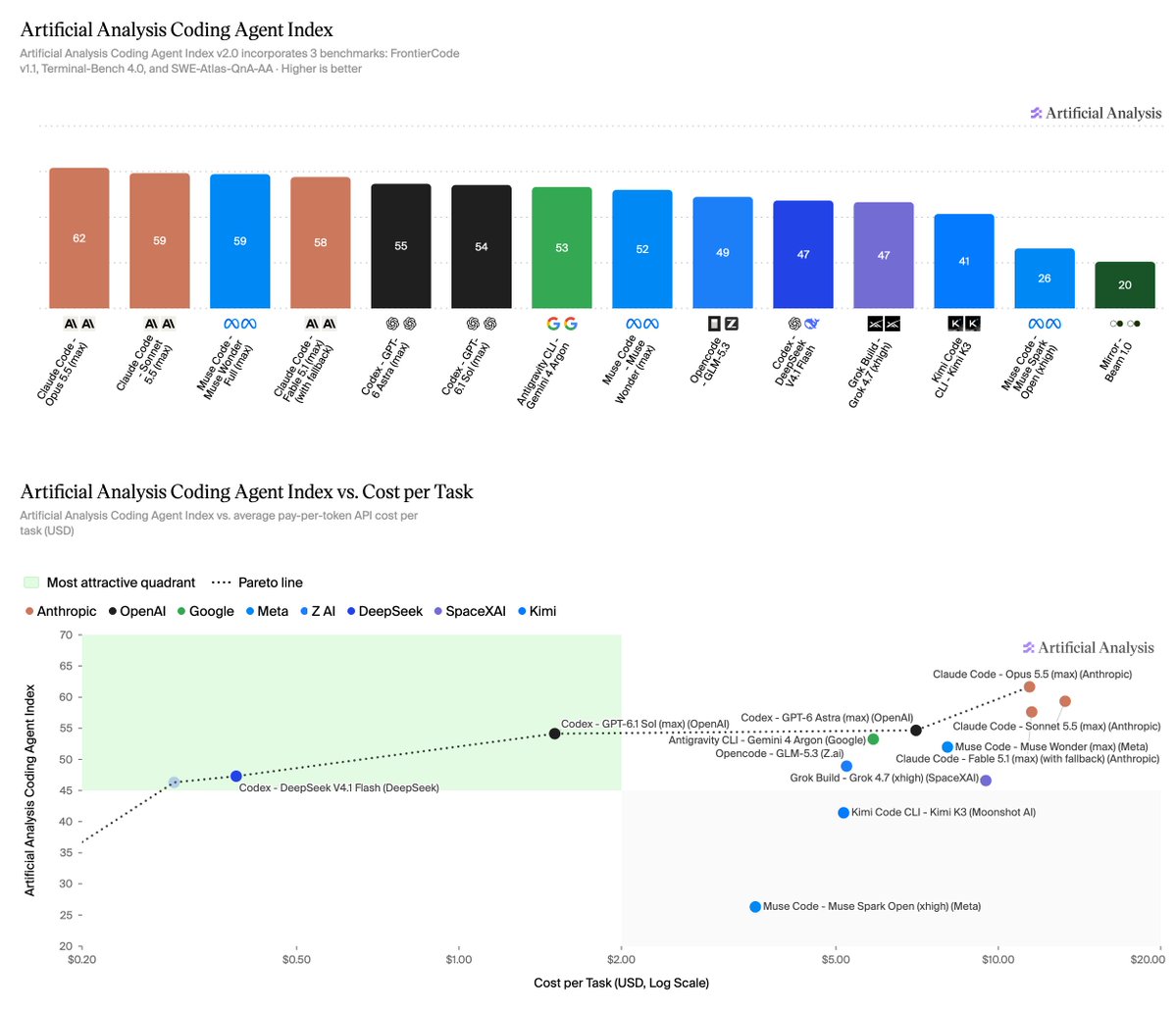
Announcing Artificial Analysis Coding Agent Index v2.1, upgrading FrontierCode and Terminal-Bench. Claude Fable 5.2 and Claude Opus 5.5 share the lead at 58 The Coding Agent Index measures models in agent harnesses; v2.1 of the Index upgrades FrontierCode from 1.1 to 2.0 and Terminal-Bench from 4.0 to 4.1. Upgraded: ➤ FrontierCode-AA 2.0 (replacing FrontierCode v1.1): our implementation of Cognition's FrontierCode 2.0, comprising 132 real-world coding tasks graded on whether a repository maintainer would merge the agent's change ➤ Terminal-Bench 4.1 (replacing Terminal-Bench 4.0): the same 66 tasks, scored with updated verifiers that improve reliability and resistance to reward hacking Staying in the Index: SWE-Atlas-QnA-AA Key results: ➤ Claude Fable 5.2 and Claude Opus 5.5 share the lead at 58: Claude Fable 5.2 scores 58 at both xhigh and high in Claude Code. Claude Opus 5.5 (max) scores 58 in Claude Code and, paired with GPT-6 Luna High, in Cognition's multi-model harness Devin Fusion CLI. Claude Fable 5.2 (max) scores 56 as more of its attempts hit task time limits. Claude Sonnet 5.5 (max, 56) in Claude Code and Gemini 4 Carbon (high, 55) in Antigravity CLI follow ➤…
Context
Artificial Analysis has released version 2.1 of its Coding Index, which scores a model running inside an , the program such as Claude Code or Codex that gives the model its tools and instructions, rather than the model on its own (announcement). The update replaces two of the index's three benchmarks with newer versions. FrontierCode-AA 2.0, Artificial Analysis's implementation of Cognition's FrontierCode 2.0, replaces FrontierCode v1.1 and has 132 real-world coding tasks graded on whether a repository maintainer would merge the agent's change; Cognition's own description of version 2.0 explains how it adds a test of engineering judgment. Terminal-Bench 4.1 keeps the same 66 tasks as 4.0 but scores them with updated verifiers that Artificial Analysis says are more reliable and harder to reward-hack, where an agent satisfies the grader without doing the task. The third , SWE-Atlas-QnA-AA, stays.
Scores fell as a result, by 5 points on average, and Artificial Analysis attributes the drop mainly to FrontierCode-AA 2.0. A v2.1 score therefore cannot be compared with a v2.0 score, just as v2.0 reset the scale before it. The only configuration that did not fall was Codex running GPT-6.1 Terra at max effort, which stayed within 1 point of its earlier score.
Two Anthropic models share the lead at 58. Claude Fable 5.2 scores 58 in Claude Code at both its xhigh and high effort settings, which control how much reasoning the model spends. Claude Opus 5.5 at max effort scores 58 in Claude Code, and also 58 when paired with GPT-6 Luna High in Devin Fusion CLI, Cognition's harness that combines more than one model. More effort did not help Fable 5.2: at max it scores 56, because more of its attempts ran into task time limits. Claude Sonnet 5.5 at max scores 56 in Claude Code and Gemini 4 Carbon at high scores 55 in Antigravity CLI.
Cost separates configurations more than score does. Among configurations scoring 48 or more, cost per task varies about 30 times, from $1.51 for Codex with GPT-6.1 Sol at max effort, scoring 52, to $44.22 for Claude Code with Fable 5.2 at max, scoring 56. The post's text does not give costs for the 58-point configurations.
- AI agent — An AI system that doesn't just answer once but works toward a goal in a loop — taking actions, reading the results, and deciding what to do next.
- agent harness — The scaffolding around a model that turns it into a working agent — the loop, the tools it can call, and the rules for when to stop.
- benchmark — A standard public test set for comparing AI models — the shared scoreboards behind every "model X beats model Y" claim.
Checking sign-in…
Loading comments…