GPT-6.1 Sol reaches near-Astra intelligence at a quarter of the cost per task
- Source
- x.com
- Date

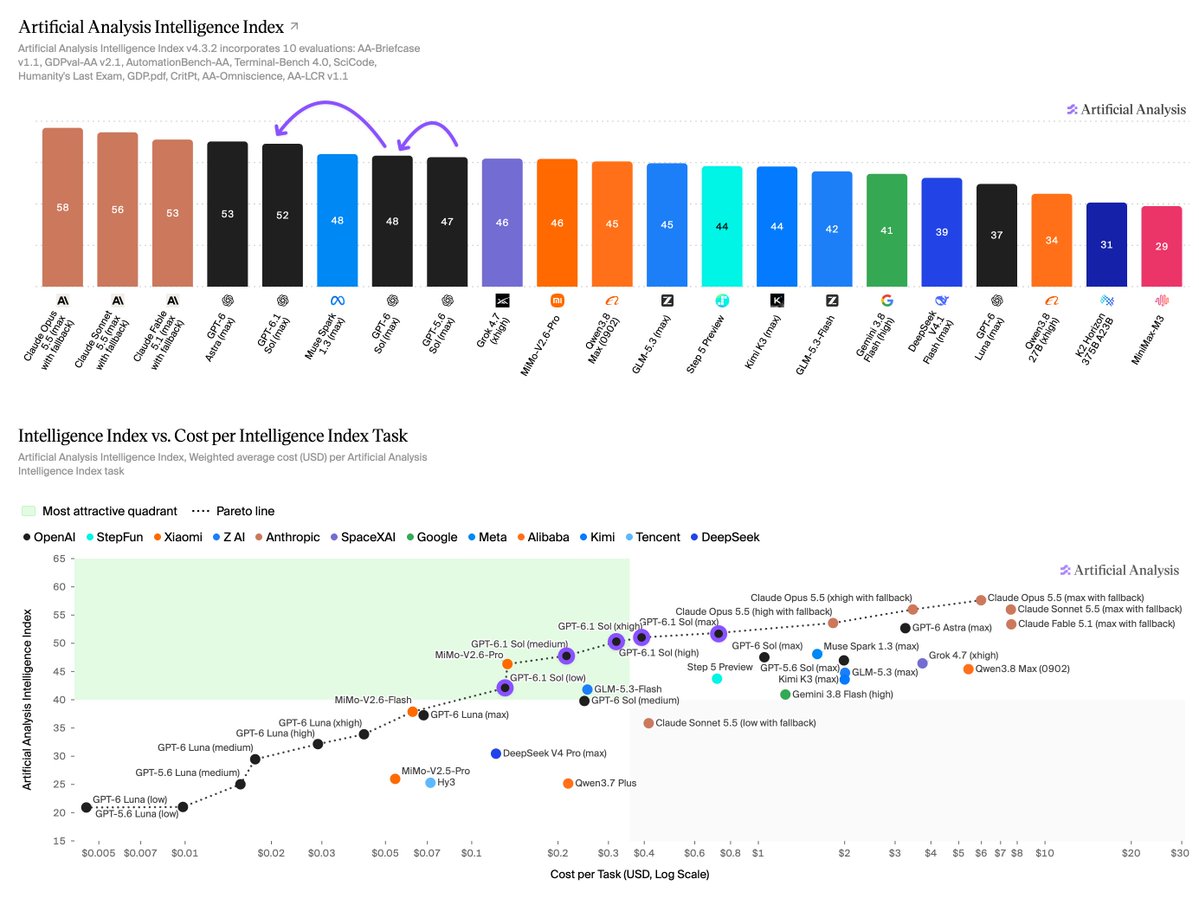
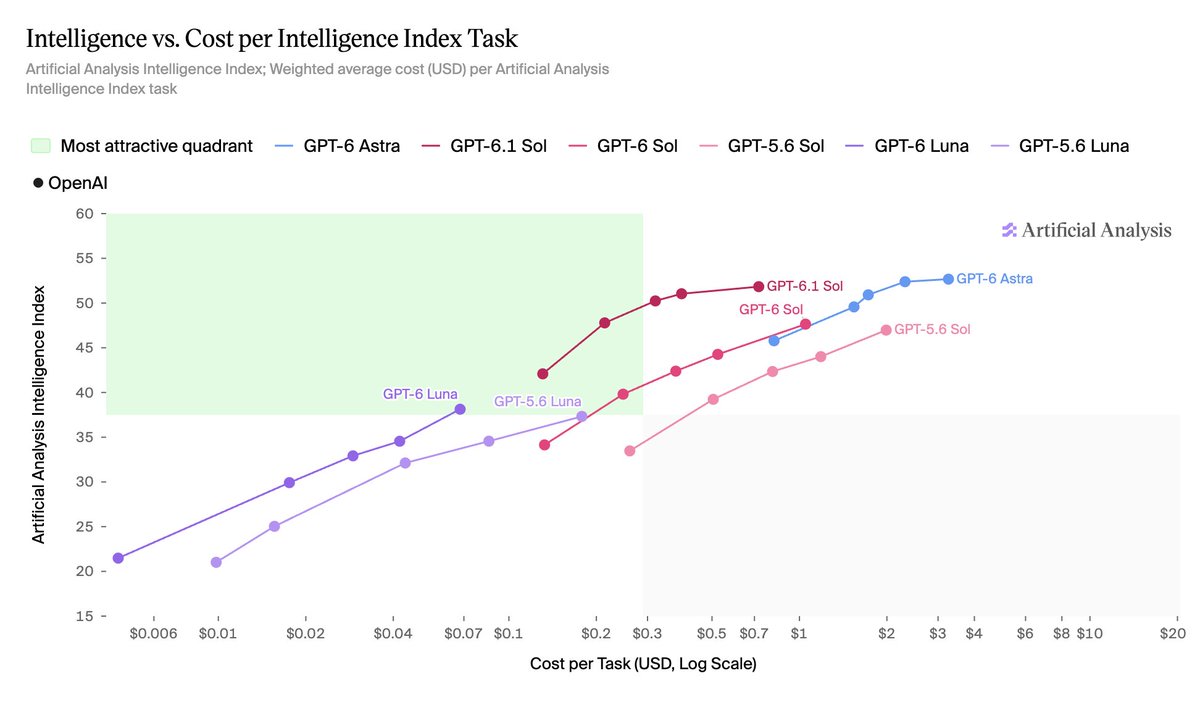
GPT-6.1 Sol replaces GPT-6 Sol after just 7 days. It scores 1 point below GPT-6 Astra in the Intelligence Index at less than one quarter of the Cost per Task Pricing matches GPT-6 Sol at $2/$10 per million input/output tokens, except that the cache read discount rises from 90% to 95%. GPT-6.1 Sol’s overall blended price for agentic workloads is therefore slightly lower than GPT-6 Sol. This represents an additional price cut, following GPT-6 Sol’s original 50% discount from GPT-5.6 Sol. Key takeaways: ➤ Achieves near-Astra Intelligence: GPT-6.1 Sol gains 4 points in the Intelligence Index vs GPT-6 Sol, and 5 points vs GPT-5.6 Sol - landing 1 point below GPT-6 Astra. It makes significant gains in agentic knowledge work, improving 4 points and 5 points in AA-Briefcase v1.1 and GDPval-AA v2.1 respectively. Other notable gains include a 12 point jump in Terminal-Bench 4.0, a 5 point jump in Humanity’s Last Exam, a 6 point jump in GDP.pdf, and an 8 point jump in AA-Omniscience Accuracy coupled with hallucination rate falling from 60% to 54%. ➤ Pushes cost efficiency frontier: At max effort, GPT-6.1 Sol costs less than a quarter of GPT-6 Astra per Intelligence Index task ($0.72 vs…
Context
Artificial Analysis's testing puts OpenAI's GPT-6.1 Sol one point below the company's GPT-6 Astra on the firm's Intelligence Index while costing less than a quarter as much per task. At max effort, the firm measured $0.72 per Intelligence Index task for GPT-6.1 Sol against $3.26 for GPT-6 Astra. GPT-6.1 Sol replaced GPT-6 Sol after just seven days, and it scores 4 points higher on the index than GPT-6 Sol and 5 higher than GPT-5.6 Sol.
The cheaper runs did not come from a lower list price. GPT-6.1 Sol keeps GPT-6 Sol's $2 per million input and $10 per million output tokens. The only pricing change is a larger discount on cache reads, input the provider has already processed for an earlier request, which rises from 90% to 95%. Artificial Analysis says that makes the blended price for agentic workloads slightly lower than GPT-6 Sol's, on top of the 50% cut GPT-6 Sol had already made from GPT-5.6 Sol. Yet the measured cost per task fell 31% against GPT-6 Sol, which cost $1.05, and 64% against GPT-5.6 Sol at $1.99, even though GPT-6.1 Sol produces about 10 to 30% more output tokens across effort levels. The report does not explain how these figures fit together, so the saving is a measurement on this benchmark suite, not something a reader could work out from the price sheet.
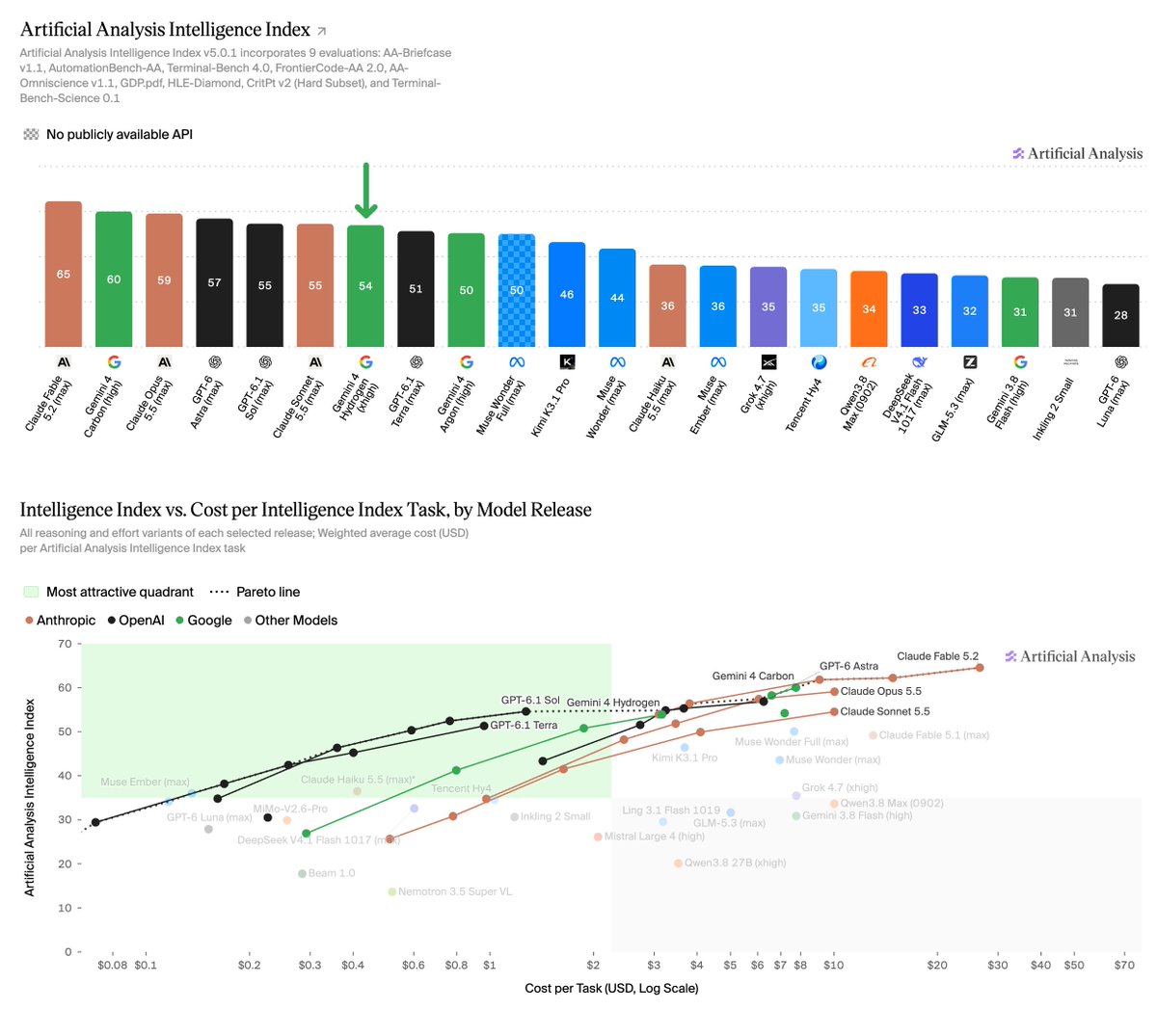
By the firm's measurements, every GPT-6.1 Sol effort level pushes out its cost-efficiency frontier, meaning there is no cheaper model for a given level of intelligence. Its low and medium effort levels also sit on the token-efficiency frontier despite the extra output, because the index score rose. The firm reports gains including 12 points on Terminal-Bench 4.0 and 4 and 5 points on AA-Briefcase v1.1 and GDPval-AA v2.1, its tests of agentic knowledge work, along with a rate on AA-Omniscience that fell from 60% to 54%. On its Coding Index, GPT-6.1 Sol gained 3 points on GPT-6 Sol at max effort and sits 2 points below GPT-6 Astra. A week earlier, the firm's evaluation of GPT-6 Sol had credited that model with halving cost.
- token — The chunk of text a model reads and writes in — roughly three-quarters of a word — and the unit AI usage is billed in.
- hallucination — When a model states something false with full confidence — inventing facts, citations, or APIs that don't exist.
- AI agent — An AI system that doesn't just answer once but works toward a goal in a loop — taking actions, reading the results, and deciding what to do next.
- eval — A repeatable test for AI quality — a set of tasks plus scoring — used the way software teams use test suites, because model output is too variable to judge by eyeballing.

Checking sign-in…
Loading comments…