Coding Agent Index: Sonnet 5.5 leads on score, GPT-6.1 Sol on cost
- Source
- x.com
- Date

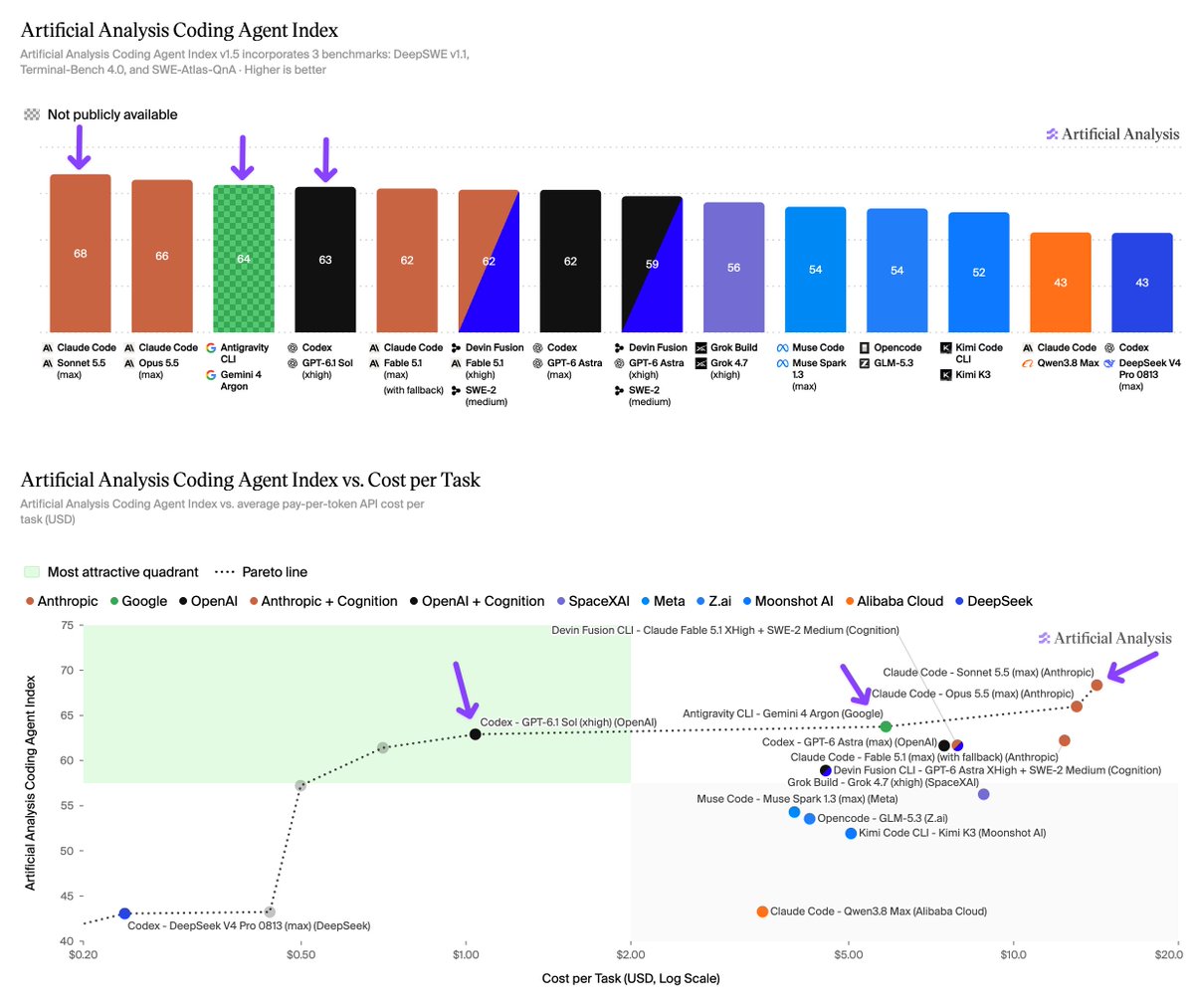
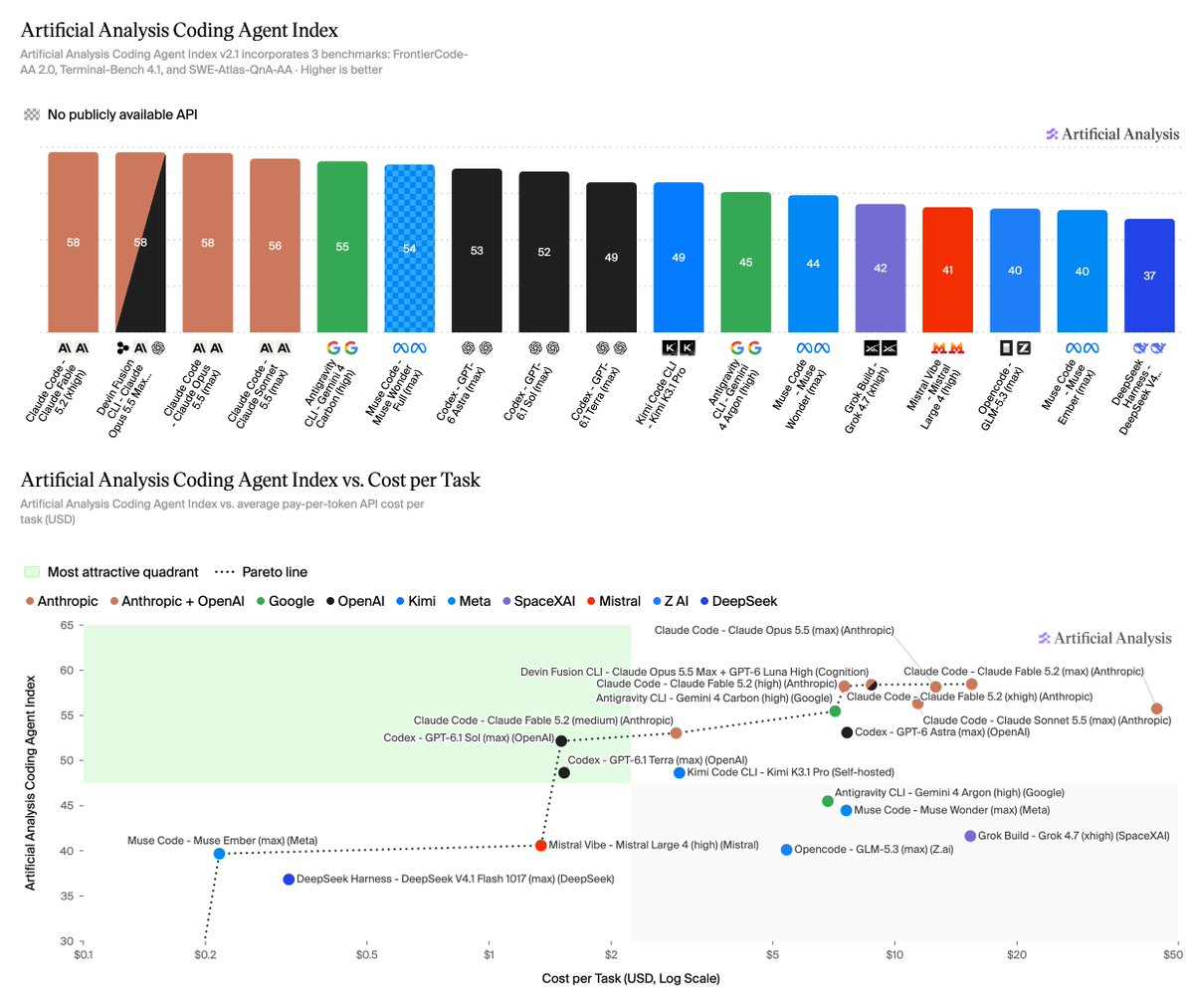
This week Claude Sonnet 5.5, GPT-6.1 Sol and Gemini 4 Argon all launched near the top of the Coding Agent Index leaderboard, but each has a different balance of performance and cost The Artificial Analysis Coding Agent Index measures agents (a combination of model and harness) across three agentic coding evaluations. ➤ Claude Sonnet 5.5 (max) in Claude Code takes the top spot at 68, but also has the highest measured cost per task: $14.19 ➤ Gemini 4 Argon (high) in Antigravity CLI scores 64 at $5.84 per task - less than half of Sonnet 5.5’s cost. Note, this uses Google’s promotional pricing, and Argon is not yet publicly available ➤ GPT-6.1 Sol (xhigh) in Codex scores 63 at $1.04, roughly one sixth of Argon’s cost
Context
Three models that launched the same week landed near the top of the Artificial Analysis Coding Index, but the highest score and the lowest cost belong to different systems. Artificial Analysis reports that Anthropic's Claude Sonnet 5.5 at max effort in Claude Code took the top spot at 68, with the highest measured cost per task at $14.19. OpenAI's GPT-6.1 Sol at xhigh effort in Codex scored 63 at $1.04 per task.
Google's Gemini 4 Argon at high effort in Antigravity CLI fell in between, at 64 for $5.84 per task, less than half of Sonnet 5.5's cost. Artificial Analysis notes that this figure uses Google's promotional pricing and that Argon was not yet publicly available, so the cost may not reflect what users would later pay.
The index scores agents, meaning a model paired with its , the software such as Claude Code or Codex that gives the model tools and runs its working loop. So a ranking reflects the combination, not the model alone, across three agentic coding evaluations that the post does not name. Artificial Analysis later released version 2.0 of the index, which replaced one and revised grading, so these scores belong to the earlier version.
- AI agent — An AI system that doesn't just answer once but works toward a goal in a loop — taking actions, reading the results, and deciding what to do next.
- agent harness — The scaffolding around a model that turns it into a working agent — the loop, the tools it can call, and the rules for when to stop.
- eval — A repeatable test for AI quality — a set of tasks plus scoring — used the way software teams use test suites, because model output is too variable to judge by eyeballing.
Checking sign-in…
Loading comments…