Solar Pro 4's AA-Omniscience score improves from -53 to -1, however the improvem
- Source
- x.com
- Publisher
- Artificial Analysis
- Date

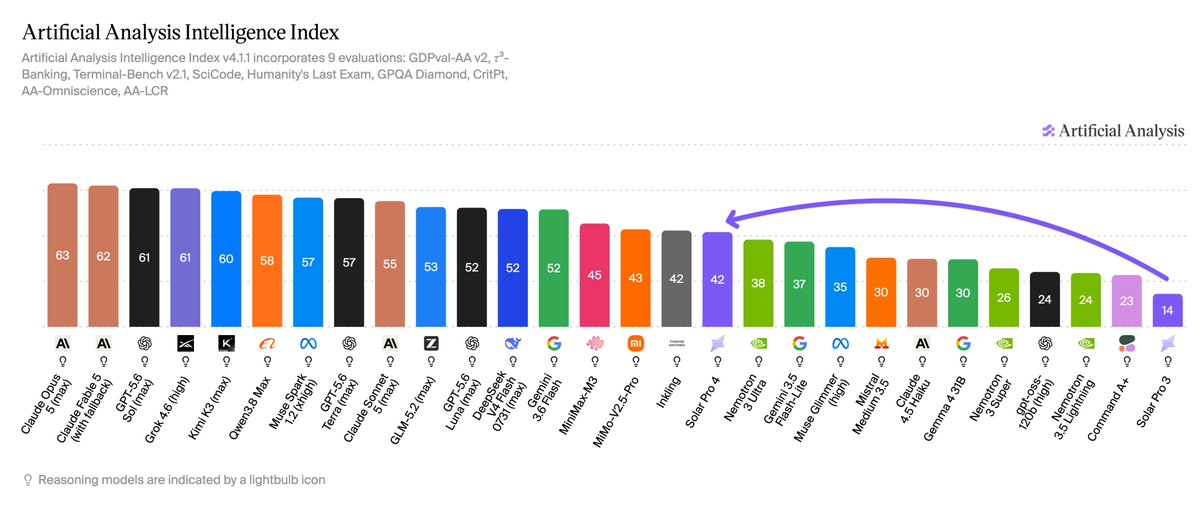
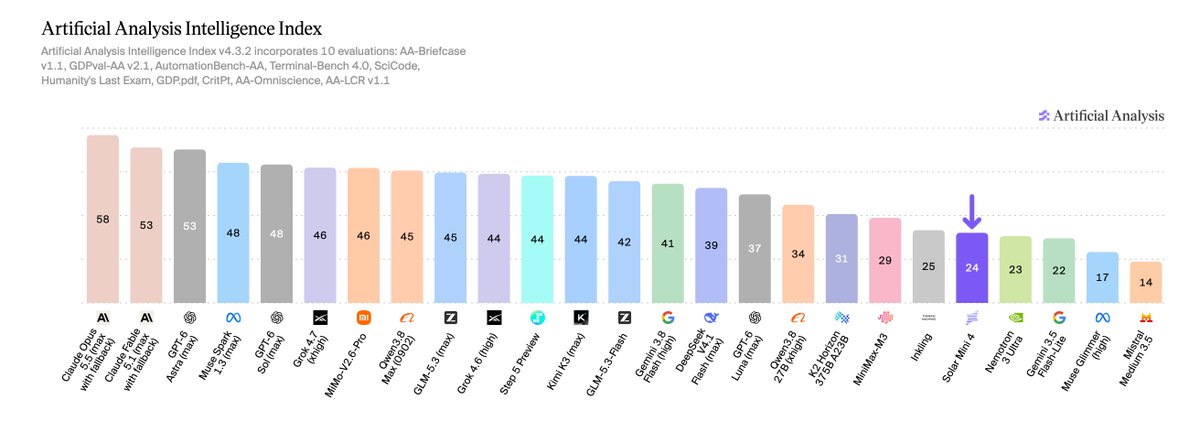
Korean AI lab Upstage has released Solar Pro 4, scoring 42 on the Artificial Analysis Intelligence Index, a significant increase from Solar Pro 3’s 14 Solar Pro 4 is @upstageai's new proprietary flagship reasoning model, replacing Solar Pro 3 from April 2026. At 42 on the Intelligence Index it sits alongside Inkling (xhigh, 42) and just behind MiMo-V2.5-Pro (43), and shows a 27-point increase over Solar Pro 3. Pricing increases to $0.30/$1.20/$0.06 per 1M input/output/cache hit tokens from Solar Pro 3's $0.15/$0.60/$0.02 via Upstage’s first-party API. Key results: ➤ Solar Pro 4’s largest improvements on Solar Pro 3 are on agentic and long context work. Terminal-Bench v2.1 improves from 12% to 57%, AA-LCR from 31% to 71%, and τ³-Banking from 9% to 23%. GDPval-AA v2 shows strong progress on real-world agentic tasks, where Solar Pro 3 scored an Elo of 498, well below the human baseline of 1000, Solar Pro 4 scores 1276. ➤ AA-Omniscience improvement from -53 to -1 was driven by abstaining on more questions. Solar Pro 4 attempts only 41% of questions against 92% for Solar Pro 3, and its hallucination rate is 24%, higher than Command A+ (14%) and MiniMax-M3 (18%), and a vast improvement from Solar Pro 3’s 88%. AA-Omniscience Accuracy remains unchanged at 19%. ➤ Solar Pro 4 is more token efficient than Solar Pro 3, though still verbose for its intelligence level. It uses 43k output tokens per Intelligence Index task, around 17% fewer than Solar Pro 3's 52k. ➤ The intelligence gain comes with a hit to latency. Solar Pro 4 takes 9.5 minutes to complete an average Intelligence Index task, against 6.9 minutes for Solar Pro 3, despite using fewer output tokens per task. ➤ Pricing is $0.30/$1.20 per 1M input/output tokens. This is in line with @MiniMax_AI's first-party pricing for MiniMax-M3, which scores 3 points higher at 45, and is more expensive than @deepseek_ai's DeepSeek V4 Flash 0731 (Reasoning, Max Effort) at $0.14/$0.28 and 52 on the Intelligence Index. Cache hits are priced at $0.06 per 1M, an 80% discount on input token price. Additional model details: ➤ Context window: 512K tokens ➤ Max output tokens: 128K ➤ Modalities: Text input and output only ➤ Pricing: $0.30 / $1.20 / $0.06 per 1M input/output/cache hit tokens ➤ Inference providers at time of launch: Upstage first-party API, OpenRouter, TimelyRouter

Solar Pro 4's AA-Omniscience score improves from -53 to -1, however the improvement comes from abstention rather than knowledge. It attempted only 41% of questions compared to 92% for Solar Pro 3, and while its hallucination rate improves from 88% to 24%, its AA-Omniscience Accuracy is almost unchanged at 19%.

Context
On Artificial Analysis's knowledge test, Solar Pro 4 answers about as many questions correctly as Solar Pro 3. What changed is how often it guesses. Artificial Analysis reports that Upstage's new flagship raised its AA-Omniscience score from -53 to -1 while attempting 41% of questions instead of 92%. Accuracy stayed at about 19%, and the rate fell from 88% to 24%.
The scoring explains the jump. Under Artificial Analysis's methodology, the net score adds points for correct answers, subtracts points for hallucinated ones and treats abstentions as neutral, so replacing wrong guesses with abstentions lifts the score without any new knowledge. Fewer confident wrong answers is a real improvement for anyone relying on the model's factual claims, but it is not a gain in what the model can answer. Artificial Analysis described a similar pattern in Ling 3.0 Tiny, which attempted 37% of questions rather than guessing.
Solar Pro 4's overall Intelligence Index score rose from 14 to 42, and Artificial Analysis says its largest improvements are in agentic and long- work: -Bench v2.1 went from 12% to 57% and the long-context test AA-LCR from 31% to 71%. Those gains cost more. Upstage's first-party API doubles prices to $0.30 per million input tokens and $1.20 per million output tokens, and an average index task takes 9.5 minutes against 6.9 for Solar Pro 3.
- reasoning model — A model trained to think — generating extended internal reasoning before answering — trading time and tokens for accuracy on hard problems.
- Hallucination — Generated content that is false or unsupported, even when it sounds plausible.
- Context and context window — Context is the information available for a generation; the context window is the capacity available to hold it.
- Terminal — A program that shows text and accepts typed text.