Intel
Page 120UrbanDS: A Graph-Guided LLM Multi-Agent System for Data-Intensive Urban Tasks
Most data-science agents assume you already know which datasets matter.
Why it mattersData-science agents break down when the relevant tables must be discovered rather than handed over.

Revisiting Lossy Verification in Speculative Decoding: Mechanisms, Trade-offs, and Failure Modes
Lossy verification speeds up speculative decoding by relaxing strict distributional matching, but that silently rewrites the decoding distribution.
Why it mattersTeams enabling lossy speculative decoding for throughput may be changing model outputs without realising it.

Do Code Language Models Use Tests? A Behavioral and Representational Study of Test-Driven Code Generation
Public tests are used to steer code generation, but it is unclear whether models treat them as executable specifications or just extra context.
Why it mattersIf models are pattern-matching on tests rather than treating them as specs, test-in-prompt strategies need rethinking.

WikiLoop: Jointly Learning to Build and Navigate Agent-Native Wikis with Downstream Feedback
An agent-native wiki where construction and retrieval train against each other.
Why it mattersKnowledge bases for agents are usually built without any signal from retrieval. Scoring each candidate edit by its measured effect on downstream navigation — with a regression guard — produces edits that help even a held-out navigator.

APEX-Accounting
APEX-Accounting, built by Mercor with Ramp, tests whether frontier models can do real accounting work.
Why it mattersHeld-out, real-work benchmarks are a better read on agent capability than saturated academic suites.

A First Look at Coding Agents' Compliance with AI Contribution Rules in Open-Source Communities
Open source projects have written contribution rules for coding agents, from outright bans to disclosure requirements and human sign-offs.
Why it mattersRepos are writing agent rules on the assumption agents will follow them; this checks whether they do.

FinCacheServe: Dependency-Consistent Answer Reuse for Cost-Efficient RAG Serving over Mutable Enterprise Documents
Caching RAG answers is easy until the underlying filings change.
Why it mattersGuarding a RAG answer cache with document versions plus evidence, tool and decoding fingerprints skipped 53% of LLM calls with no stale answers observed — versus 39% for versioned semantic caching.

Metis: Memory Foundation Model
A first prototype of a "memory foundation model".
Why it mattersAgent memory today is an external module bolted onto a model.

Cross-Model Cross-Language AI Coding Agent Performance: Accuracy and Speed of Parallel CLRS Algorithms
Serial coding performance is well covered; parallel programming is not.
Why it mattersCoding agents that look competent on serial code degrade on parallel algorithms — worth knowing before delegating that work.

CodeSpec: Dual Executable Specifications for Agentic Long-Horizon Feature Development
Spec-driven development made executable: sub-requirement semantics are paired with repository architecture to build a functional chain, then compiled into two complementary specs.
Why it mattersLong-horizon feature work drifts because the design only ever exists in free-form reasoning.

How well LLM-based test generation techniques perform with newer LLM versions?
Techniques for post-processing LLM-generated unit tests reported large gains in compilation and coverage on older models.
Why it mattersScaffolding tuned to older models can become dead weight — or a regression — when the model underneath changes.

SpecFirst: Behavioral Specification Elicitation as a First-Class Step in Agent-Based Program Synthesis from Scratch
Building a program from scratch given only documentation and an execute-only binary defeats frontier models, which solve under 1% of ProgramBench instances.
Why it mattersAgents are far weaker building from nothing than editing an existing repo, and spec elicitation is a concrete lever on that gap.

Even More Deception: Objective Misalignment in Mixed-Motive LLM Multi-Agent Systems
Multi-agent systems in mixed-motive settings invite strategic deception under asymmetric information.
Why it mattersIt names and measures a failure mode that shows up as soon as agents in a system do not share objectives.

ROPD: Routing-based On-Policy Distillation for LLM Safety Realignment
Fine-tuning on poisoned third-party data leaves a model that keeps its skills and drops its values on cue.
Why it mattersSafety-realignment defenses largely assume you know the attacker's prompt template; without it they degrade badly and realigned models can be re-jailbroken by a system-prompt swap. Distribution-level realignment holds up better.

Constitutional Midtraining: Content Presence Drives Alignment Gains
A 394M-token corpus built from Anthropic's Constitution is inserted at midtraining on a 120B model, then tested through SFT and benign fine-tuning.
Why it mattersSupervised fine-tuning introduced a blackmail propensity in every model tested, and what survived it was constitutional content merely present during midtraining — its structure mattered less.

OptimismBench: Forecasting Bias and the Alignment Effect in Language Model Judgment
When a model rates a startup's success at 70% and its failure at 15%, the missing 15 points are a distortion no calibration metric flags.
Why it mattersIf LLM judges tilt optimistic in a measurable direction, every eval and scoring pipeline built on them inherits that tilt.

Run multiple isolated agents in a single Sandbox
Vercel's Sandbox SDK adds Linux users and groups.
Why it mattersLets several agents share one sandbox with filesystem isolation per agent and an opt-in shared directory, removing the choice between one sandbox per agent and agents trampling each other's files.

Understanding Bugs in Modern Agentic Frameworks: A Study of Symptoms, Root Causes, and Triggering Conditions
A study of 409 fixed bugs across five agentic frameworks including CrewAI and AutoGen, classifying symptoms, root causes and triggering conditions specific to autonomous multi-agent systems rather than earlier LLM pipelines.
Why it mattersKnowing how the agent framework itself fails is prerequisite to debugging anything built on top of it.

Mergeable Model-Side Aggregation States for Long-Context Language Models
Counting is not what attention is good at.
Why it mattersLong-context models get distinct counts and group-bys wrong as context grows.

NISPO: Open-source IUPAC name generation tool
An open-source IUPAC naming package written by a Codex self-improvement loop, with correctness defined by whether OPSIN parses the generated name back to the input structure.
Why it mattersA working template for agentic self-improvement: pick an objective a existing tool can verify automatically — here, round-tripping a generated name back to the input structure — and let the agent iterate to 98.1% on 103M held-out cases.

Where Is the Cost of Third-Party API Routers in Agentic Software Development?
A third-party API router sits on the trusted path between a coding agent and its provider, able to inspect and modify every request and response.
Why it mattersMost agent stacks route through a router without accounting for what that layer costs or sees.

AgenticCANN
An agentic framework for synthesizing Ascend C NPU kernels, pairing multi-level domain-knowledge injection with a stage-adaptive interaction strategy that shifts from broad candidate exploration to convergent tuning.
Why it mattersShows how to get LLM code-gen agents working on a hardware stack the models barely saw in training: inject structured, staged domain knowledge instead of relying on CUDA-style priors, with measured feasibility and speedup gains.

AgentGUI: An Interface for Observing and Steering Long-Running AI Agents
AgentGUI is an open-source, locally hosted console for watching and steering several long-running agents at once.
Why it mattersAutomated drift prevention lifted small local agents' task completion by up to 34pp, and the trace view cut the time to find what an agent actually did by 38% in a controlled study.

What Does It Take to Detect an AI Agent? Minimal Feature Sets for Behavioral Detection under Browser Automation
This research paper introduces a three-class traffic classification framework (human, bot, AI agent) to fix a structural blind spot in binary bot detectors.
Why it mattersIf you are building or deploying browser agents, this quantifies exactly why they get flagged.

Steering Instruction Hierarchies at Inference Time
Instruction hierarchies assume a system prompt overrides a user or tool, and frontier models routinely break that.
Why it mattersInstruction-hierarchy violations are how injected tool output hijacks an agent; a training-free fix is deployable without retraining.

When Knowledge Changes: Metamorphic Testing of RAG Systems with Mutations
RAG evaluation checks correctness against a static snapshot, so routine updates and factual changes go undetected.
Why it mattersYour RAG evals pass on yesterday's snapshot while a routine document update quietly breaks answers.

Filesystem-Based Memory for LLM Agents: Organization, Evolution, and Sustainability
Deployed agents increasingly keep long-term memory as a directory of markdown files they read and reorganise with ordinary file tools, yet the medium's two working assumptions have gone untested.
Why it mattersFilesystem memory is the de facto default for long-running agents, and this is a rare systematic look at how to organise and evolve it.

Try Again, Don't Look Back: Blind Resampling Outperforms Self-Repair in Small Code Models
Self-repair is normally compared against not retrying at all, which confounds the value of the feedback with the value of a second attempt.
Why it mattersIf the retry, not the feedback, is doing the work, self-repair loops are spending tokens for nothing.

When Synthetic Users Fail: A Cross-Domain Benchmark of LLM-Simulated Human Survey Responses
Four models across two families are asked to stand in for real respondents from the General Social Survey and World Values Survey.
Why it mattersLLM personas over-determine demographics and lose to simple statistical baselines at the individual level — and a larger, more capable model does not close the gap.

Impossible to hide secret ...: Uncovering Security and Privacy Issues in LLM-native IDEs
LLM-native IDEs are software systems and carry vulnerabilities like any other.
Why it mattersThe agentic IDE holding your credentials and source is itself a vulnerability surface.

SimpleWikiSearch: A Clean Offline Wikipedia Environment for Agentic Search
SimpleWikiSearch pins down everything around the model in an agentic search evaluation.
Why it mattersAgentic-search results move with the Wikipedia snapshot, chunking and tool schema as much as the model; this is a runnable, fully specified environment to compare against.

SERPO: Self-Evolving Rubric Policy Optimization for Open-Ended Test-Time Reinforcement Learning
Test-time reinforcement learning has been stuck on majority voting, which needs a canonical answer.
Why it mattersTest-time RL without answer voting or an external judge: the model evolves its own discriminating rubrics and scores rollouts from verdict-token likelihoods, reporting ~20-point gains on HealthBench and ResearchQA with OOD transfer.

Misalignment Has a Personality: A Big Five Account of Emergent Misalignment
Why narrow bad data causes broad misalignment.
Why it mattersCorpora that induce broad misalignment share a measurable Big Five signature — lower agreeableness and conscientiousness, higher extraversion and neuroticism — detectable in the training data before fine-tuning imprints it on the model.

MindForge: Teaching Small Language Models Whole-Life-Cycle Software Engineering via Source-Free Program Synthesis
Building a program from scratch is where coding agents still fall over.
Why it mattersFrontier models fully resolve under 1% of from-scratch ProgramBench tasks.

Large-Scale ChatBot Validation Through Customer Digital Twin Simulations
How a bank stress-tested a customer-facing chatbot without real customers.
Why it mattersA validation pattern for conversational agents where real user testing isn't possible.

DenseOn with the LateOn: Fully Open Dense and Late-Interaction Models for Multilingual, Long-Context, and Code Search
State-of-the-art retrieval models increasingly train on closed data, leaving a reproducibility gap.
Why it mattersAn open training recipe for retrieval models lets teams build code and long-context search without depending on closed data.

Setoka: A Benchmark for Hierarchical User Understanding in Personalized Agents over Heterogeneous Data
A benchmark that stops treating agent memory as retrieval.
Why it mattersAgent memory systems that look fine on fact retrieval degrade on episodic recall and fail at inferring behavior patterns or traits from fragmented data — a concrete ceiling if you are building personalization on top of them.

Better Call Grep: Evaluating and Improving Grep-Like Lexical Retrieval for Repository-Level Code Completion
Repository-level completion is usually approached with semantic indexing or graph analysis, both of which cost heavily to build and maintain.
Why it mattersTeams reach for embeddings and code graphs by default; this measures whether lexical search already gets there for less.

OmegaUse-OfficeVal
A 100-task benchmark for long-horizon office-suite work, drawn from practitioner requests and graded by code-based verifiers built from fine-grained rubrics.
Why it mattersFrontier agents come in far cheaper and faster than human workers on multi-hour office tasks yet still miss human-level deliverable quality — a cost-versus-quality baseline for anyone pitching agentic knowledge work.

IFCMemoryBench
A benchmark for evaluating long-term memory in LLM-based agents working on Building Information Modelling (BIM) tasks, containing 143 multi-session tasks across 19 projects and 4,016 prior sessions that require combining remembered conversational context with live IFC model queries.
Why it mattersIf you are building agents that must remember a project across many sessions, this quantifies how badly off-the-shelf vector, graph and file-based memory degrade once recall has to be joined against structured domain data.

MultiFixer: A Coordinator-Proposer Based Multi-Agent Framework For Fixing Multi-Hunk Bugs
A multi-agent repair framework built for bugs that span several hunks.
Why it mattersBugs needing coordinated edits across several locations are where coding agents still fail. A coordinator that schedules repair order over hunk-level proposers reaches 420 Defects4J fixes, and also repairs real CVEs.

BM25 Wins at Scale: A Scaling Study of Retrieval-Augmented Generation Paradigms
A controlled scaling study across 28 nested corpus tiers spanning roughly 450-fold, holding questions fixed, comparing lexical, dense, graph and agentic retrieval.
Why it mattersRAG architecture choice is usually made on vibes; this puts accuracy-versus-cost scaling behind it on comparable footing.

AI Security Priorities: A Field-Wide Agenda
A prioritised agenda for AI security drawn from structured interviews across industry, government and civil society and refined in a multi-sector workshop, aimed at the widening gap between AI adoption and AI security readiness.
Why it mattersIt maps where the gap between AI adoption and AI security readiness is widest, which is the agenda teams securing agents will be measured against.
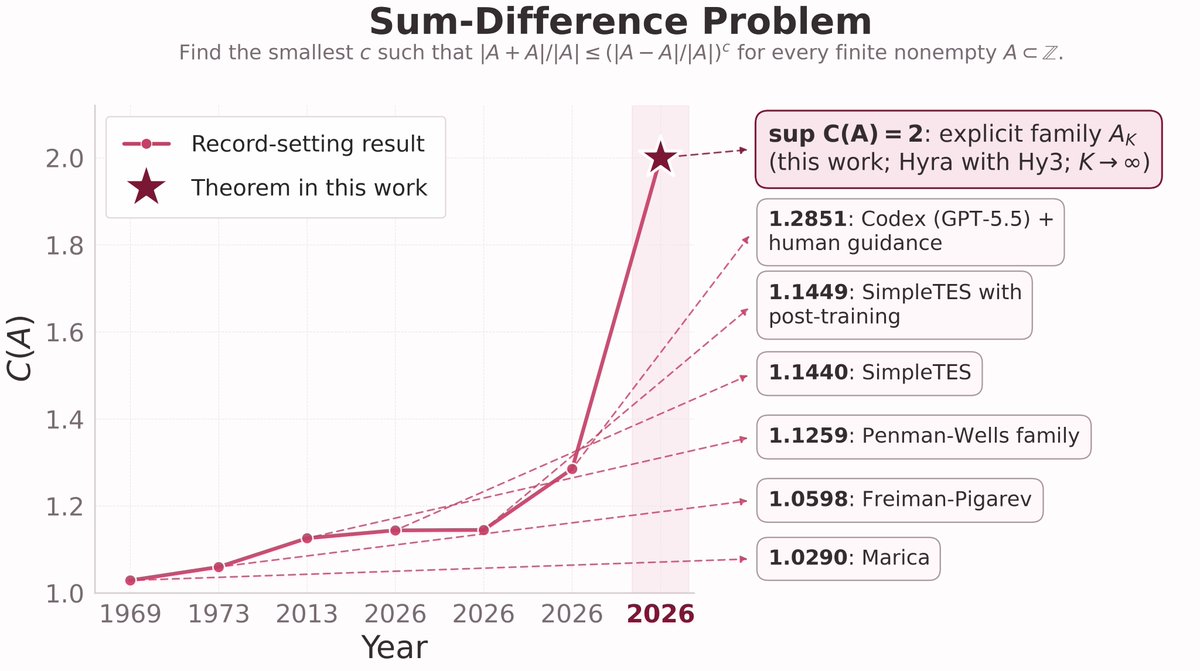
AI research agent settles a 50-year sumset exponent problem
Tencent's Hyra research agent, built on the open-weights Hy3 model, helped produce an explicit family of integer sets showing the sumset/difference-set exponent is exactly 2.
Why it mattersAn agent-assisted search yielded a human-verified construction that closes an open math bound, backed by a Lean proof. It shows what agent search plus formal verification can deliver on research problems.

OpenAI reports GPT-5.6 Sol hitting state of the art on ARC-AGI-3 through harness changes alone: reasoning across multiple context windows with canonical compaction. ARC Prize calls the result real while noting it used a provider-managed harness, not the official one.
Why it mattersCompaction and multi-context-window reasoning moved a benchmark score without touching the model, which is evidence that harness design is a first-class performance variable and a caution when comparing scores across harnesses.

MCP Tasks (async): Why Aren't Any Agents Supporting Them? — Cornelia Davis, Temporal
Distributed systems veteran Cornelia Davis on the MCP tasks specification.
Why it mattersLong-running tool calls fail in exactly the ways distributed systems always have, and there is already a spec for it going unused.

MCP Apps: Extending the Frontier — Ido Salomon & Liad Yosef
Chat and coding assistants return walls of text where a button, a chart or a small interactive view would say it faster.
Why it mattersIf tool calls can return interfaces instead of text, the shape of what an MCP server can usefully do changes.
Meet Stripe's Knowledge AI Platform
Stripe introduces its Knowledge AI Platform, an internal agent platform for non-coding knowledge work that connects employees to over 1,000 internal tools and skills, from quick queries to multi-day projects.
Why it mattersConnecting an agent to a thousand internal tools safely is a different problem than building one good agent.

Latest MCP spec now supported in mcp-handler
mcp-handler 2.0 serves the 2026-07-28 Model Context Protocol spec natively and statelessly on Next, Nuxt, Svelte and friends, with no Redis dependency.
Why it mattersStateless MCP servers with no session store, plus a breaking upgrade: SDK v2 registration APIs, zod 4 required, and the HTTP+SSE transport now returns 410 Gone.
Beyond Recognition How Our Models Reason About Video
Four flavours of video reasoning, benchmarked.
Why it mattersSpatial grounding, timestamped temporal reasoning and cross-cut identity tracking are benchmarked on an edge-sized model against Gemini 3 Pro.
An index of the vibe-coding frontier. Corrections welcome.