GLM-5.3-Flash lands on the intelligence-per-dollar Pareto frontier
- Source
- x.com
- Date

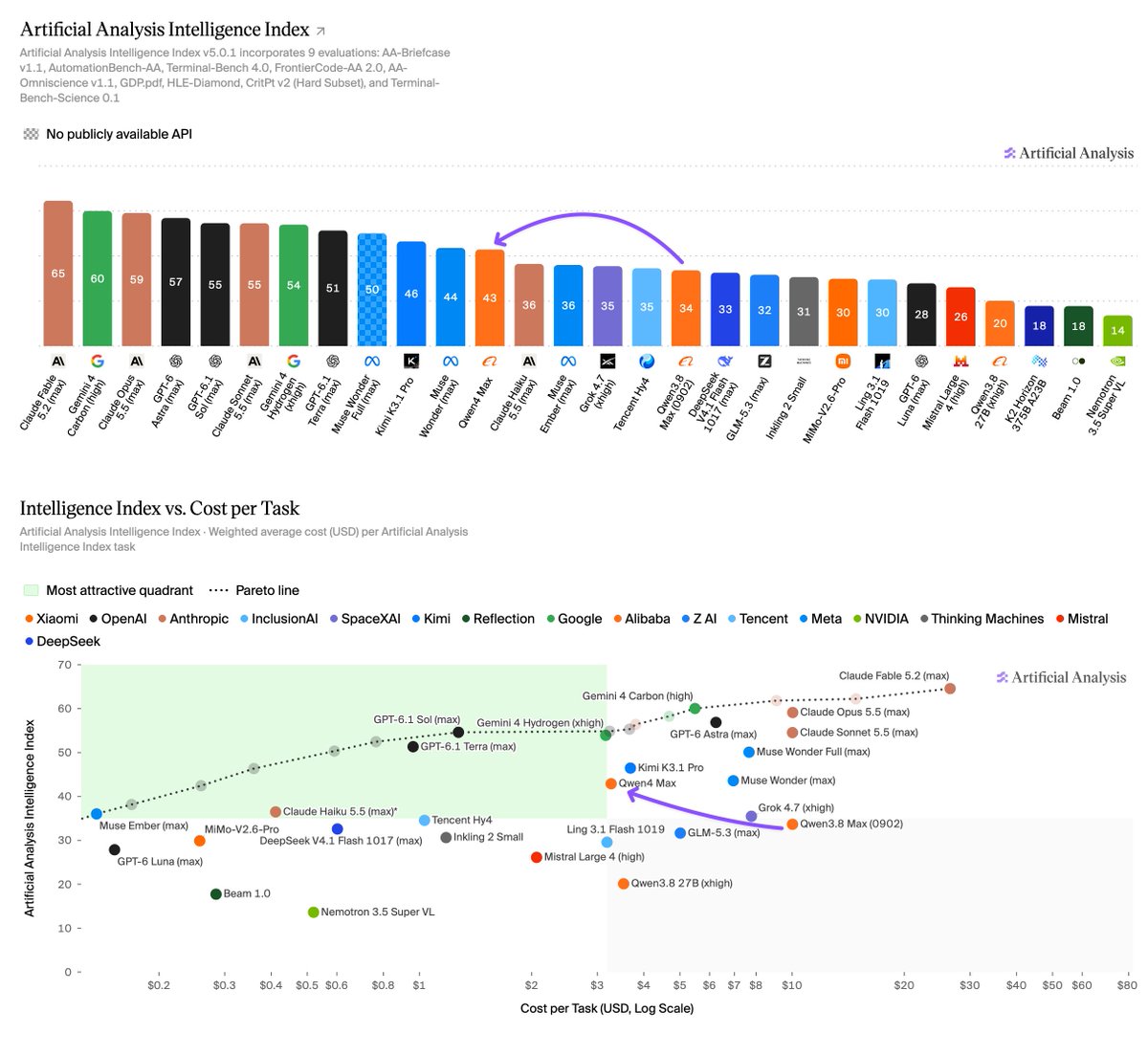
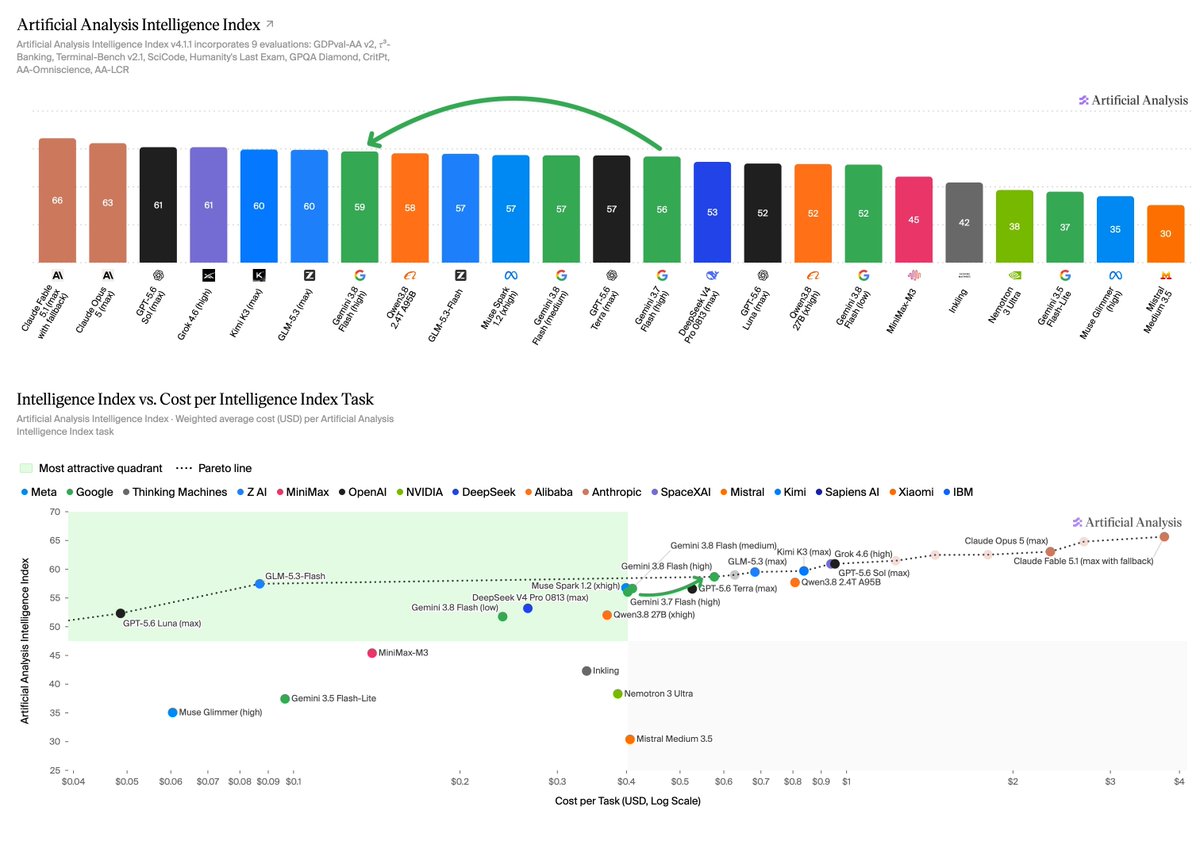
GLM-5.3-Flash scores 57 on the Artificial Analysis Intelligence Index. At $0.09 Cost per Task, it sits comfortably on the Intelligence vs. Cost per Task Pareto frontier @Zai_org has released GLM-5.3-Flash, a smaller and cheaper sibling to GLM-5.3 at 320B total parameters and just 18B active parameters. GLM-5.3-Flash supports low/high/max reasoning efforts, and scores 57 evaluation on the Artificial Analysis Intelligence Index with max reasoning effort. This places the model only 3 points behind GLM-5.3 at 60 and in line with GPT-5.6 Terra and Muse Spark 1.2. On Z AI's first-party API, GLM-5.3-Flash is priced at $0.15 / 1M input tokens and $0.50 / 1M output tokens, just over 10% of the price of GLM-5.3. Cached input tokens are priced at $0.026 / 1M tokens, an 80% discount. Its Cost per Task on the Intelligence Index is $0.09, compared to $0.68 for GLM-5.3 (max), and it sits on the Pareto frontier for Intelligence vs. Cost per Task. Key results: ➤ GLM-5.3-Flash is 3 points behind GLM-5.3 (max) on the Artificial Analysis Intelligence Index, at ~7.5x lower Cost per Task. At $0.09 per Intelligence Index task against $0.68 for GLM-5.3, it sits on the Pareto frontier for Intelligence…

Context
Artificial Analysis, which runs a standard battery of nine evaluations and combines them into one Intelligence Index, scores Z.ai's GLM-5.3-Flash at 57, three points behind the full GLM-5.3 at 60. Running the whole battery cost $0.09 per task with Flash against $0.68 with GLM-5.3, about 7.5 times less. Cost per task is the a model actually generates while working, multiplied by what the API charges for them, so it captures both price and wordiness.
Flash is not cheap because it is concise. It generated 149 million output tokens over the battery, only about 11% fewer than GLM-5.3's 168 million, and 134 million of them were reasoning tokens. It also used more than Kimi K3 and Qwen3.8, which score the same. The gap comes from price: $0.15 per million input tokens and $0.50 per million output tokens on Z.ai's API, just over a tenth of GLM-5.3's price. Only 18 billion of Flash's 320 billion parameters are active for each token, which keeps the computation behind every token small.
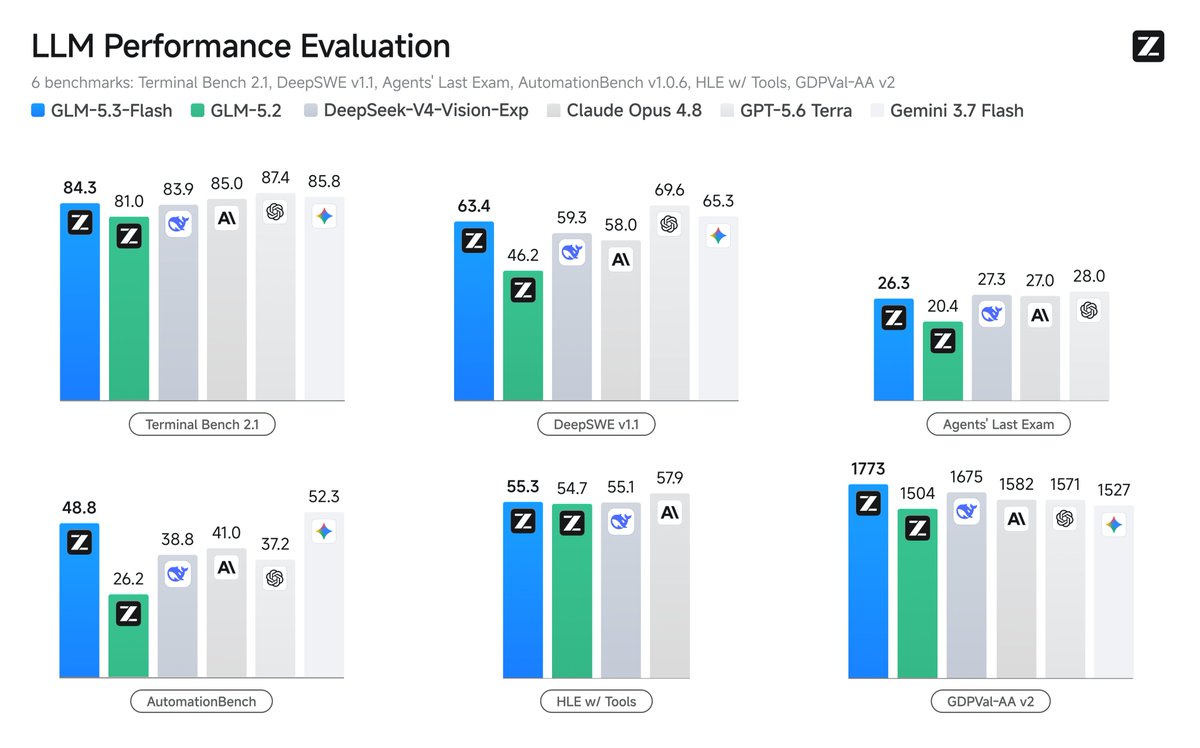
That combination places it on the Pareto frontier, the line of models where no rival scores higher for the same or lower cost. On Artificial Analysis's chart, only GPT-5.6 Luna (max) sits on that line at a lower cost, and it scores lower. Flash ties GPT-5.6 Terra and Muse Spark 1.2 at 57 while costing about 5.7 and 4.4 times less per task, and matches GLM-5.3 on Terminal-Bench v2.1 and on the GDPval-AA v2 agentic work test. Where it falls short is knowledge: its accuracy on the AA-Omniscience factual test is 28%, against 34% for GLM-5.3 and 47% for GPT-5.6 Terra. For agentic and coding work at volume it is a strong default on these numbers; for tasks that lean on recall of facts, the bigger models remain ahead. The prices are Z.ai's first-party launch prices, and other providers may charge differently. For the comparison point, see the GLM-5.3 evaluation.
- token — The chunk of text a model reads and writes in — roughly three-quarters of a word — and the unit AI usage is billed in.
- eval — A repeatable test for AI quality — a set of tasks plus scoring — used the way software teams use test suites, because model output is too variable to judge by eyeballing.
- context window — The maximum amount of text a model can consider at once — its working memory for the current conversation or task.
Checking sign-in…
Loading comments…