Intel
Page 123
Skills as the Interface to Agentic Products
A talk by FactSet's Yogendra Miraje on treating 'skills' — short skill.md files with routing signals like name, description, and trigger words.
Why it mattersIf you're building an internal agent platform, this frames skills as the unit of capability and gives you the operational scaffolding most skill tutorials skip.

Mercury 2 gets 100M free tokens, 10x limits and a Baseten listing
Inception raised the free allotment for new Mercury API keys from 10M to 100M tokens, lifted free-tier rate limits tenfold, shipped unquantified latency and tool-calling improvements to Mercury 2.
Why it mattersIf you want to benchmark a fast diffusion LLM on voice, search or sub-agent workloads, the free allotment is now 100M tokens with 10x higher rate limits, and Baseten users can add Mercury 2 without a new provider.

Model Routing Layers and the Prompt Cache Tax
An analysis of AI model routers (like those shipped by Cursor and Ramp) finds that prompt caches are model-specific.
Why it mattersAnyone running multi-model routing in an agent or IDE loop is likely paying a hidden cache-invalidation tax on every switch; this piece puts numbers on it and gives a concrete mitigation.
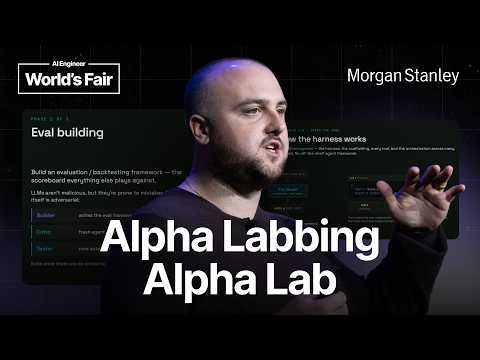
Morgan Stanley's ALPHALAB: Multi-Agent Research Across Optimization Domains — Brendan Rappazzo
AlphaLab is a multi-agent research system built by Morgan Stanley's research group in which a strategist agent proposes experiments and worker agents write code, configure backtests and evals, submit cluster jobs, and run statistical tests while managing their own context.
Why it mattersIt shows what an agentic research loop looks like when it has to survive real institutional scrutiny.

Numbat is an open-source agent detection and response layer that works across desktop, CLI, IDE and gateway harnesses. It offers live monitoring, local detection, blocking of actions before they execute, and forensic reconstruction from session artifacts. Apache 2.0, single Go binary.
Why it mattersSecurity teams get harness-agnostic visibility into what coding and desktop agents are doing, with the ability to block selected actions before execution and reconstruct past sessions from existing artifacts. Apache 2.0, single Go binary.

Hermes Agent Wake Word ("Hey Hermes")
A hands-free voice-activation feature for the Hermes Agent CLI, TUI.
Why it mattersIf you want to talk to an agent without touching the keyboard, this shows a working pattern for local trigger-phrase detection with three interchangeable engines.
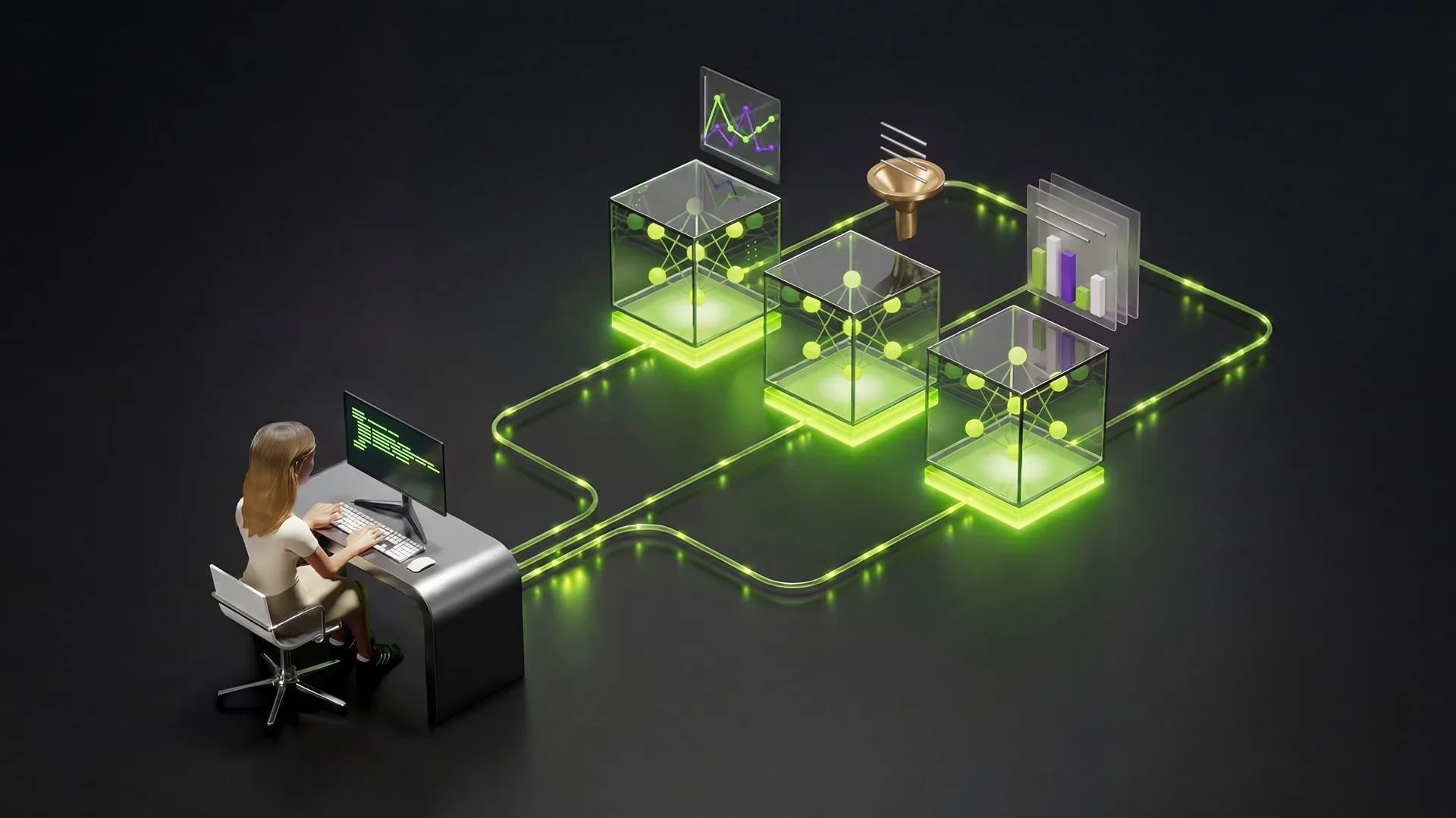
How to Self-Host a Validated AI Coding Assistant with NVIDIA NeMo Guardrails
Self-hosting a coding assistant in a regulated or source-sensitive environment runs into three problems.
Why it mattersHallucinated package names are an attack surface, and self-hosting is the only option for many teams.
Formal methods with Hillel Wayne (The Pragmatic Engineer Podcast)
Hillel Wayne pushes back on the theory that machine-written code will finally mainstream formal verification, using TLA+ war stories like Amazon's 35-step distributed bug to show where specs pay off and where property-based testing is the realistic ceiling.
Why it mattersA grounded answer to whether AI-written code makes formal verification necessary, plus property-based testing as the practical middle ground when a full TLA+ spec is out of reach.

A new benchmark for evaluating patient-facing health AI agents
Most health AI benchmarks test either static medical knowledge or provider-facing tool use.
Why it mattersA clinician-vetted benchmark for agents that act for patients over multiturn conversations, plus published failure modes of current foundation models — a template for evaluating any agent operating under safety constraints.


Autonomous Agent Improvement with LangSmith Engine
A LangChain Academy course that walks through the Agent Development Lifecycle (ADLC).
Why it mattersIf you run agents in production and your improvement loop is ad-hoc, this lays out a repeatable lifecycle — flag failures in real traces, generate and test candidate fixes as experiments, then watch for regressions after deploy.

Discovering Cryptographic Weaknesses
Anthropic researchers used Claude Mythos Preview to halve HAWK's effective key strength and find a new attack on round-reduced AES.
Why it mattersShows a frontier model finding flaws in cryptographic algorithms themselves, not just implementation bugs, which changes assumptions about AI-driven security research.
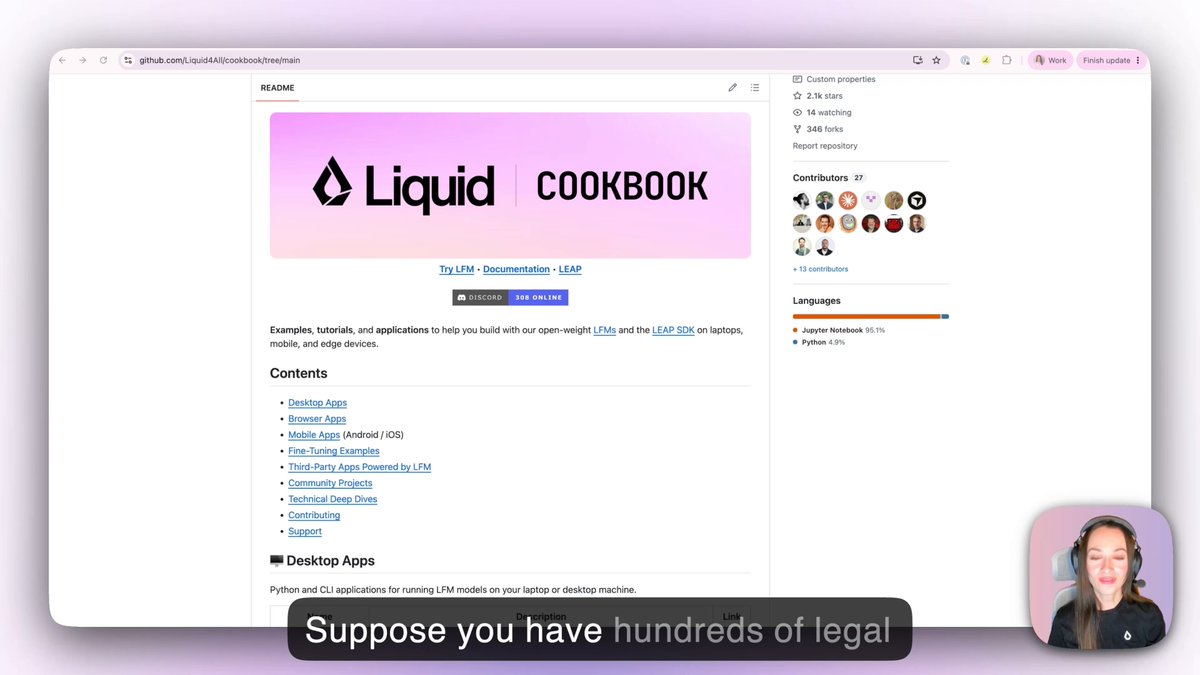
Encoder models score every label in one pass, no decoding loop
Liquid AI shows how to fine-tune its 230M and 350M encoders with a linear classification head so every label is scored in one forward pass.
Why it mattersFor high-volume labeling such as support tickets or legal documents, a fine-tuned encoder returns a probability per label in one forward pass.


Post-quantum authentication to origins is now supported
Cloudflare's Authenticated Origin Pulls and Custom Origin Trust Store now support ML-DSA (FIPS 204) post-quantum signatures.
Why it mattersIf you run mutual TLS between Cloudflare and your origin, you can now configure fully post-quantum authenticated connections using ML-DSA (FIPS 204).
AngelSpec Opens Tencent's Speculative Decoding Training Stack
Tencent open-sourced AngelSpec, a training framework for speculative decoding drafters (MTP, DFly, DFlash, Eagle3 and others) with Hy3-A21B drafter weights.
Why it mattersTeams serving large MoE models can train and swap drafters through one config-driven pipeline. The paper argues MTP suits chat while block-diffusion suits code and math. Reported speedups are Tencent's own measurements on Hy3.

Alipay-PIBench is now open source, shifting the question from whether an agent can write code to whether it can integrate payments without losing money. It covers nine real products and production repositories, scores against 459 rubrics, and includes a programmable mock gateway for adversarial and
Why it mattersMost coding benchmarks stop at whether code runs. Alipay-PIBench scores agents on integrating payments safely across nine production repos with 459 rubrics and a mock gateway that replays attacks and edge cases.
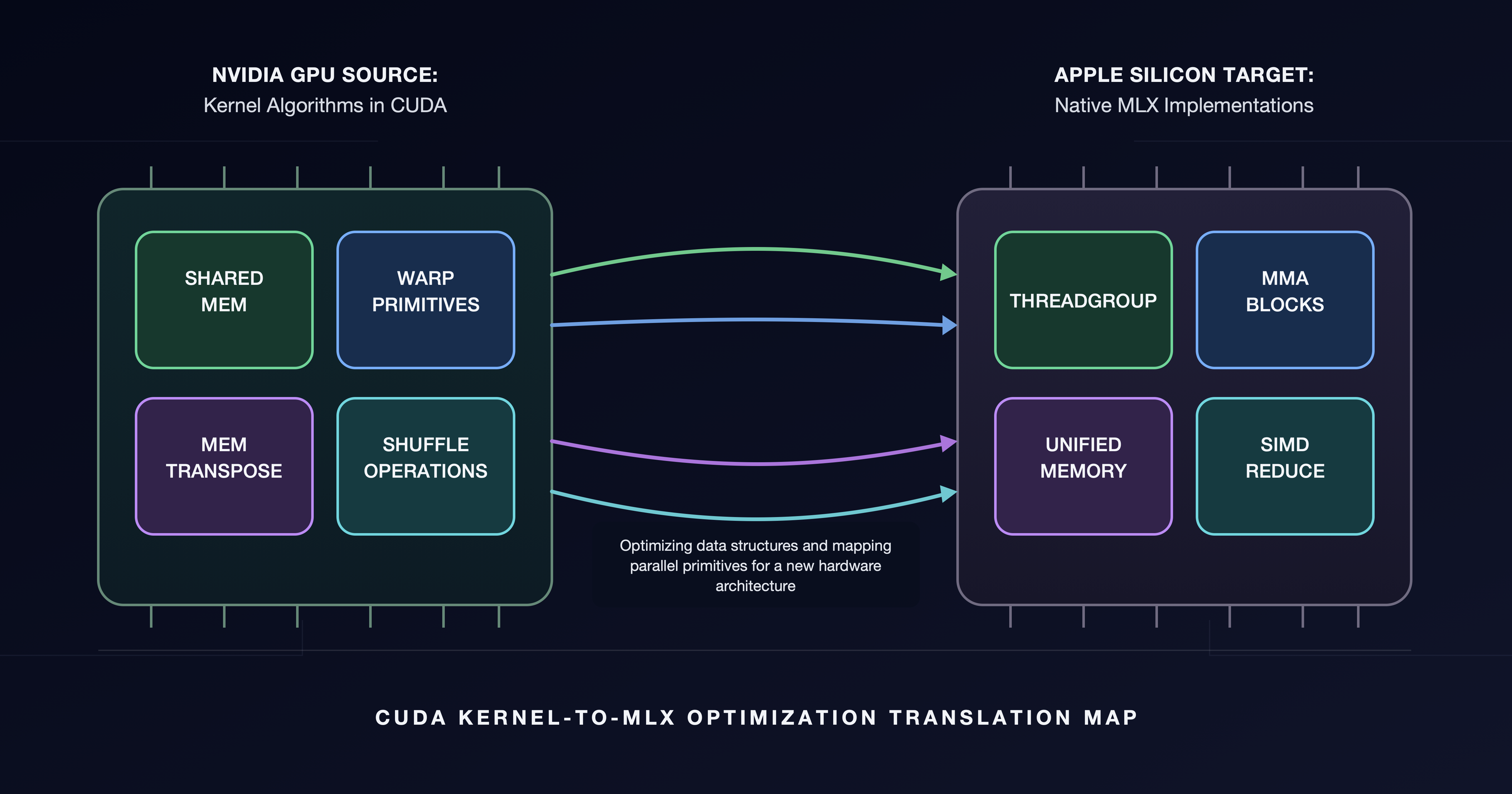
From CUDA to MLX: How K-Search Brings Decades of Kernel Expertise to Apple Silicon
Berkeley researchers extend the K-Search evolutionary kernel-search framework so decades of CUDA optimization knowledge can be automatically translated into architecture-native MLX strategies.
Why it mattersIt shows AI can automatically rediscover architecture-specific kernel optimizations instead of hand-porting CUDA code, relevant for anyone deploying models on non-NVIDIA silicon.

Automating the Developer Loop with Coding Agents
Ramana Siddanth Emani (Auditoria) describes running multiple coding agents in parallel across separate git worktrees, each guided by 'skills' to enforce patterns, to clear tasks pulled from QA reports, Jira tickets, and GitHub PRs.
Why it mattersIt shows a working end-to-end agentic dev loop — task intake from QA/Jira/PR queues, isolated worktrees per agent, skills as pattern guardrails, sub-agents for traces and E2E tests.
Layering AI Agents onto an Event-Sourced Fraud Detection System
An architecture for the gray zone in fraud decisioning.
Why it mattersEvent-sourced systems already emit the state and history an agent needs — this shows how to layer agents onto change feeds for the ambiguous cases rules and ML can't decide, without replacing either.
The Demo vs. The Memo: Why AI-Generated Investment Decks Fail Under Scrutiny
An investment committee veteran on why polished AI-generated decks collapse under questioning, and what a system has to do instead.
Why it mattersDesign requirements for generation products used in consequential decisions: rank source reliability, treat contradictions between figures as the key signal, and keep estimates labeled so they don't harden into facts across drafts.
Adding a custom MCP server to Claude and ChatGPT
A worked path for exposing your own MCP server to the standard Claude and ChatGPT chat interfaces.
Why it mattersConnecting a custom MCP server to the ordinary Claude and ChatGPT chat apps — not just IDE clients — takes several non-obvious steps; this walks the actual path for both.
Discover and install eve integrations from the CLI
Vercel's eve CLI now lets developers discover and install integrations for eve AI agents directly from the command line, pulling from an official catalog, third-party registries, or a direct URL.
Why it mattersIf you're building or operating eve agents, these commands turn integration setup into a package-manager workflow — you can search a registry, inspect an entry, and have the files written into your project for review before the agent runs.

Building An Agentic Harness That Outlasts The Model
Shopify's application security team on the agentic harness that finds vulnerabilities, proves them with real tests, and opens tuned pull requests.
Why it mattersA grounded counterweight to model-upgrade optimism in security scanning: stronger models raise candidate volume, and the validation harness that proves findings with real tests is what determines whether any of it is usable.

Together AI Partners with Moonshot AI to Host Kimi Models
Moonshot's open-weight models, starting with the 2.8T-parameter Kimi K3 MoE, get a day-one US-hosted serving path on Together with zero data retention and fine-tuning on your own data.
Why it mattersKimi K3, a 2.8T-parameter MoE, gets US-hosted inference with zero data retention and fine-tuning support, with future Moonshot open-weight releases served on day one.

Sign in with ChatGPT is now available on Vercel
Vercel now accepts ChatGPT accounts as a sign-in method for Vercel and v0, and for installing its plugin inside ChatGPT.
Why it mattersChatGPT is starting to function as an identity provider for developer platforms — if you ship an app or plugin inside it, account linking is now a supported path.
Grok Voice Think Fast 2.0 now available on AI Gateway
A speech-to-speech voice model from xAI that reasons in parallel with speaking.
Why it mattersIf you're building voice agents, the parallel-reasoning-while-speaking design means you can get tool calls fired mid-sentence without the usual think-then-speak latency penalty.

Mercury 2 10x Free Tokens
Inception raises the free allowance tenfold and lifts free-tier rate limits by the same factor, adds Baseten as a serving option.
Why it mattersEvery new API key now carries 100M free tokens and 10x higher free-tier rate limits, enough headroom to benchmark against your current stack on production-like traffic instead of a toy sample.
AI tools for Forward Deployed Engineering — Vasuman Moza, Varick Agents
Varick drops agents onto the ERP an enterprise already paid millions for, automating reconciliations end to end.
Why it mattersFrontier models are weak at resolving that two records name the same entity inside a messy enterprise; this describes post-training for that context extraction and layering agents on existing systems instead of migrating them.
Deployed Engineering at Cognition: Measuring Devin's Real-World Impact
Cognition's deployed engineering team measures Devin by before-and-after deltas on the specific work it targeted — an 82% reduction in one case.
Why it mattersA measurement approach for coding-agent ROI that avoids token-usage vanity metrics: baseline the targeted work before activation and report the delta after, with value scaling non-linearly as adoption spreads.
Perplexity added Kimi K3 to Perplexity and Perplexity Computer for Pro and Max subscribers. The model is hosted exclusively on US-based servers, which addresses data residency concerns. The post gives no benchmarks or pricing.
Why it mattersKimi K3 is now selectable in Perplexity and Perplexity Computer for Pro and Max users, served only from US servers. Teams with data residency concerns about Chinese-origin models get a US-hosted option.

Forward Deployed Engineering at Ramp: Scoping and Agents
Leo Mehr explains how Ramp's Forward Deployed Engineering team decides what to take on.
Why it mattersShows how a production team wired an LLM agent into an existing human intake workflow — harness, rubric-based evals, human feedback loop — which is the least-documented part of shipping internal agents that people actually trust.
The Dirty Secret of Forward Deployed Engineering
A former Palantir FDE traces how the role stretched from on-site firefighting to ontology and solution work, and argues the through line was never code.
Why it mattersArgues that as coding agents make code cheap, the differentiated work is data integration and outcome ownership — and that seat-based versus outcome-based pricing tells you which one a company is actually selling.

MCP Specification 2026-07-28
This release of the Model Context Protocol overhauls the protocol into a stateless request/response core, removing the initialize handshake and session IDs in favor of self-describing requests and header-based routing (Mcp-Method, Mcp-Name).
Why it mattersIf you build or operate MCP servers or clients, this release changes the wire contract.
CryptanalysisBench: Can LLMs do Cryptanalysis?
A research paper introducing a 191-task benchmark spanning six families of cryptographic primitives drawn from four NIST standardization competitions, used to test whether frontier LLMs can find real attacks against ciphers and hash functions.
Why it mattersIf you build or evaluate AI security tooling, this gives a concrete, tiered benchmark showing where frontier models actually sit on cryptographic attack discovery — including verified novel attacks.

New Attacks on HAWK and AES Cryptographic Schemes
Anthropic reports that Claude Mythos Preview, working in a multi-agent harness, cut HAWK's effective key strength roughly in half and sped up a 7-round AES attack 200 to 800x.
Why it mattersA model working in an agent harness found new cryptanalytic results at about $100,000 in API cost per result. Verification, not discovery, is now the bottleneck, which matters for anyone running agents on research or security audits.
Discovering Cryptographic Weaknesses with Claude
Anthropic reports Claude Mythos Preview found a faster key-recovery attack on the HAWK post-quantum signature candidate and a 200-800x faster attack on 7-round AES.
Why it mattersA Claude-based agent harness found mathematical flaws in cryptographic algorithms, not just implementation bugs, at about $100k per result. Security engineers should expect AI-driven cryptanalysis and verification bottlenecks.

Ai2 details how OlmoEarth Run splits continental inference jobs into independent windows across CPU prep, GPU inference and CPU postprocess stages, with idempotent tasks and an imagery index. A North America wildfire run cut 4,737 serial hours to 30.5.
Why it mattersShows how to run model inference across thousands of machines: independent windows, idempotent retryable tasks, and a pre-built data index so prep stops dominating. Ai2 reports a 155x wall-clock speedup on a continental wildfire run.
Forward Deployed Engineering at Decagon
Decagon's take on deploying a support agent into enterprises.
Why it mattersA working pattern for deploying agents per customer without accumulating bespoke debt: configure the brain and handoff rules separately from integrations, then upstream every integration so the next customer inherits it.
Field Report: AI Coding Agents in Scientific Computing
OpenAI's field report on coding agents inside scientific computing.
Why it mattersA concrete account of coding agents turned loose on legacy scientific codebases, where correctness is unforgiving, and what actually sped up as a result.
Perplexity brings Model Council into Computer. A question runs independently across multiple frontier models at a selectable depth, and a single cited report shows where they agree, disagree, and what each uniquely found.
Why it mattersMulti-model cross-checking is available inside an agent product: one query runs independently across several frontier models and returns a cited report of agreement, disagreement and unique findings.
How We Made Our Text-to-Speech API Free: The Inference Engineering Behind S2.1 Pro
Fish Audio's chief scientist explains how a 4x per-GPU efficiency gain made a free TTS API viable.
Why it mattersIt shows why autoregressive decode wastes GPU time and how kernels, batching and quantization together cut GPU needs from four H200s to one. That is useful for anyone costing out inference.

The OlmoEarth Platform: Geospatial inference at planetary scale
Ai2's OlmoEarth splits large-scale inference into CPU acquisition and preprocessing, GPU model execution.
Why it mattersA staged CPU/GPU/CPU inference pipeline with published throughput and cost-per-unit figures — a transferable template for running foundation models over very large datasets economically.
Moka v1
Moka is a 104K-parameter Go-playing neural network distilled from KataGo, compressed to just 101 KB of weights so it can run entirely inside a web browser.
Why it mattersIt's a hard, verifiable demonstration of how far task-specific distillation can go — a 127x smaller student retaining most of the teacher's playing strength in a 101 KB browser-loadable ONNX file.

Gemini API Managed Agents: 3.6 Flash, hooks, and more
Google is expanding its Managed Agents feature in the Gemini API with new capabilities, including support for a 3.6 Flash model variant and agent hooks, aimed at helping developers build more reliable, production-ready AI agents.
Why it mattersIf you're building agents on the Gemini API, Managed Agents now handles the hosted agent runtime with lifecycle hooks so you can inject validation, logging, or control logic at defined points instead of hand-rolling your own orchestration loop.

How Building Software Is Changing at Anthropic
A deep-dive report on Anthropic's internal engineering practices, based on interviews with four engineers, showing how AI has reshaped work.
Why it mattersIt gives engineers a rare, specific look at how AI-native teams actually sequence work.
Codex from 0 to 10M Users: Building ChatGPT Work — Akshay Nathan, OpenAI
OpenAI's product for extending its Codex coding-agent harness to non-developer knowledge workers.
Why it mattersIt lays out how OpenAI is unifying one agent harness — persistent compute, memory, sub-agents, plugins.

Anthropic details a six-step agent loop for large code migrations drawn from the Bun Zig-to-Rust port and a 165K-line Python-to-TypeScript port. It covers judge-building, rulebooks, adversarial review, build daemons, and costs.
Why it mattersShows how to run million-line language migrations with parallel agents: build a validated test judge first, fix the rulebook rather than the code, and let compilers and diffs referee.

Liquid AI released LFM2.5-Encoder-230M and 350M, bidirectional encoders adapted from causal decoders. The 230M runs about 3.7x faster than ModernBERT-base at 8K tokens on CPU. The 350M ranks 4th of 14 on GLUE and SuperGLUE. Demos cover zero-shot prompt routing.
Why it mattersSmall encoders that stay fast at 8K context on CPU let you run prompt routing, policy checks and classification locally instead of calling a hosted model. Categories can be changed at runtime without training a new classifier.

LFM2.5-Encoders for Fast Long-Context Inference on CPU
Liquid AI's LFM2.5-Encoder-230M and 350M are general-purpose bidirectional encoder models built by converting LFM2 causal decoders into masked-language-model encoders, supporting 8,192-token context for classification, token-level, and retrieval tasks.
Why it mattersIf you need classifiers, PII/intent detectors, rerankers or embeddings running on CPU, these 230M/350M encoders give 8K-token context and match or beat ModernBERT-base while running ~3.7x faster at long context.
Dreaming in Voxels: How AI is Generating Playable Minecraft Worlds
Sakana AI and NYU train transformers on tens of billions of Minecraft cubes, treating cubes as tokens the way text models treat words, to generate structured playable worlds at cube resolution.
Why it mattersDream-Cubed shows discrete world primitives can act as tokens for large transformers, producing controllable and playable 3D environments, with the dataset, code and paper released for others to build on.
Perplexity brings its Personal Computer agent harness to Windows. It routes work to subagents across 15+ models, edits files only inside approved folders, pulls from 400+ connected apps, and keeps persistent memory across tasks. Available to Pro, Max and Enterprise subscribers.
Why it mattersPerplexity's agent harness now runs on Windows 10 and 11 with file edits limited to folders you approve, which gives Windows users a local, permission-scoped agent environment. Availability is limited to Pro, Max and Enterprise plans.
An index of the vibe-coding frontier. Corrections welcome.