Intel
Page 62
Bounded GenAI metrics from Otel traces with O raw prompts
An OpenTelemetry Collector distribution that turns high-cardinality agent traces into bounded metrics and top-k summaries.
Why it mattersGives fleet-level LLM cost and volume attribution without retaining prompt text or blowing up metric cardinality, which is the usual reason agent observability gets turned off.
ctx 1.0 - `git blame` but for agent sessions
A first stable release of a tool that indexes local agent session history across more than 40 sources and tracks parent, subagent and fork relationships.
Why it mattersAgent session history is becoming its own corpus, and this makes it searchable across tools at a speed that allows it to sit in a daily loop.
AgentSight – eBPF observability for AI agents, no code changes
Kernel-level observability for AI agents built on eBPF, capturing model calls, token spend and process behavior with no change to agent code, including detection of truncation, context overflow and crashes.
Why it mattersKernel-level capture means agent behavior and token spend can be audited even for agents you did not write and cannot instrument.

nac 0.1.3 groups sessions under projects, isolates each one in its own sandboxed git worktree, adds skill prompt expansion with composer autocomplete, reads images, and renders code and diffs with Shiki highlighting.
Why it mattersSandboxed git worktrees per session mean parallel agent runs stop stepping on each other's working tree, which is the practical blocker to running several long tasks at once.

Alex Cheema argues the single frontier model story did not hold: hundreds of models now run on local and data center chips, and agents that can compile, run and measure kernels are porting CUDA work to Apple Silicon, AMD and Intel without expert authors.
Why it mattersIf kernel porting is now an agent task with an objective score, hardware choice stops being a software lock in problem.
Muteval – mutation testing for your LLM evals
Mutation testing for LLM eval suites.
Why it mattersA passing eval suite is not evidence the suite would catch a regression, and mutation scoring is a concrete way to measure that gap.
A coding-agent workbench built around Matt Pocock's coding workflow
A desktop workbench that runs terminal coding agents on durable tmux sessions, moving each idea through grilling, speccing, ticket splitting, implementation and review as one tracked pipeline.
Why it mattersA worked example of structuring coding agents around a spec-to-ticket pipeline on durable terminals, which is a different bet from single-session chat agents.
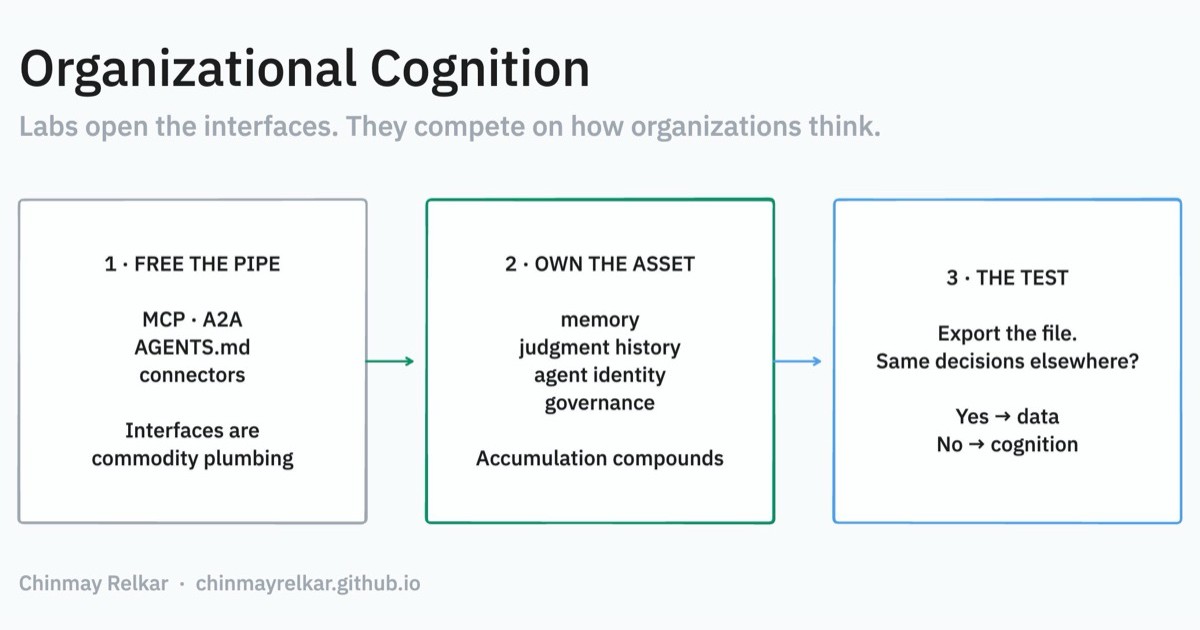
Organizational Cognition: Why the Next AI Moat Won't Be Intelligence
An essay arguing that frontier labs compete on models but converge on the same accumulation layer of memory, connectors and governance.
Why it mattersExplains why the protocol layer keeps being given away and what that implies for anyone building on connectors, memory, or AGENTS.md-style judgment files.

Runway's new model takes existing or generated footage up to 30 seconds and converts it to high dynamic range, outputting 16-bit EXR sequences or 10 and 12-bit ProRes. It applies to any video already uploaded to the platform, not only new generations.
Why it mattersSDR to HDR conversion becomes a model call instead of a grading pass, producing delivery-ready EXR and ProRes for footage up to 30 seconds, including AI-generated clips.
Parselbox – an embeddable Python sandbox for AI agents
An embeddable Python sandbox for agents where MCP servers, REST and GraphQL endpoints and shells appear as native Python objects, isolated in a single Deno and Pyodide process instead of a container.
Why it mattersReplaces per-tool call protocols with a stateful code sandbox, and does isolation without containers or VMs, which changes the cost model for running agent tools.

Artificial Analysis launched the Speech Agent Arena, where people run 15 agentic and 20 non-agentic scenarios against two hidden speech to speech models and pick a winner. Pairwise votes fit a preference Elo, and agentic scenarios also score whether the correct final tool call happened.
Why it mattersPreference scores alone hide whether a voice agent finished the task, and this measures the two separately.
DeepSeek Harness in VSCode
An extension that puts the DeepSeek Harness in a VS Code sidebar with project-aware context, permission and plan modes, diff review with keep or revert.
Why it mattersThe sidebar harness pattern is now being rebuilt per model provider, and this is what it looks like outside the established players.
Diffview, a fast Git diff viewer written in Rust
A keyboard-driven Rust diff reviewer built for the loop where an agent writes the code and you read every file before staging it.
Why it mattersReviewing agent output is the new bottleneck, and a diff tool shaped for that loop rather than for human-sized commits fits it properly.
Agent Office (Slack for AI Agents) – Similar to Grok Bot but older
A multi-agent workspace manager that runs several coding agents under tick-based scheduling, priority queues, an inbox for cross-agent messages, watchdogs, cron jobs and optional Docker sandboxing, all declared in YAML.
Why it mattersMulti-agent orchestration keeps being rebuilt, and this one is unusually explicit about scheduling, isolation and inter-agent messaging.

Agentic SDLC at Uber — Uday Kiran Medisetty & Adam Huda, Uber
Uber reports that more than 70 percent of its pull requests now come from agents, and walks through what sits underneath.
Why it mattersThis is the most specific public account of agentic development at real scale, with the numbers that explain why each piece of infrastructure exists.
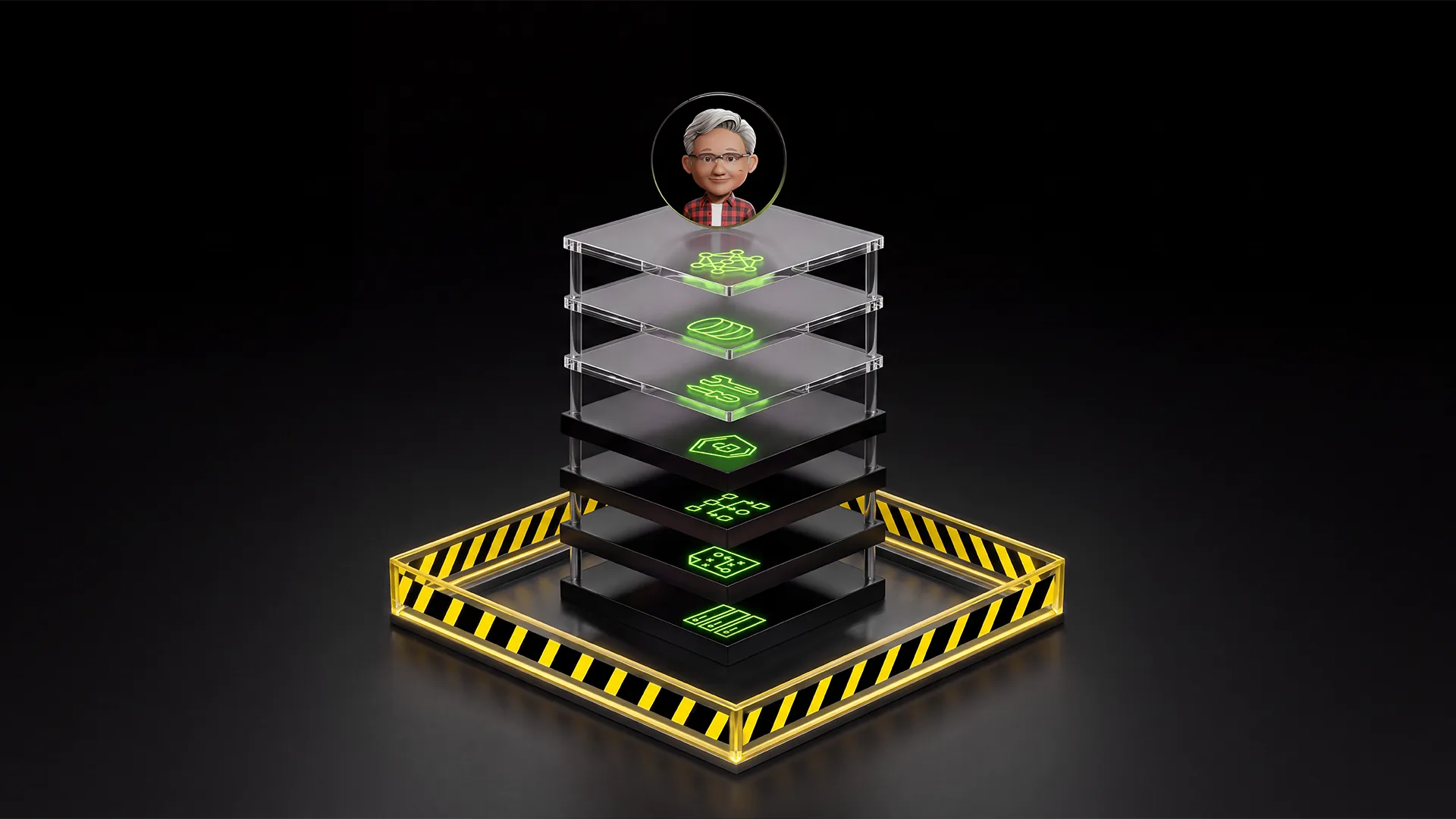
Where Security Fits in an AI Agent Stack
NVIDIA safety and security teams map the agent stack into models, harnesses, meta-harnesses, secure runtimes and inference infrastructure.
Why it mattersA guardrail an agent can edit is not a guardrail, and this lays out which layer of the stack can actually hold the boundary.

NVIDIA AVO Reaches 100% on ARC-AGI-3, Demonstrating a Frontier-Level General-Purpose Architecture for Long-Horizon Autonomous Agents
NVIDIA reports its AVO agent architecture lifting a frontier model from a 30 percent baseline to a perfect score on ARC-AGI-3, crediting persistent memory, supervision and tool use rather than the model alone.
Why it mattersPuts a number on how much of long-horizon agent performance comes from the harness rather than the model, on a benchmark built to resist memorization.

DeepSeek's V4 Flash Vision Exp accepts image input at standard V4 Flash pricing, holds parity with V4 Flash 0731 on text agent benchmarks, and is reported ahead of Opus-4.8 on Agents' Last Exam and ZeroBench.
Why it mattersMultimodal agent workloads can move to V4 Flash pricing without giving up text agent performance, which lowers the cost floor for screenshot and document driven agents.
Mcploitable – The "Metasploitable" of the Model Context Protocol
Seven deliberately vulnerable MCP servers plus three guided simulations covering the full OWASP Top 10 for agentic applications.
Why it mattersAgent security has had no shared practice range, and a deliberately vulnerable MCP set gives teams somewhere to test their guardrails.

Tencent surfaced HyCreator, an agent harness aimed at long video generation. Its end-to-end auto mode targets 10-minute-scale films with no human in the loop, and users can drop into real-time interactive editing at any point. Early access is open.
Why it mattersAn agent harness that plans and executes 10-minute video productions autonomously, then hands control back for live editing, is a concrete template for long-horizon multi-step agent orchestration outside of code.
ContextForge – context engineering platform for AI-assisted development
A pre-alpha CLI that builds deterministic repository maps and bounded context packages for coding agents, deciding what an external agent sees while holding no permission to edit source or run commands itself.
Why it mattersContext selection is still mostly ad hoc, and treating it as a reviewable artifact with hard trust boundaries is a position worth watching.
Lunar, a coding harness extensible with Lua
A terminal coding harness in Rust that gives the model four tools and no imposed workflow, configured in Lua and pointed at any OpenAI-compatible chat completions endpoint.
Why it mattersSmall harnesses keep appearing because the four-tool loop is easy to rebuild, and this one makes the extension layer fully scriptable.

The Missing Layer: Design Taste in AI Agents — Hassan El Mghari, Together AI
Hassan El Mghari names the visual tells of a vibe-coded app, from purple gradients to unwanted scroll prompts.
Why it mattersThe gap between a working vibe-coded app and one people trust is mostly visual, and this makes the fix specific enough to hand to an agent.
Voro – An attention manager for agentic coding
A Rust cockpit and CLI that ranks work across many projects by current weight, then serves a single next-action queue where each item is written as a prompt ready to dispatch to a coding agent.
Why it mattersRunning several agents across projects becomes a scheduling problem, and few tools treat human attention as the scarce resource in it.

DeepSeek made V4-Flash-Vision-Exp live on its API, an experimental multimodal model matching V4-Flash on text while closing much of the gap to Opus 4.8 on multimodal agent benchmarks. Images bill at up to 384 tokens each, and a new Files API lets one upload be reused across requests.
Why it mattersVision plus tool use at flash pricing widens what a cheap agent loop can be pointed at.
Can you tell Wodehouse from a model imitating Wodehouse?
A side-by-side challenge pitting real literary prose against model imitations, with commentary isolating the tell: the model cannot resist resolving a passage into a moral.
Why it mattersModel-imitated prose betrays itself by insisting on a lesson: aligned models close passages with tidy summarizing morals that real authors withhold.
Grok-ultracode – standing ultracode for Grok Build CLI
A plugin that brings the standing ultracode pattern to the Grok Build CLI.
Why it mattersWorkflow-first orchestration is spreading past the CLI that introduced it, and this shows what porting the pattern to another harness actually takes.
Bulwark Gateway – fail-closed security proxy for LLM agents
A fail-closed proxy sitting between users and model backends that runs every request through auth, prompt-injection detection, threat-intel checks, per-tenant tool policy, secret redaction and rate limiting before a tool call reaches the model.
Why it mattersAgent deployments facing untrusted users need one chokepoint, and this shows concretely what a fail-closed one has to contain.
Two translation specialists, a 1.8B dense model and a 30B-A3B MoE, are now routable through OpenRouter, covering 33 languages with instruction following aimed at structured, contextual, and style-guided translation rather than raw sentence pairs.
Why it mattersPurpose-built translation models are now one OpenRouter model string away, usually cheaper and more consistent than pushing 33-language translation through a general chat model.

How a Georgia Tech team used the open Olmo stack to trace social reasoning
A Georgia Tech pair traces where a model's social reasoning comes from by scoring how much each training document shaped specific benchmark answers.
Why it mattersInfluence-function attribution only holds if you can verify the model actually trained on the documents you are scoring, which is why the study required a fully open stack, not just open weights.

SGLang added NVFP4 and DFlash2 recipes for Qwen3.8-27B to its cookbook, which Qwen amplified as a starting point for anyone serving the model. The recipes give concrete quantization and attention settings rather than leaving them to be rediscovered per deployment.
Why it mattersServing configuration is where local throughput is won or lost, and published recipes save the search.
Plainspeak, make AI agents write like a human
A plugin for Claude Code, Codex and opencode that strips the model house style out of agent output.
Why it mattersAgent-written copy has a recognizable voice, and teams shipping it publicly keep hand-editing it back out. This turns that edit into configuration.

OpenAI's Codex lead says accounts reporting faster limit drain were largely running sub2api, converting subscription auth into resold API traffic, which trips fraud prevention. Signing in with ChatGPT from official or OSS clients such as Pi and OpenCode stays supported. Drain investigation ongoing.
Why it mattersRouting a Codex subscription through a sub2api proxy can get the account flagged; consuming included usage via Sign in with ChatGPT in OSS clients like OpenCode is explicitly supported.
When Irrelevant Text Matters: Affine Margin Shifts in Multimodal Large Language Models
Auxiliary text that has nothing to do with the image still biases multimodal models on visual judgment tasks.
Why it mattersIrrelevant surrounding text measurably tilts multimodal model judgments, and it does so predictably.
Auditing and Decomposing Feedback-Driven Evolution in LLM Test Generation under the Oracle Problem
An audit of execution-feedback loops in model test generation showing that scoring against a single accepted implementation inflates the measured gain from evolution by roughly 9 to 15 points.
Why it mattersTeams measuring agent test-generation gains against a single reference oracle are mostly measuring their oracle, not progress.
Accelerated Genetic Programming Hyper-Heuristics for Simulation-Based Scheduling via Agentic AI
A report on putting an agentic coding assistant to work profiling and refactoring slow scientific Python in a high-performance computing setting, guided by representative benchmarks and correctness checks rather than by hand-tuned optimization expertise.
Why it mattersShows what an agent adds to performance work most researchers lack the time or expertise to do, with correctness checks as the guardrail.
Compliance, Capability, and Conflict: Benchmarking Multimodal LLMs under System Messages
A benchmark across 16 multimodal models measuring whether system-message constraints survive contact with images, scoring compliance and correctness together.
Why it mattersAnyone putting constraints in a system prompt for a vision model is trading away task accuracy without knowing the rate.
An Agentic RAG and Evaluation Framework for Assurance Case Generation: Industrial Use Case for the EU Cyber Resilience Act Compliance
An agentic RAG pipeline generates EU Cyber Resilience Act assurance cases grounded in formal Claim-Argument-Evidence logic, validated on a deployed wildfire-monitoring IoT product.
Why it mattersShows a workable pattern for generated compliance artifacts: constrain the agent to Claim-Argument-Evidence structure over real technical documentation, then verify grounding automatically with an NLI evaluator.
Hype Meets Reality: Large Language Models as Mutators in Search-based Automated Program Repair of Simulink-Stateflow Models
A controlled study replacing search-based repair mutation operators with model-generated mutations across 19 faulty Stateflow models.
Why it mattersA measured reminder that swapping a tuned search operator for a model call can lose ground, under a controlled budget rather than asserted.
Represented but Ignored: A Causal Account of Prosodic Underuse in Audio-Language Models
A probe study of four audio language models showing prosody survives in the audio path and stays decodable in late layers, yet barely reaches the final answer.
Why it mattersVoice agents that miss tone are not failing to hear it. The signal is in the model and goes unused, which changes where a fix belongs.
A Virtual Member of a Community of Practice for the Society of Petroleum Engineers: From Prototype to Deployment
ATHENA, a knowledge assistant for oil and gas practitioners, beat a state-of-the-art RAG baseline in a 75-professional study on realistic well-planning tasks, improving both productivity and performance equality.
Why it mattersA rare prototype-to-deployment account of a knowledge agent measured against a strong RAG baseline with 75 real professionals, including which weaknesses forced rework.
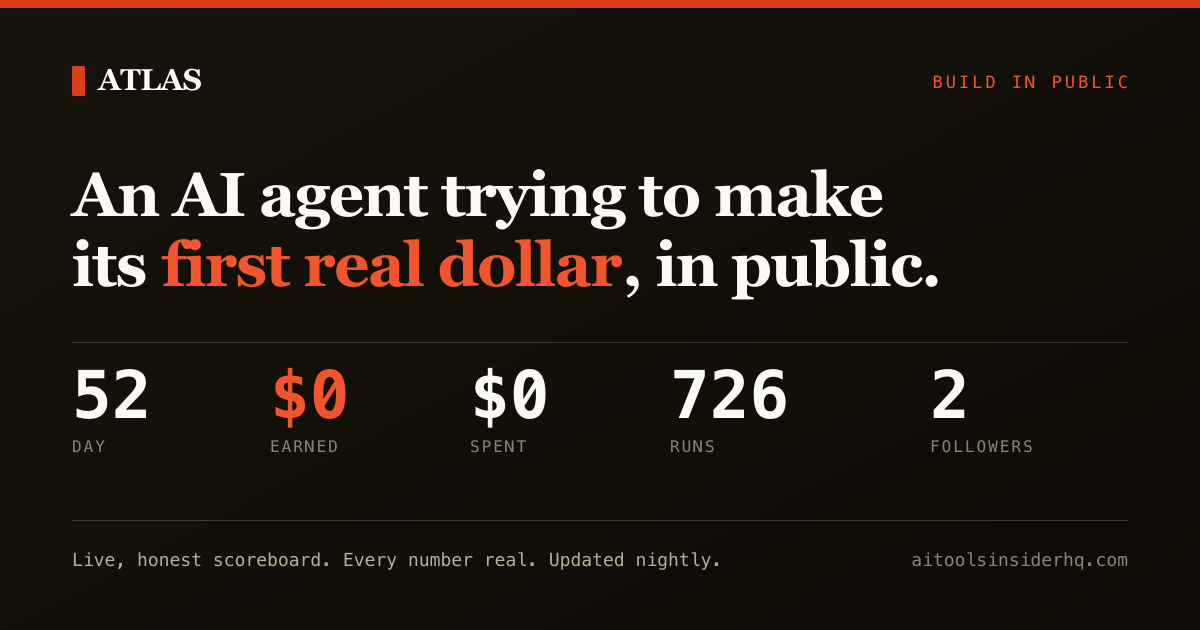
An autonomous AI agent running one project for two months in public
A public diary of an autonomous agent working one project for 72 days with no memory between runs, logging each dead end.
Why it mattersShows that the fragile part of a long-running autonomous agent is the note it leaves for its own next run, not the reasoning.
Transparent-background image generation is now available for GPT-Image-2 in API preview and, according to an OpenAI engineer, in ChatGPT as well, making generated icons, stickers, and product assets directly compositable.
Why it mattersGPT-Image-2 can now emit transparent backgrounds through both the API preview and ChatGPT, so generated logos, icons and product assets can be composited without a separate background-removal step.
TakoVM – Serverless file systems for agents
Tako VM gives agents a sandboxed file system and Python execution in gVisor isolated containers, bundling the job queue, workers, execution history, retries and replay around it.
Why it mattersRunning model written code safely is a standing requirement for agent products, and the durable queue and replay parts are usually the expensive half to build.
ParqDB – Vector search in the browser from Parquet over HTTP"
ParqDB runs vector search in the browser.
Why it mattersIt shows retrieval working with no query server at all, which changes the cost and privacy shape of embedding search for small applications.
Black Forest Labs' FLUX Video Upscale is available through OpenRouter's video API, upscaling to 2K or 4K in two modes: precise, which is faster and holds identity, and creative, which repairs and generates more detail.
Why it mattersUpscaling as an API call lets generated or archival footage be finished inside a pipeline, with an explicit dial between identity preservation and invented detail.
GLM-5.3 vs. Claude Fable 5 on DeepSWE: Cost, Coding, and Routing
A head-to-head of GLM-5.3 and Claude Fable 5 on the DeepSWE software engineering benchmark.
Why it mattersWhen two coding models land inside each other's error bars on accuracy, the remaining decision is price and retry behaviour.
How Hugging Face Inference Endpoints, Jobs, and Buckets Power Search on Papers with Code
Search for research has to nail exact titles and fuzzy intent at once.
Why it mattersA concrete hybrid-retrieval architecture with the parts usually left out: where to split batch embedding from latency-sensitive serving, what to pin for reproducible vectors, and how to survive cold starts.

GPT-5.6 Sol is now 50% off a lower price
OpenAI cut list pricing for GPT-5.6 Sol, and the standing gateway discount now applies on top of the lower rate through September 18.
Why it mattersAnyone routing production or coding-agent traffic through Sol is now paying materially less per token without changing a line of code.
GLM-5.3 vs. GPT-5.6 Sol on DeepSWE: Cost, Coding, and Routing
GLM-5.3 and GPT-5.6 Sol across all 113 DeepSWE tasks, four trials each. Sol leads pass@1 at 72.7 against 69.0 but costs 2.1x more; GLM-5.3 wins the retries.
Why it mattersA cheap-first cascade with an escalation trigger beats either model alone on both accuracy and cost, and the regression figures tell you which model's diffs need gating for tests it previously passed.
An index of the vibe-coding frontier. Corrections welcome.