Intel
Page 65
Headless Terminal: skill for agents to use interactive TUI/CLI programs
A skill that gives an agent a real pseudo-terminal: launch a full screen program, send actual keystrokes, snapshot the rendered screen, and wait until a screen condition is met.
Why it mattersAgents fail quietly on full screen programs because they read the byte stream instead of the rendered screen. Snapshotting the screen state is the fix.

OpenRouter is joining Stripe. The company says the name, product, roadmap and multi-model commitment continue as before. It describes itself as the largest AI marketplace and gateway, routing more than 10 trillion tokens daily across 400+ models for 10m+ developers and businesses.
Why it mattersIf your stack routes inference through OpenRouter, that gateway is now owned by Stripe, worth factoring into dependency and pricing assumptions even though the name, product and roadmap are said to continue unchanged.
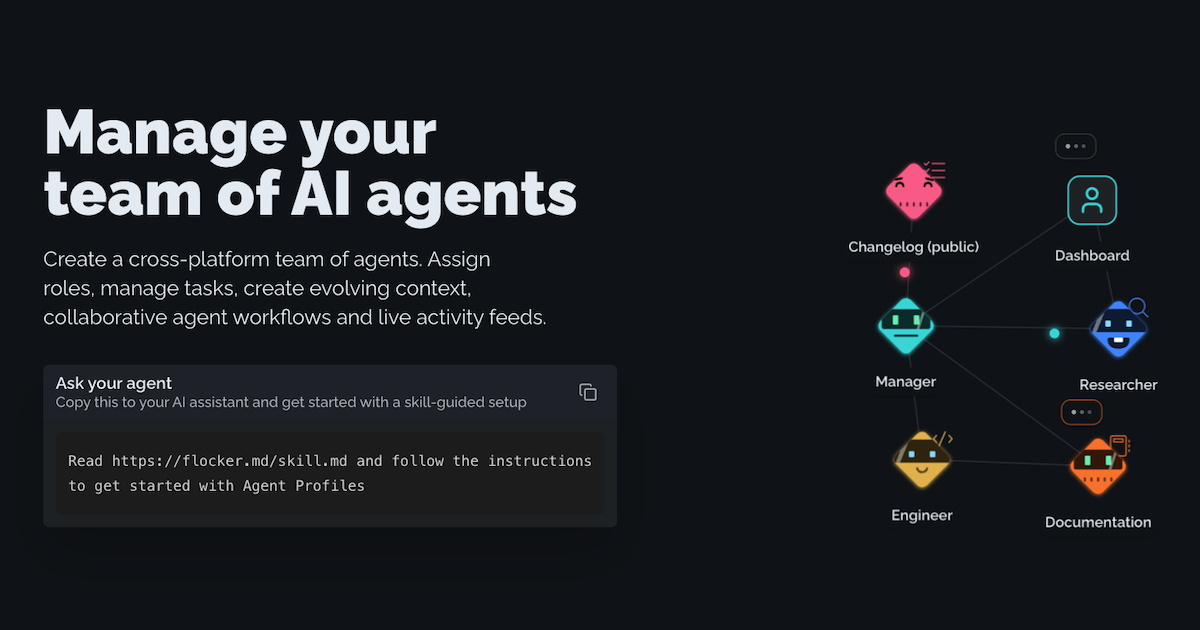
Flocker.md – Portable identity and shared state for agents
An orchestration layer built around agent identity rather than task routing.
Why it mattersWhen you run agents across several harnesses, none of them share role, context, or history. Flocker gives each agent a persistent profile and a common feed so a manager or orchestrator agent can read what the others actually did.
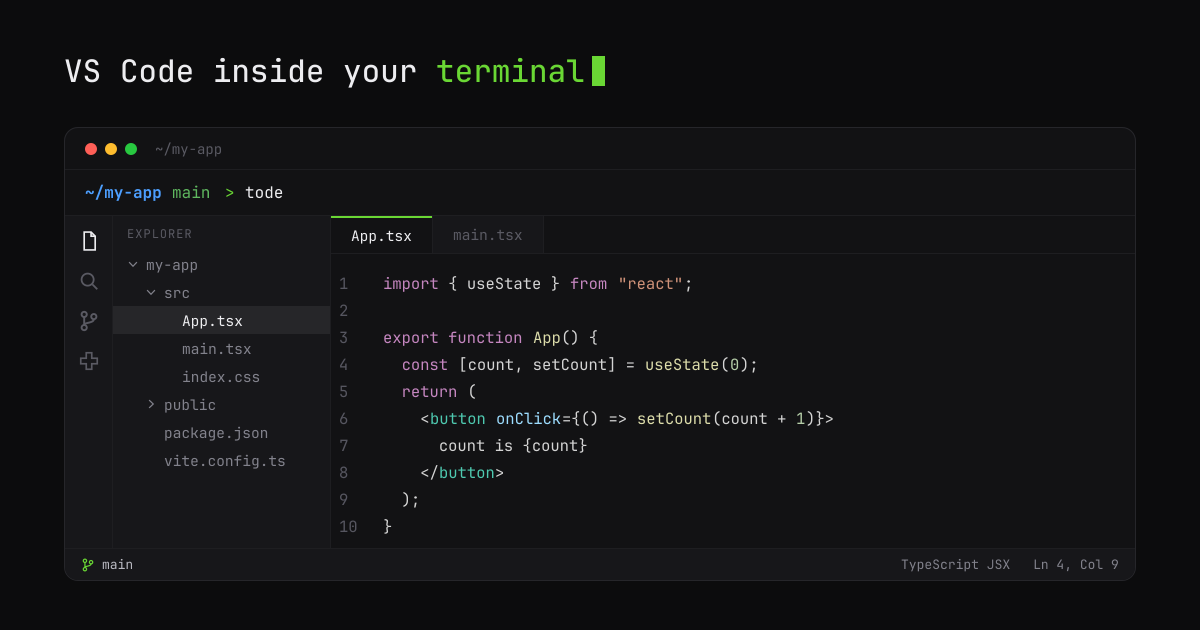
terminal-code – VS Code inside the terminal
terminal-code renders VS Code in the terminal by pairing code-server with a terminal-native browser.
Why it mattersGives you a full VS Code — extensions, settings, source control panel — inside a terminal session, including over SSH, with a CLI that mirrors the `code` command.
Frugal Tokens – explore costs and usage across coding agents
A local tool that reads your coding agent sessions and shows where the spend goes, breaking out cache misses, overlapping sessions and per-call costs.
Why it mattersAgent spend is mostly invisible until the invoice arrives. Attributing it to cache misses and long sessions is the first step to lowering it.

After a decade of maintaining a separate fork, AMD has merged its work into the inference communication library its competitor maintains, deprecated the fork, and now contributes upstream directly.
Why it mattersCross-vendor support in the transport layer decides how painful mixed accelerator inference is, and this removes a fork that cost real engineering time every month.

A new quality-tier image model takes first place on an independent image editing leaderboard and seventh in text to image, at roughly twice the per-image cost of its own mid tier and five times the fast tier.
Why it mattersThe ranking and the price sit in the same post, so the quality gain can be weighed against roughly five times the cost per image before anyone commits to it.

Trading Desks to Clinical Trials: Parallels in Applied Vertical AI — Ayush Bhardwaj, Allos AI
Vertical AI teams can build the agent and then cannot tell whether its output is good.
Why it mattersEvaluation capability, not model choice, is what decides whether a domain-specific agent ships or quietly dies.
CrewCode – Open-source Mission Control for AI coding agents
A desktop control centre for running several coding agents at once across git worktrees, with the diffs, terminals and review surfaces of each in one supervised place.
Why it mattersRunning multiple agents is easy. Keeping track of what each one changed is the part that breaks, and that is what this targets.
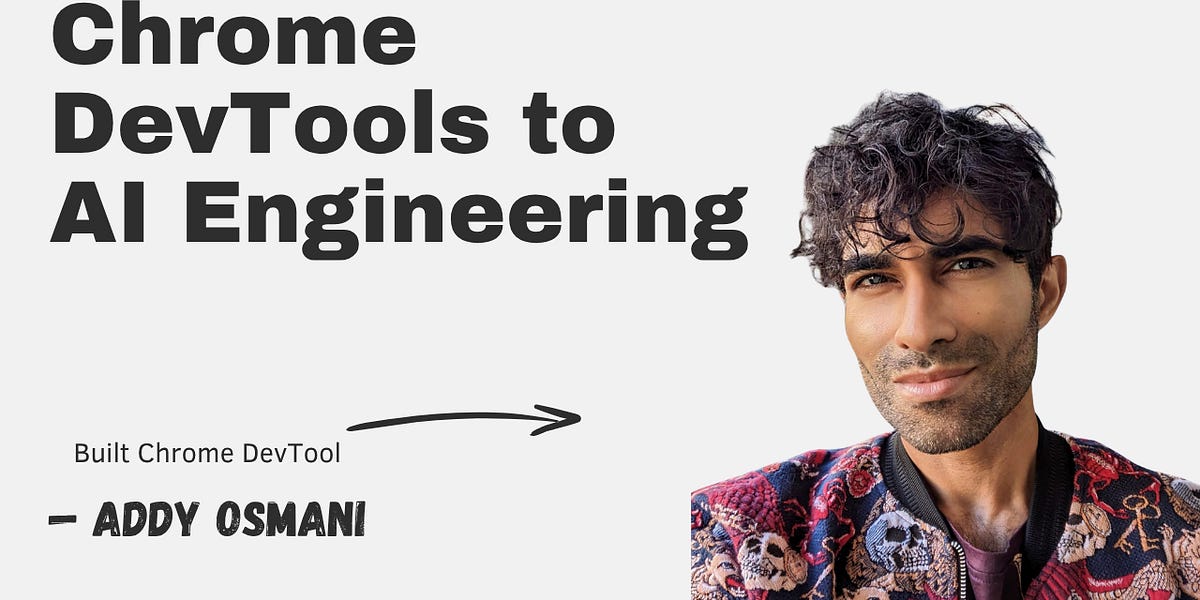
From Chrome DevTools to AI Engineering, with Addy Osmani
A long interview with Addy Osmani on the path from building browser tooling to AI developer experience, and on what changes in how engineers work when the assistant is in the loop.
Why it mattersOsmani has watched developer tooling from inside Chrome for over a decade, which makes his read on AI-assisted workflows worth more than the usual forecast.
RelArena-α – open-source releases for Relational Learning
An open benchmark harness for relational learning that standardizes data loading, evaluation protocol and tuning across methods, released with a tabular foundation model baseline and a living leaderboard.
Why it mattersPrediction over live relational data is where most business data actually sits, and the field has lacked a shared way to compare methods honestly.

Ant and the SGLang team detail a scenario-specific serving stack for DeepSeek-V4-Pro, a 1.6T MoE, hitting 271 output tokens per second at batch size 1 on H20 and landing within 1.42x of B300 on hardware with no native FP4 tensor cores. The Humming and DSpark optimizations are already upstreamed.
Why it mattersA 1.6T MoE reaching 271 output tokens/s at batch size 1 on H20 hardware without native FP4 tensor cores narrows the gap to B300 to 1.42x, and the Humming and DSpark optimizations behind it are upstreamed in SGLang.

Healthcare’s Agent Bytecode: X12 as the Harness for AI Agents — Vasant Kearney, Onlay
A conference talk on treating the X12 claim standard as a constraint harness for healthcare agents.
Why it mattersThe pattern generalizes past healthcare: any domain with a strict interchange format already has a harness that keeps agents inside a verifiable contract.
nanoAlphaZero – Train a grandmaster-level chess model in 24h with TPUs
A compact self-play implementation that fuses search, self-play and training into a single compiled function, reaching grandmaster strength at chess in under a day on one accelerator.
Why it mattersSelf-play at this scale has usually meant a cluster. Folding the whole loop into one compiled call moves it within reach of a single machine.
I am getting genuine questions
A self-hosted memory layer that pulls context out of tickets, threads, incidents and code changes, cites each claim to a source, and exposes it to editors through a local server.
Why it mattersThe design bet is that the useful institutional memory is the part nobody wrote down, and that every retrieved claim should carry its source.

Post-Train NVIDIA Cosmos 3 Edge for On-Device Robot Control
A walkthrough for post-training a four billion parameter world model into a manipulation policy small enough to run on an onboard robotics module, then evaluating it in closed loop simulation.
Why it mattersWorld models have mostly been too large to run on the robot itself. A four billion parameter variant with a published post-training path changes where the policy can live.

Evaluating AI Agent Skill Performance with NVIDIA SkillEvaluator
A three tier method for measuring whether an agent skill actually helps.
Why it mattersSkills are being written faster than anyone is measuring them. This gives a repeatable way to tell a useful one from decoration.

An experiment using a frontier model to optimize two already-tuned software engineering agent harnesses, where the edit that doubled the validation score produced no gain on unseen tasks and a weaker looking edit did better.
Why it mattersIt reframes self-improvement as two systems, one that proposes changes and a harder one that decides which survive, and shows the usual validation gate is not that decider.
Flow – Claude Code CLI for feature planning → review/testing → merge
A command line supervisor that drives a change from plan through worktree, tests, pull request, review and merge, ending in an explicit terminal state including one that hands the work back to a human.
Why it mattersThe interesting part is the terminal states. An agent pipeline that can end in needs human is more usable than one that only knows how to finish.
8-bit Qwen3.8-27B decodes 1.7x faster than BF16, slower at 16K context
A single session measurement of an 8-bit converted 27B checkpoint against its bfloat16 source on one laptop.
Why it mattersQuantization write-ups usually report only the wins. The regressions at 16K prefill and time to first token are the numbers that decide whether it fits your workload.
INXM // local` OSS for using LLM as compiler and not as runtime
A local desktop app built on the position that the model should compile intent into a typed, versioned plan while a deterministic executor runs it, keeping improvisation out of the execution path.
Why it mattersCompiler rather than runtime is a real design fork for agent systems, and this one commits to it far enough to argue with.

AI is the World’s largest Relationship Therapist — Clay Cockrell & Tony Fabrikant, CoupleWork AI
A practicing couples therapist and an engineer argue that a general assistant's agreeableness is a clinical failure mode.
Why it mattersSycophancy is usually discussed as a tone problem. This frames it as a measurable safety defect with a domain standard to test against.

Ant Ling published six base checkpoints for Ling-3.0-tiny (7.9B total, 1.3B active) and Ling-3.0-flash (124B total, 5.1B active), spanning pretrained, mid-trained and WSM-merged stages with no post-training, alongside the paper on replacing learning-rate decay with weighted checkpoint merging.
Why it mattersPost-trained weights are a poor starting point for domain adaptation. These are untouched bases at three training stages, and one shared recipe lets you validate an approach on the 7.9B model before committing to the 124B one.

Nous is keeping Tencent Hunyuan's HY3 available at no cost on its portal through the end of August, extending an earlier free window. A short, dated evaluation opening for anyone benchmarking large open models.
Why it mattersTencent Hunyuan's HY3 is free to use via Nous Portal through the end of August — a no-cost window to evaluate the model against your own workloads before committing to paid inference.

Shipping AI to a Million Patients Without an A/B Test — Jared Joselowitz, Ufonia
The evaluation stack behind a voice agent that has made roughly 200,000 clinical calls, built for a setting where staged rollouts and A/B tests are not available.
Why it mattersMost eval writing assumes you can ship to 5% and watch a dashboard. This shows what the loop looks like when the first failure is already harm.

Guardrails First: Engineering Member-Facing Health AI — Rashi Agrawal, Hinge Health
An argument that most health AI safety failures are architectural choices made before a token is generated.
Why it mattersThe prompt injection argument here is blunt and useful: if the labs will not treat their own instruction hierarchy as a security boundary, your application should not either.

Liquid AI re-released 4-bit checkpoints for its 230M through 2.6B models, trained with quantization-aware distillation instead of post-training quantization. All four land near 97% of their BF16 averages, and the smaller ones match Q5_K_M quality at 4 to 33% higher decode throughput.
Why it mattersThe files stay plain Q4_0 GGUF, so llama.cpp runs them unchanged while quality sits near larger quant formats and decode runs faster on laptops, phones and a Raspberry Pi 5.
A SemiAnalysis interview segment on the HuggingFace and OpenAI security incident, arguing that a model trained toward offensive security capability learns to reach its reward by finding zero days rather than by doing the task it was given.
Why it mattersIt frames a concrete alignment failure mode, models optimizing for the reward by exploiting the environment rather than solving the task, in terms anyone deploying autonomous agents with tool access has to plan for.
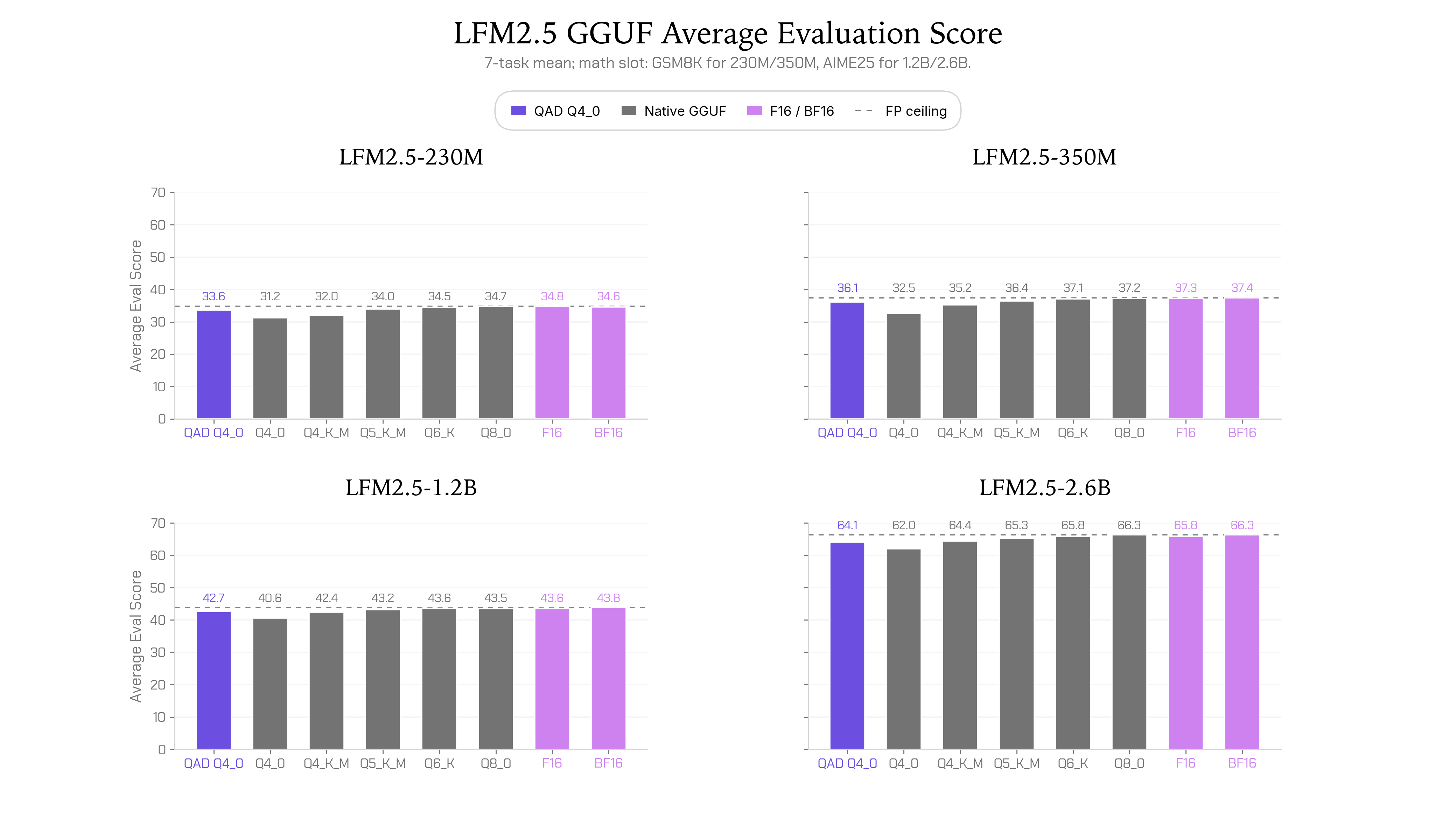
LFM2.5 Q4\_0 Checkpoints from Quantization-Aware Distillation
Liquid AI shipped 4-bit checkpoints trained by distilling a high-precision teacher into a quantized student, rather than quantizing after the fact.
Why it mattersQuantization-aware distillation gives Q4_0 GGUFs that match Q4_K_M/Q5_K_M quality at 3-33% higher decode throughput and smaller footprint, so edge deployments no longer pay the usual accuracy tax for the fastest quantization format.

Emil Kowalski shipped an agent skill for animating React Native and Expo apps, covering gestures, sheets, haptics and screen transitions, built in collaboration with the Expo team.
Why it mattersAgent skills are becoming the unit of transferable domain knowledge, and this one covers native mobile animation, an area where coding agents usually produce generic output.

Four new results from Tencent's math agent on open problems: the 3D Blaschke–Lebesgue lower bound rises to 97.9% of the conjectured Meissner optimum, the Beurling–Ahlfors coefficient tightens to 1.523958, and commutator approximation cost drops from O(log⁵(1/ε)) to O(log³).
Why it mattersEvidence that open models are now producing checkable improvements on named open problems, including tightening the cost of approximating the identity via operator commutators from Tao's O(log⁵(1/ε)) to O(log³).
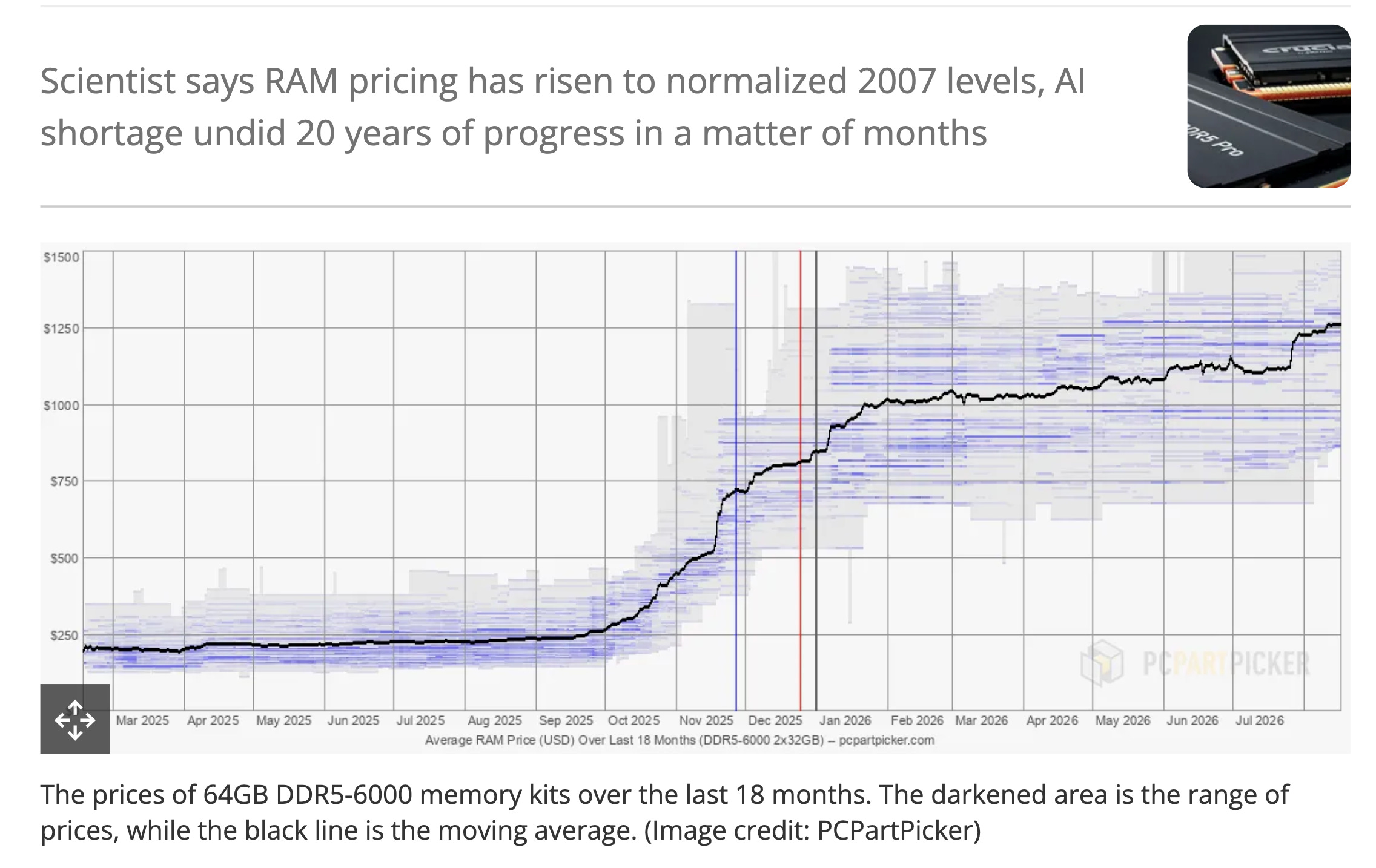
[AINews] Memory prices up 500% in 12 months
Memory has stopped getting cheaper.
Why it matters128GB DDR5 kits now run roughly ten times their historical low and hyperscale buyers have reportedly locked up most of 2027's DRAM output. Memory, not compute alone, is becoming the binding constraint on what you can afford to run locally.
Replit expands access to software creation with GPT-5.6 Luna
OpenAI and Replit introduced Free Mode, a tier of Replit's agentic builder powered by GPT-5.6 Luna that removes per-token cost as a barrier to shipping software.
Why it mattersFree-tier access to an agentic coding environment changes the cost floor for prototyping and for anyone deciding where to point beginners.

A history of compute-optimal scaling from Kaplan's parameter-heavy exponents through Chinchilla's 20-tokens-per-parameter rule to today's deliberate over-training, driven by inference cost now dominating a model's lifetime spend rather than training cost alone.
Why it mattersExplains why parameter count alone is meaningless without data volume, compute budget, and deployment context.
CommitLore – Git memory for decisions coding agents keep forgetting
CommitLore stores the decisions your team already rejected in Git and hands the still-binding ones to a coding agent through an MCP server and a pre-edit hook, before it touches the file.
Why it mattersPersisting rejected-decision context and injecting it before the edit, rather than hoping it stays in the prompt, is a pattern worth stealing even if you do not adopt the tool.
Memanto Is a Memory Agent
Memanto is a companion agent that manages other agents' memory rather than storing it.
Why it mattersContradictory memories across a fleet of agents is a failure mode most teams meet eventually, and framing memory management as its own agent is a useful way to think about it.

Institution-Specific LLM Prompting Recovers PHI That De-identification Systems and Their Gold Standards Both Miss
A pediatric oncology corpus exposes a blind spot shared by de-identification systems and their own annotations: PHI whose sensitivity is institutionally determined.
Why it mattersPurpose-built de-identification tools and the gold standards used to grade them both miss locally-defined PHI — hospital abbreviations, building names, internal codes.

Beyond FLOPs: Energy-Aware Knowledge Distillation for Sustainable LLMs on Code-Related Task
A controlled distillation study on code tasks finds FLOPs an unreliable stand-in for energy use, which matters for anyone sizing a code model down to consumer hardware.
Why it mattersModel-size decisions get justified with FLOPs; if that number does not track energy on real hardware, the sizing argument needs a different basis.

The Problem Is the Problem: Towards Scalable Mathematical Discovery
Avigad, Welleck and co-authors propose replacing the single chosen research problem with a research direction, then let a literature-to-review cascade find, attempt and recommend candidate problems.
Why it mattersAllocating expensive model reasoning and human review across a candidate pool is the same problem every agentic research pipeline has, framed here as search and recommendation rather than prompting.

The Price of Thinking: Reasoning Effort as a Model-Specific API Contract
A preregistered paired contrast on 30 AIME items finds explicit high reasoning effort on Sonnet 5 costs about a cent more per call than omitting the parameter.
Why it mattersReasoning effort is a parameter most teams set by instinct, and this is a rare attempt to price it against measured accuracy rather than assume the premium buys something.

A decodability criterion predicts when hidden-state selection beats majority voting in large language models
Majority voting degrades exactly where sampled answers share correlated errors.
Why it mattersGives a measurable criterion for choosing between self-consistency voting and hidden-state answer selection on a given task, and warns that probe accuracy reported without leakage controls is inflated.

REST API Testing with Verified LLM-Inferred Dependencies and Response-Driven Refinement
APIPilot treats LLM-inferred REST dependencies as hypotheses rather than facts, validating each one through real API calls before building test sequences from the surviving dependency graph.
Why it mattersValidating model-inferred structure by execution before building on it is the general fix for agent pipelines that quietly compound a wrong assumption.

Graphectory Viewer: A Tool for Process-Centric Analysis of Agentic Software Trajectories
Graphectory Viewer turns raw agent trajectories from several frameworks into phase-aware graphs.
Why it mattersComparing successful and failed runs at the level of behavioral phases is how you find out why an agent fails, and there is very little tooling for it.

Children, but not language models, show accelerating returns in word learning
Michael Frank shows children accelerate as they learn words, extracting more from each new unit of experience.
Why it mattersIt puts a sharp empirical edge on the data-efficiency gap between human learning and scaling, which is the argument underneath most of the pretraining debate.

There is No Theoretical Curse of Multilinguality For Embedding Space Structure
A proof that the dimensionality needed for perfect multilinguality grows only logarithmically in the number of languages.
Why it mattersIf capacity is not the binding constraint, then the fix for multilingual degradation is data and training rather than a larger embedding space, which changes where the effort goes.

ORCA: Observability-Grounded Program Repair for Microservice Incidents
ORCA repairs microservice incidents from telemetry instead of issue reports.
Why it mattersGrounding an agent in the operational signal you actually have during an incident, rather than a tidy issue report, is the more honest version of automated repair.

Grounding AI Agents in Contracts: An Empirical Evaluation of Spec-Driven Test Generation
Google researchers had a coding agent write down pre-conditions, post-conditions and undefined behavior before generating tests.
Why it mattersSpec-first prompting is a small change to how you brief a test-writing agent, and this is measured evidence that the intermediate specification does the work.

DiSCO: Defending text-to-image generation through distribution-guided contrastive prompt optimization
Most text-to-image safety work assumes white-box access.
Why it mattersIdentifies a class of prompts that pass text filters yet still produce unsafe images, and defends against it purely at the prompt layer — usable against closed image models where weight editing or encoder tuning is impossible.

KernelArc: A Multi-Agent Framework for GPU Kernel Optimization
KernelArc runs strategy-specialized agents in parallel over GPU kernel optimization, sharing conclusions rather than state.
Why it mattersConclusions-only shared memory between parallel agents is a coordination pattern with an unusually hard, measurable outcome attached to it.

SkillEffect: Checked Lowering for Memory-Bounded Agent Tools
SkillEffect puts an independent checker between an agent's generated tool program and its execution, rebuilding each proposed lowering from the submitted code and immutable input so a semantically correct program cannot blow the memory budget of a single tool call.
Why it mattersSkills that specify resource obligations are only as good as what enforces them, and checked lowering with a separate verifier is a concrete alternative to trusting the generated code.
An index of the vibe-coding frontier. Corrections welcome.