Llm Inference Price Trends
- Source
- epoch.ai
- Author
- Epoch AI publications
- Date
Context
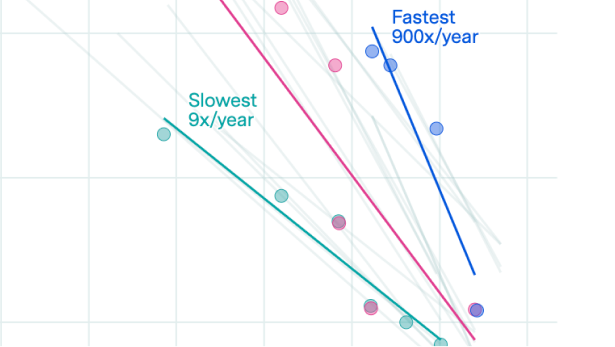
This March 12, 2025 data insight from Epoch AI, by Ben Cottier, Ben Snodin, David Owen and Tom Adamczewski, measures falling AI prices in a way that holds capability constant. Instead of tracking a model's price, it picks a performance milestone, such as GPT-4's score on GPQA Diamond, a set of PhD-level science questions, and follows the cheapest model that matches or beats it over time. For that GPT-4 milestone, the price fell about 40x per year. Across six benchmarks and the milestones set by successive state-of-the-art models, the declines ranged from 9x to 900x per year, with a median of 50x.
The width of that range is the main finding: how fast a capability gets cheaper depends heavily on which capability. Timing matters too. The fastest trends, such as 900x per year, begin after January 2024, and when Epoch dropped all model data from before 2024, the median rate rose from 50x to 200x per year, even for performance levels first reached before 2024. Epoch reads this as a recent acceleration across benchmarks, but says that because the steepest drops are so recent it is less clear they will persist.
Prices here are per , a 3:1 weighted average of input and output prices drawn mostly from Artificial Analysis, and reasoning models are excluded because they generate far more tokens, which makes comparing them with other models on price per token misleading. Epoch checked whether the cost of actually running its evaluations fell at a similar pace and found it did, with the largest gap 200x per year for cost against 400x for price per token. It points to smaller models and more cost-effective hardware as known causes, but did not model the drivers and found no clear evidence that thinner profit margins explain the drops (epoch.ai). Epoch's later, expanded estimate of falling costs at fixed performance is covered separately.
- token — The chunk of text a model reads and writes in — roughly three-quarters of a word — and the unit AI usage is billed in.
- eval — A repeatable test for AI quality — a set of tasks plus scoring — used the way software teams use test suites, because model output is too variable to judge by eyeballing.
- LLM — A large language model — the neural network behind tools like Claude and ChatGPT, trained on huge amounts of text to predict what comes next.
- inference — Running a trained model to get answers — the phase where AI is actually used, as opposed to trained.

Checking sign-in…
Loading comments…