Intel
Page 97
Improving Agents is a Data Mining Problem — Vivek Trivedy, LangChain
LangChain's Vivek Trivedy on pointing agents at other agents' traces to answer questions nobody can read their way to.
Why it mattersIt gives a decision rule for the prompt-tuning versus finetuning question and shows traces are the substrate that makes agent improvement measurable rather than anecdotal.

SemiAnalysis on DeepSeek V4 Pro 0813 massively beating Nemotron3 Ultra on agentic tasks, and the argument that committee-based frontier model development fundamentally does not work.
Why it mattersA new open-lineage frontier model claiming a lead on agentic tasks at a much lower active parameter count is worth evaluating before committing to a proprietary default.
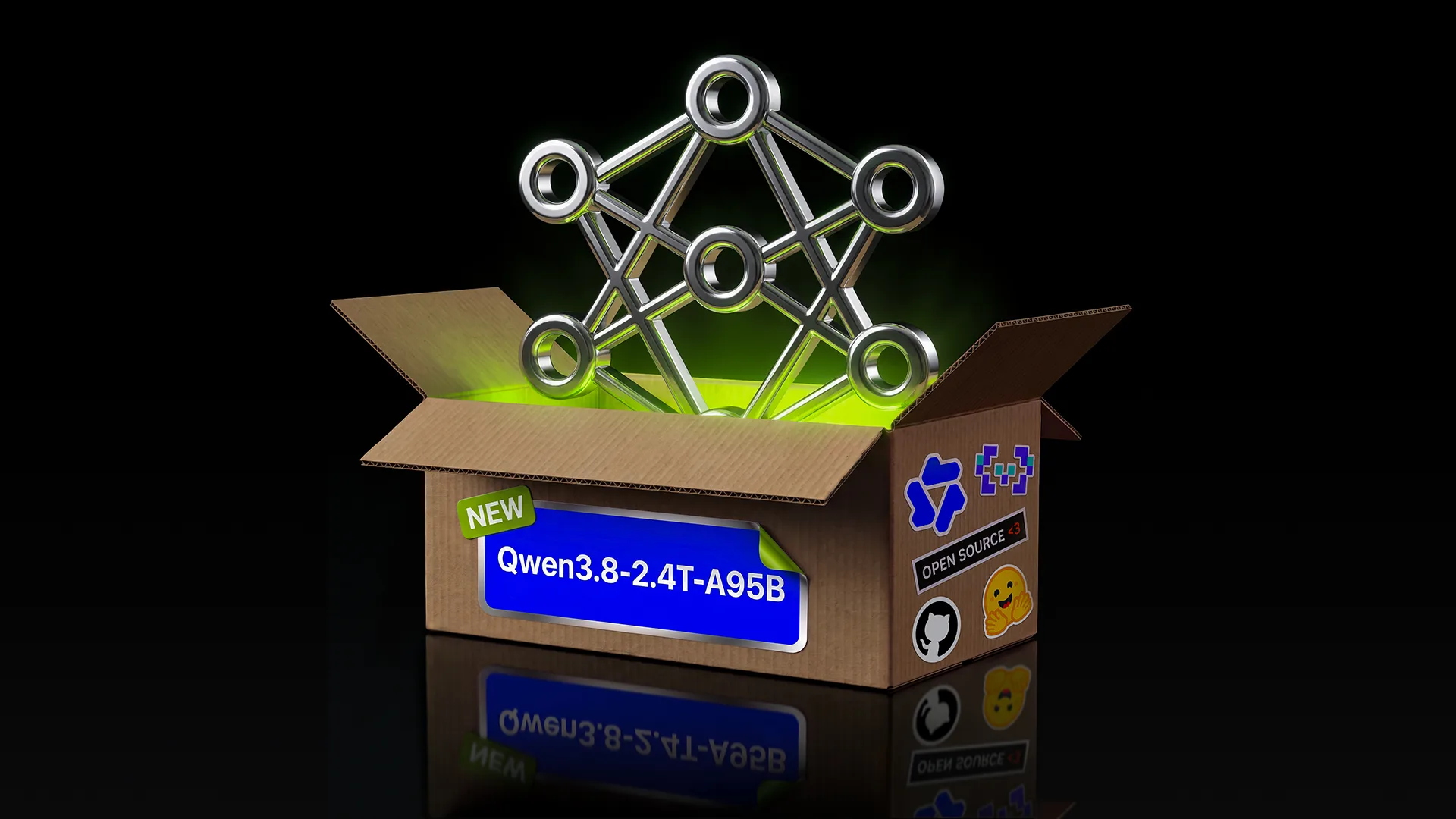
Serve Qwen3.8-2.4T-A95B, a 2.4T-Parameter Model, with Configurable Reasoning on NVIDIA GB300 NVL72
Alibaba released open weights for Qwen3.8-2.4T-A95B, its largest open-weight model at 2.4T total parameters with 95B activated per token.
Why it mattersA near-frontier open-weight model with published serving guidance is a real option for teams that want to run inference themselves instead of renting an API.

Paradigma's fellows explain their record-setting training runs: FP8 MLP down-projection with fused delayed-scale quantization, a damped late-stage weight-extrapolation optimizer, cheap attention and embedding gates, and learnable exclusive self-attention, plus lessons on steering coding agents in re
Why it mattersShows how to make FP8 pay off by fusing quantization and amax tracking into the up-projection kernel so activations are never reread. Also describes how the team scaled human involvement across parallel coding-agent research runs.

Designing Agents (The Floor Is the Frontier) — Ben Hylak, Raindrop
Raindrop's Ben Hylak argues eval advice is stuck in the chatbot era.
Why it mattersThe floor, not the ceiling, is what breaks user trust, and the two-number triage gives teams a way to rank an effectively infinite issue list.
Artificial Analysis reports Grok 4.6 gaining sharply on AA-Briefcase, a private benchmark of 91 long-horizon knowledge-work tasks, tying Claude Fable 5 within confidence intervals at $4.42 per task versus $22.30. The benchmark page details rubric and pairwise grading.
Why it mattersAA-Briefcase grades long-horizon agent work (spreadsheets, decks, memos) on rubric checks plus pairwise quality, and reports cost per task.

Artificial Analysis reports Grok 4.6 gaining sharply on AA-Briefcase, a private agentic knowledge-work benchmark. Confidence intervals overlap with Claude Fable 5, while cost per task is $4.42 versus $22.30, $17.79 for Opus 5 and $6.73 for Kimi K3.
Why it mattersOn a private long-horizon agentic benchmark, Grok 4.6 is statistically level with Claude Fable 5 at about a fifth of the cost per task ($4.42 vs $22.30), which matters when choosing a model for agent workloads.

Bringing Continual Learning into Enterprises — Samuel Denton, Applied Compute
Applied Compute pushed a Qwen model's SWE-bench submissions from 80 turns toward 40, lifting the submit-tool call rate from 22% to 60% with pass rate flat.
Why it mattersIt shows a practical way to correct agent behavior from production traces without a replayable environment, and names the failure modes of the obvious alternatives.

LangSmith is now available as a bring your own cloud deployment on @awscloud. Ke
LangSmith is now available as a bring your own cloud deployment on @awscloud.
Why it mattersTeams that could not send agent traces to a vendor-hosted service now have a supported path to run LangSmith inside their own account.

Nous Research adds /export and /import to Hermes. A profile (skills, memory, persona, crons, plugins, settings, desktop themes and layouts) saves to a single file with credentials stripped, then loads on another install.
Why it mattersHermes profiles can now be exported to one credential-free file and imported elsewhere, so an agent setup with skills, memory, crons and plugins can be moved or shared without manual reconstruction.
Artificial Analysis benchmarks Upstage's Solar Pro 4: Intelligence Index 14 to 42, large agentic and long-context gains, doubled pricing and slower tasks. Its Omniscience improvement comes from abstaining (41% attempted), while accuracy stays near 19%.
Why it mattersSolar Pro 4's headline Omniscience jump comes from answering fewer questions, with accuracy flat near 19%. Its agentic gains are real (Terminal-Bench 12% to 57%), but pricing doubled and latency rose, which affects model selection.
Artificial Analysis benchmarks Upstage's Solar Pro 4: Intelligence Index 42 (up from 14), Terminal-Bench v2.1 at 57%, 512K context, higher price than Solar Pro 3, and a latency penalty. Hallucination rate falls mainly through abstaining more.
Why it mattersSolar Pro 4 jumps on agentic benchmarks (Terminal-Bench v2.1 57%) at $0.30/$1.20 per 1M tokens, but runs slower per task and costs more than DeepSeek V4 Flash, which scored higher. That helps you judge cost against capability.

LLM Knowledge Bases: a practical guide — Ben Holmes, Warp
Ben Holmes starts a knowledge base with voice dictation rather than organisation, on the grounds that talking runs at 200 words a minute.
Why it mattersA concrete agent-maintained knowledge pipeline that runs on a schedule, including the small details that keep an agent from inventing its own taxonomy.

Stop being skeptical about AI for development with Charity Majors
Charity Majors on the Pragmatic Engineer podcast, arguing against continued skepticism about using AI in software development.
Why it mattersA practitioner known for skepticism about hype walking through what changed her mind is more useful than another advocacy piece.

DeepSeek V4 Pro 0813 is live on OpenRouter. DeepSeek reports gains over V4 Pro Preview: DeepSWE 62.7, CyberGym 83.3, NL2Repo 61.5 and Terminal Bench 2.1 87.9. More providers are expected soon. Independent verification is not yet available.
Why it mattersDeepSeek reports large agentic coding gains over V4 Pro Preview, such as Terminal Bench 2.1 at 87.9 (+15.8), and the model is routable now.

Adaption Labs: Gradient-Free Continual Learning — Sara Hooker, Adaption
Sara Hooker estimates fewer than five thousand people know how to train a frontier model at scale, knowledge passed on like an apprenticeship rather than a literature.
Why it mattersA grounded case, with system results behind it, that the axis of progress is shifting away from pretraining scale and toward automated search over the training loop.

Cohere's CEO announced North Micro Vision, a new vision model for enterprise document understanding released under the Apache 2 license. The post gives no benchmarks or size, so evaluate it yourself before building a self-hosted document pipeline on it.
Why it mattersA permissively licensed (Apache 2) vision model for document understanding can be self-hosted in document pipelines without usage restrictions. Benchmarks and size were not in the source, so check them before adopting.
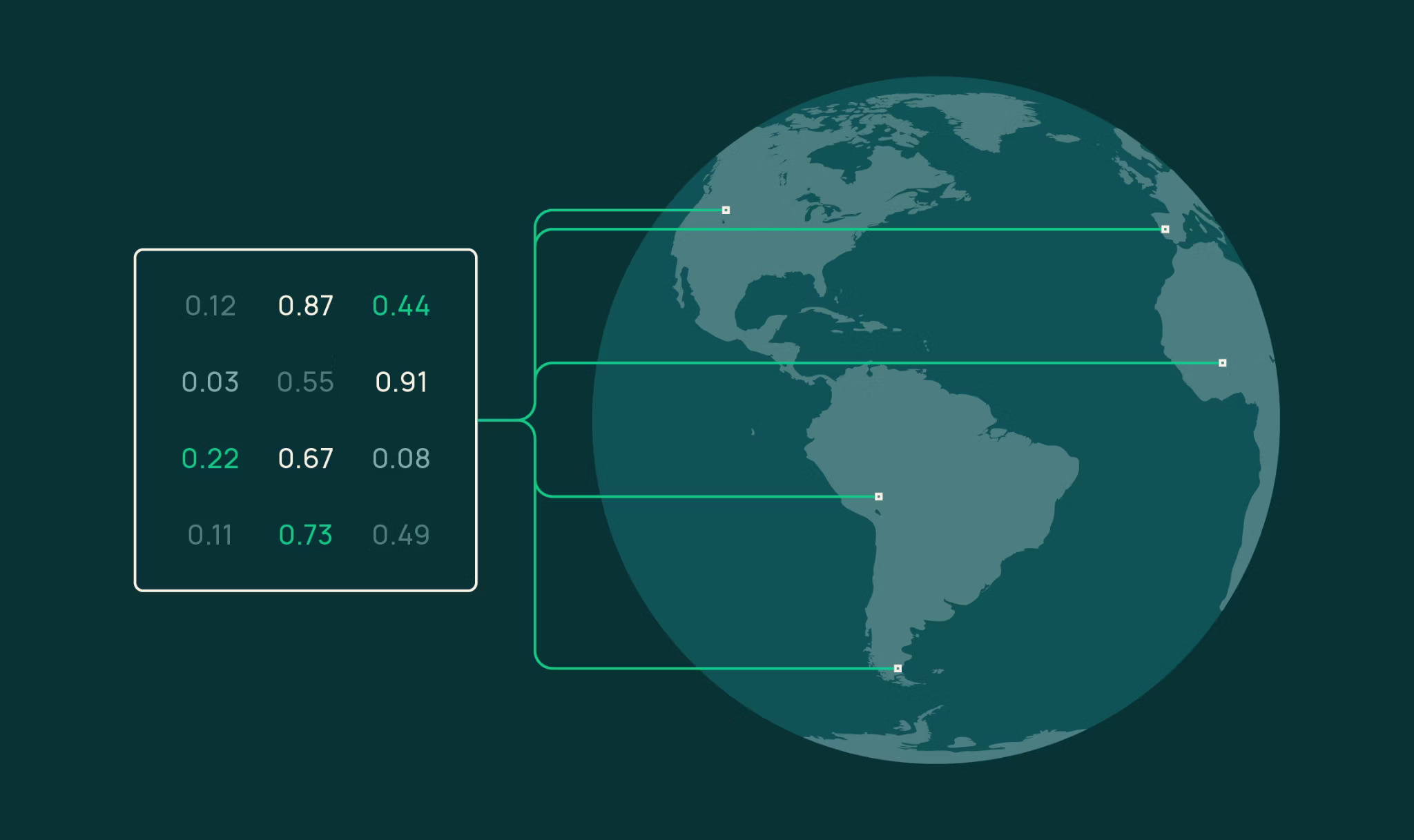
Introducing OlmoEarth embeddings: Custom embedding exports from OlmoEarth Studio for downstream analysis
OlmoEarth Studio can now compute and export embedding vectors for any polygon and time range, delivered as int8 Cloud-Optimized GeoTIFFs from Nano, Tiny or Base encoders over Sentinel-1 and Sentinel-2 imagery.
Why it mattersA cheap entry point to a public Earth-observation foundation model: export int8 embedding rasters for your own area and time range, then run similarity search, few-shot segmentation or change detection without training anything.

How to Choose Full-Stack Observability for NVIDIA AI Factories
A triage framework for GPU clusters running AI workloads.
Why it mattersAI training jobs degrade badly without anything reporting "down" — this shows which telemetry catches stragglers and gray failures early, and which signals actually deserve an alert.

Intelligence + Continual Learning = Expertise — Yu Su, NeoCognition
Yu Su separates intelligence, reasoning through an unfamiliar problem from the context you were handed, from expertise, accumulated situated competence.
Why it mattersIt gives a precise account of why coding agents generalize where other agentic work does not, which is directly useful when scoping what an agent can be trusted to do.

Alex Cheema runs the local-inference maths on a freshly published 2.4T-parameter, 95B-active open model: 4.89TB of weights, no 4-bit quant from the lab, and four 512GB M3 Ultras as the only viable local 4-bit rig — with an NVFP4 quant from NVIDIA, Unsloth or Red Hat the missing piece.
Why it mattersA 2.4T-parameter open release is not locally runnable as shipped: 4.89TB of weights with no 4-bit quant from the lab, and even 4-bit needs roughly four 512GB machines.
Grok 4.6 is routable on OpenRouter, with gains over Grok 4.5 claimed on GPDVal-AA V2 and pricing unchanged at $2 per million input tokens and $6 per million output.
Why it mattersA frontier-tier model holding its price across a version bump means you can change the model string without rebuilding your cost model, at $2 in and $6 out per million tokens.

Why coding-agent harnesses can cost more than the model prompt
Caleb Writes Code examines how system prompts, repeated tool turns, and caching affect the cost of running a coding agent.
Why it mattersCompare the cost of a completed agent task rather than model token prices alone. Harness overhead and cache behavior can make the same model cost different amounts in different clients.
Artificial Analysis benchmarks Grok 4.6: 61 on the Intelligence Index, strong GDPval-AA, tau3-Banking and Terminal-Bench results, $0.84 per task, and turn-efficient agent runs. Speed is below average at 71 tokens per second with a long time to first token.
Why it mattersGrok 4.6 reaches frontier-level agentic scores at $2/$6 per million tokens, over 60% below Claude Opus 5 and GPT-5.6 Sol, and uses about half the turns per task, which changes cost-performance choices for agent workloads.

Scaling Compute on Context — Jack Morris, Engram
Train directly on ten thousand financial reports, drive the loss to near zero, and generation collapses.
Why it mattersIf you are trying to make a model good at your own corpus, this lays out which methods have real headroom and which quietly cap out.
📊We’ve rebuilt Dashboards in LangSmith to make them more useful for investigati
📊We’ve rebuilt Dashboards in LangSmith to make them more useful for investigation and reporting.
Why it mattersTrace-level breakdowns by model and user change how quickly you can localize a regression in an agent that is already in production.
OpenRouter's Ori Eval, a model-comparison CLI, now reports failure causes and the serving provider, counts crashed runs as failures, estimates run cost with ori eval --pilot, warns on same-family judges, and supports headless login for CI and agent runs.
Why it mattersModel-as-judge evals are biased when judge and candidate share a family. Ori Eval now warns about this and estimates full-run cost within 5% before spending, which makes model comparisons cheaper and more trustworthy in CI.

Memory Harnesses for Long-Running Research Agents — Stefania Druga, Sakana.ai
On a literature review where every paper already fitted in the context window, adding a memory harness changed nothing but cost.
Why it mattersIt gives a defensible answer to when an agent memory system earns its cost and which recall policy to reach for first.
Sakana Chatがアップデート:「Sakana Fugu」と新世代「Sakana Namazu」が利用可能に
Sakana AI updates its chat product with the Fugu orchestrator model, a newer Namazu generation, sandboxed Python execution and a panel that previews generated HTML, Word files and slides for download.
Why it mattersSakana Chat now runs Python in a sandbox and renders the resulting HTML, documents and slides in-session, and adds the Fugu orchestrator plus a newer Namazu generation for Japanese work.

Runway's Agent gained connectors for Figma, Dropbox and Notion on all paid plans, letting it sync designs, files and docs from those tools. Based on the announcement post only; permissions and scope details were not collected.
Why it mattersRunway's Agent can now pull designs, files and documents from Figma, Dropbox and Notion directly into its work, so context no longer has to be exported by hand. It is available on all paid plans.
Scaling up Continual Learning — Ronak Malde, Trajectory
Push on-policy self-distillation to trajectories with a hundred tool calls and the model collapses into hedging, favouring wait, but and maybe.
Why it mattersLong-horizon agent training has a specific, reproducible failure mode here, along with the corrections that keep it from collapsing into hedging.

Google DeepMind's SL2T model brings American Sign Language input to Pixel 11, letting people sign into Gboard and Live Transcribe instead of typing. It maps simultaneous hand, body and face movement straight to text, tracks poses on-device, and runs translation server-side.
Why it mattersSign-language input is now a shipped phone keyboard modality, and the split design — pose extraction on device, translation on the server — is a reusable pattern for privacy-sensitive multimodal features.

Putting sign language AI into users’ hands
Google DeepMind introduces SL2T, a sign-language-to-text model behind new features for Deaf and hard of hearing users, aimed at the 200-plus sign languages automatic translation and dictation never reached.
Why it mattersA frontier lab shipping a production sign-language model marks a new modality moving from research into a shipped consumer surface.

LFM2.5-VL-3B targets screen and UI agents, scoring 80.7 on ScreenSpot-v2 and 59.5 on ToolSandbox. It decodes 228 tok/s on an M5 Max and 20 tok/s on a Galaxy S26 Ultra in about 3GB, with day-one support in llama.cpp, MLX, vLLM, SGLang and ONNX.
Why it mattersA roughly 3GB vision model that grounds UI elements and calls tools from screenshots lets you run computer-use style agents locally. Day-one llama.cpp, MLX, vLLM, SGLang and ONNX support lowers the cost of trying it.

LFM2.5-VL-3B for Better and Faster Vision Capabilities for the Edge
Why it mattersA small vision-language model built for on-device inference changes what engineers can run locally instead of calling a hosted API. Anyone shipping multimodal features at the edge should know this option now exists.

Deepgram shipped Flux TTS, a speech synthesis model built for live agent conversations. Its stated difference from typical TTS is conversation-level context: delivery of a line is conditioned on what came before, rather than each utterance being synthesized on its own.
Why it mattersFlux TTS carries conversational context across turns instead of rendering each line in isolation, aimed at the flat, disconnected delivery that agent voices fall into during live calls.

Beyond Static Intelligence: Evaluating Continual Learning — Parth Asawa, UC Berkeley
Every leaderboard wipes memory between tasks, which assumes learning across instances does not count.
Why it mattersIt supplies a way to measure whether an agent actually learns across tasks, and finds the elaborate context-management systems losing to in-context learning.

Nemotron 3.5 Lightning First Test – NVIDIA’s NEWEST Open Model!
A hands-on test of NVIDIA's Nemotron 3.5 Lightning across browser workflows, C++ coding, 3D CAD modelling, frontend design, long-context recall, niche knowledge and roleplay.
Why it mattersEarly independent testing of a new open model tells you where it actually holds up on coding and long-context work before you spend time wiring it into anything.

Computer-use models will agentify the web, not APIs — Dhruv Batra, Yutori
Yutori's Dhruv Batra argues the web will not meet agents with APIs, because the long tail of 200 million sites will not ship MCP servers.
Why it mattersA clear case against betting agent architecture on the web meeting agents halfway with structured interfaces.
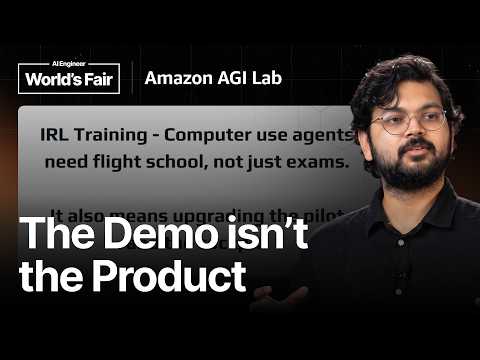
From RL to IRL — Gaurav Mishra, Amazon AGI Lab
Amazon AGI Lab's Gaurav Mishra on browser agents meeting reality.
Why it mattersReframes agent reliability as training for recovery rather than thickening the harness around the model.
I wrote an AI textbook — how long until AI can do it better?
Nathan Lambert on where AI writing actually threatens to do better.
Why it mattersAnyone betting on models doing sustained, organized technical work should know where the current ceiling sits and why more raw capability has not moved it.
How We’re Building Scam Alert on WhatsApp With End-to-End Encryption and Verifiability Guarantees
WhatsApp is beta-testing Scam Alert, an opt-in on-device model that flags likely scam messages without any content leaving the phone.
Why it mattersOn-device classification small enough to run on phone hardware lets a product add ML safety signals without breaking end-to-end encryption — no message content leaves the device and nothing is auto-reported.
Meta Superintelligence Labs released Muse Glimmer, its first open-weights model: a 30B dense text and image model under Apache 2.0, aimed at local agent use. OpenRouter reports 75.5 on MCP Atlas and 51.2 on SWE-Bench Pro, served via zero-retention providers.
Why it mattersA 30B dense, Apache 2.0, text and image model aimed at local agent use gives you a permissively licensed option to run or host yourself. Reported scores are 75.5 on MCP Atlas and 51.2 on SWE-Bench Pro.

DoorDash details Flux, its in-house cloud agent platform running 130,000 tasks a month. It covers four primitives (Firecracker sandboxes, an MCP gateway with scoped permissions, YAML playbooks, multi-surface invocation) and adoption lessons.
Why it mattersShows how to move coding agents off laptops: Firecracker sandboxes, an MCP gateway granting per-playbook scoped tools with audit logs, and YAML playbooks mixing agentic and deterministic steps. Starting with code review earned trust.
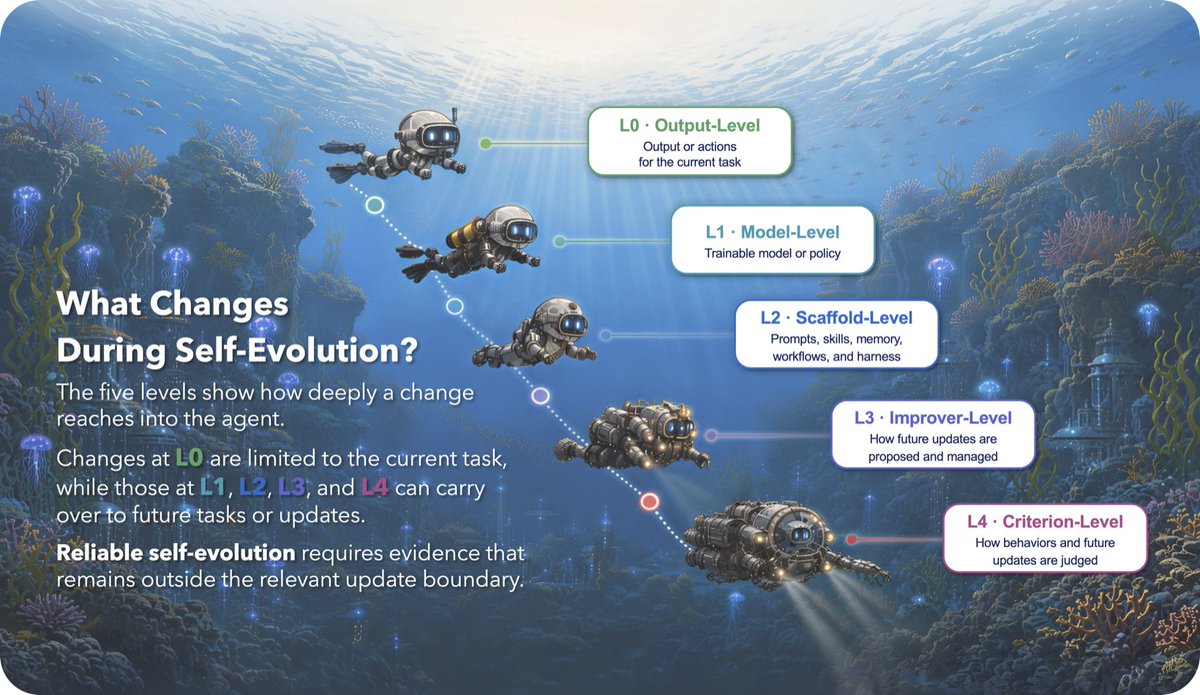
Survey Maps Self-Evolving Agents to L0-L4 and a Reliability Ladder
Tencent Hunyuan and Zhejiang University classify self-evolving agents by the deepest component that changes (output, model, scaffold, improver, criterion) and pair each level with audit controls.
Why it mattersAgents that rewrite prompts, skills, memory or harness code need acceptance gates the agent cannot edit.
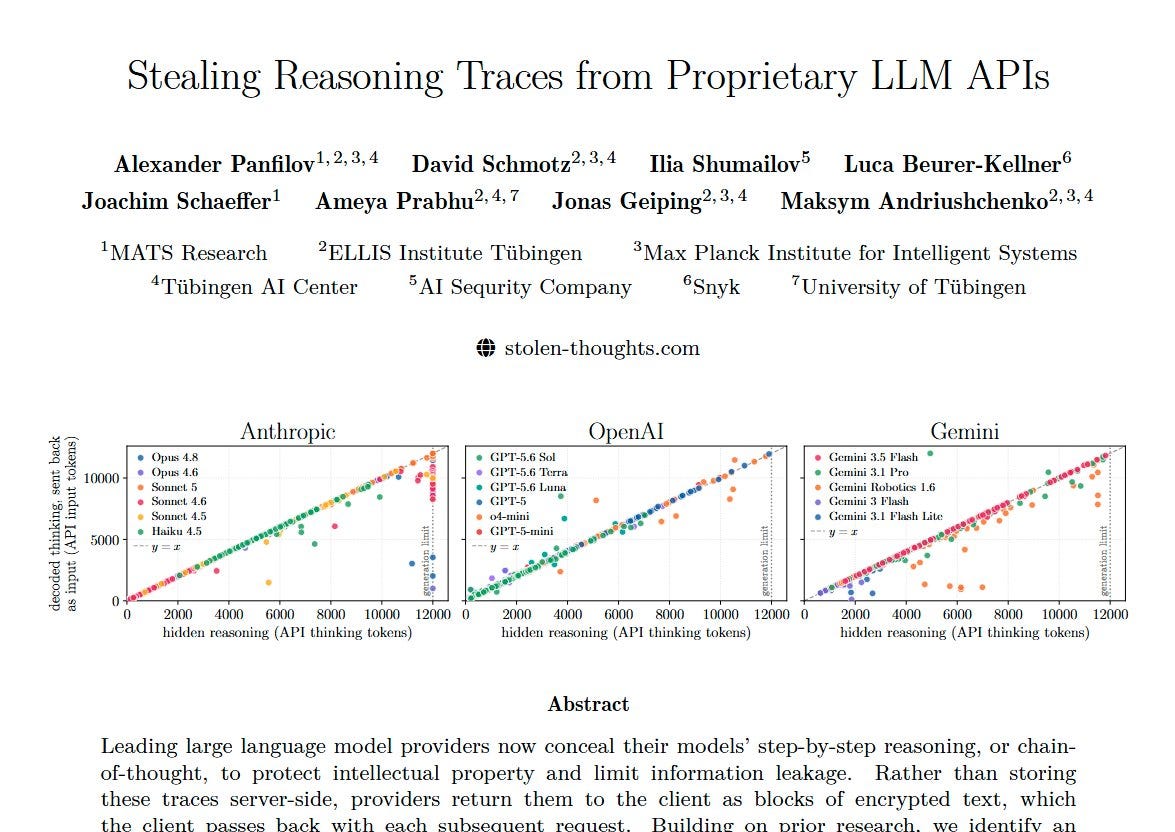
[AINews] How to steal a Reasoning Trace
Reasoning traces that labs encrypt to prevent distillation turn out to be decodable and replayable across models and sessions.
Why it mattersShared sessions with encrypted reasoning blobs are not opaque — secrets an agent reasoned about but never printed can be recovered. Treat any published trace as public and rotate what it touched.

DeepSeek V4 Pro now runs updated weights on AI Gateway
DeepSeek V4 Pro on Vercel's AI Gateway now serves updated weights by default under the unpinned model ID, so existing calls pick them up silently.
Why it mattersDeepSeek V4 Pro calls may already be hitting different weights than last week — pin the dated model ID if you need reproducible behaviour.

Do Personalized Skills Help Coding Agents? An Empirical Study of Developer Interaction Histories
An empirical study of whether developer interaction histories make useful agent skills, capturing the preferences that emerge through repeated corrections and reusing them without touching model parameters.
Why it mattersAnyone investing in per-developer agent memory or personalized skill files should see evidence that pooling beats personalization on the same data.

The Parser Already Knows: Lightweight Bias Correction in Constrained Decoding
Grammar-constrained decoding distorts the model's distribution by masking tokens, and correcting that with resampling is expensive.
Why it mattersStructured output and tool-call schemas run through constrained decoding everywhere, and this removes the quality-versus-latency compromise those pipelines currently accept.

Similarity Gates Approve Reversals: A Validity Audit of Embedding-Cosine Thresholds in Agent Systems
Agent frameworks gate on embedding-cosine similarity to ask whether text still means the same thing, but the score measures how much the wording changed.
Why it mattersDedup filters, semantic caches and grader gates built on cosine thresholds are common in agent stacks, and this shows the failure is structural rather than a tuning problem.
An index of the vibe-coding frontier. Corrections welcome.