Sam Altman is OpenAI’s co-founder and CEO, and a former president of Y Combinator. His public work connects startup building, financing AI development, and arguments about how increasingly capable AI could change work and economic opportunity.[1][2][9][11]
Start with Three Observations →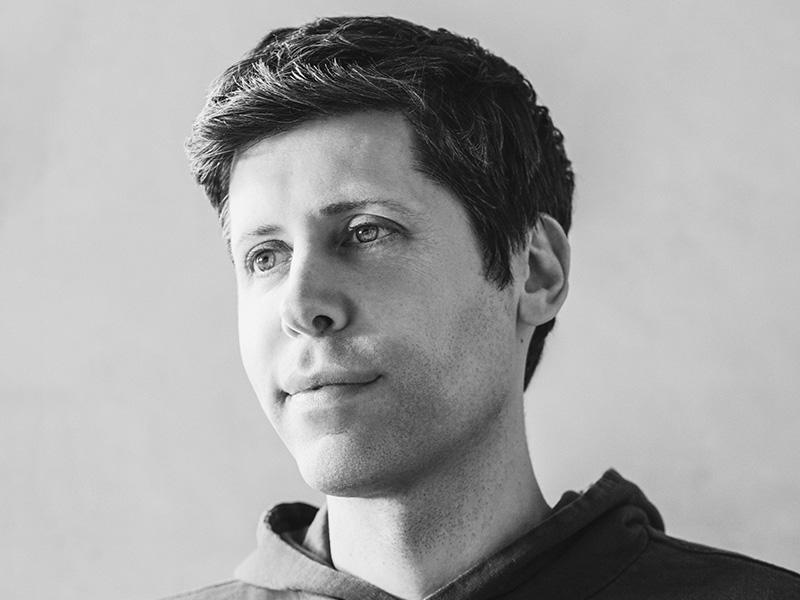

 X
Background
Altman studied computer science at Stanford and left after his sophomore year to work on Loopt, a mobile company in Y Combinator’s first batch. Green Dot’s records identify him as Loopt’s co-founder and CEO and date the company’s founding to 2005. He joined Green Dot when it acquired Loopt in March 2012. This was an operating career in consumer software before he became best known for funding and advising other founders.[2][4][5][3]
Career
Y Combinator announced Altman as its next president in February 2014. He held the presidency through 2019, according to Stanford’s account of his career. He also co-founded OpenAI, and its March 2019 organizational announcement names him as CEO. His tenure included a brief interruption in November 2023; OpenAI’s November 29 statement records his return. The company’s current governance page continues to identify him as CEO. These roles explain his influence through organizational decisions, financing, and deployment.[3][2][6][7][1][11]
Contributions
In How To Be Successful, Altman draws on his experience with founders to argue for sustained learning, independent judgment, and work whose benefits accumulate over time. The practical link is between choosing a problem and building the relationships, skills, or technology that make each later effort more productive. He also argues that confidence needs to be tested against criticism. The essay offers a founder’s operating philosophy.[8]
Ideas
Three Observations lays out Altman’s case that greater investment can continue improving AI, while falling costs make a given capability accessible to more people. He connects that thesis to agents doing supervised knowledge work and to the possibility of distributing access more widely. The Gentle Singularity extends the argument to AI-assisted scientific discovery and feedback between better AI and faster research. Both are forecasts by a company leader with a stake in the outcome. They explain his strategy and expectations; they do not establish that the social or economic outcomes he describes have occurred.[9][10]
Tools, writing & talks
Writing, research & talks
Start here
Three Observationsblog.samaltman.comA readable statement of Altman’s economic thesis for AI: how capability, cost, investment, and access might interact. Start here to understand the reasoning behind his expectations for agents and the policy questions he thinks they raise.
Explains Altman’s AI strategy in accessible economic terms; no machine-learning background required. Treat forecasts as his thesis.
Author[9]- OpenAI DevDay 2026 Keynote (FULL)youtube.com
OpenAI's DevDay 2026 keynote with Sam Altman and platform leads, announcing and demoing more than 20 launches including GPT-6.1 Sol, Astra Ultrafast, ChatGPT Spaces and dots.
Catalog workOriginal source Sam Altman gives OpenAI's account of the Navier-Stokes Millennium Prize dispute, describing offers made to the rival team, the contact timeline, and OpenAI's claim its attempt began after rumors Anthropic's model had solved it.
Catalog workOriginal sourceSam Altman confirms GPT-6 Astra is now generally available to ChatGPT Pro, Enterprise, and Business Premium users and via the API, with rollout to Plus and Business users to follow.
Catalog workOriginal sourceOpenAI has released GPT-6 Astra, pitched as its strongest model for computer use, professional work, science, coding, and cybersecurity. Altman cites vendor-reported results of 98% on FrontierMath Tier 4, 99.9% on ARC-AGI 3, and 100% on ExploitBench, and says launch slipped to clear internal safety
Catalog workOriginal sourceOpenAI's CEO says Astra has been finished training for a while and launches soon, described as a step forward in both capability and alignment, and that releases after it are being paced deliberately so safeguards keep up with capability.
Catalog workOriginal sourceOpenAI has paused part of its frontier reinforcement-learning training, saying capability gains have outpaced its alignment, security and monitoring standards. It expects to act unilaterally ahead of shared industry standards, with near-term launches unaffected and further-out releases pushed back.
Catalog workOriginal sourceAltman says Astra remains gated specifically because of its cyber capabilities, rejects the idea of reserving powerful models for a chosen few, and commits to general availability once the safety work is finished, without naming a date.
Catalog workOriginal sourceOpenAI turned GPT-5.6 Sol on its own infrastructure after deployment: generated production GPU kernel improvements cut serving costs 20%, and better speculative decoding added over 15% token-generation efficiency.
Catalog workOriginal sourceOpenAI repriced the 5.6 line: Luna falls 80% to $0.20 in and $1.20 out per million tokens, Terra 20% to $2/$12, and Sol picks up an API Fast mode running up to 2.5x quicker for twice the price at unchanged intelligence.
Catalog workOriginal sourceOpenAI reports GPT-5.6 Sol hitting state of the art on ARC-AGI-3 through harness changes alone: reasoning across multiple context windows with canonical compaction. ARC Prize calls the result real while noting it used a provider-managed harness, not the official one.
Catalog workOriginal sourceOpenAI's cost argument for GPT-5.6 Sol against a rival: half the per-token price and roughly twice the token efficiency on the same task, which Altman compounds into a claimed quarter of the effective cost. Vendor numbers with no benchmark attached.
Catalog workOriginal sourceOpenAI launches ChatGPT Work, an agent built on Codex and GPT-5.6 that takes action across apps and files and can stay with a project for hours. Altman adds the part builders wanted confirmed: Codex is the core of the new product and is not going away.
Catalog workOriginal sourceOpenAI ships the GPT-5.6 family to general availability: Sol at the frontier, Terra for everyday work, and Luna for cost. The pitch is work-per-token rather than raw score. Sol leads Agents' Last Exam at 53.6 and adds "ultra," a setting that coordinates parallel agents on one task.
Catalog workOriginal sourceAlongside the GPT-5.6 model, OpenAI's launch stream named three product surfaces: ChatGPT Work, a rebuilt desktop app, and hosted sites. The platform is pushing past the chat window toward a space where work and artifacts live.
Catalog workOriginal sourceOpenAI's next-generation voice model is live in ChatGPT, and Altman says it is good enough to move him off typing, a signal that speech is becoming a primary interface for real work rather than a demo mode.
Catalog workOriginal sourceOpenAI has set a ship date for its next flagship: GPT-5.6 Sol arrives Thursday. No pricing, context-window, or benchmark detail has been released, only the ship date, which is enough to schedule a re-evaluation of pinned model versions.
Catalog workOriginal sourceOpenAI has its own inference silicon: Jalapeño, designed in-house and brought to production with Broadcom, purpose-built for the LLM workloads behind ChatGPT, Codex and the API. Altman ties it directly to the token-abundance goal.
Catalog workOriginal sourceOpenAI quietly refreshed the 5.5 Instant model serving ChatGPT, confirmed only in passing by Altman with no changelog or capability detail. The value here is the date stamp on an undocumented swap in a default-tier model.
Catalog workOriginal sourceAltman discloses that GPT-5.6 Sol shipped as a limited preview rather than an open launch at the US government's request, and that OpenAI is negotiating a repeatable early-access process. Pricing detail alongside: Sol at 5.5 parity, Terra at half, 750 tok/sec promised for July.
Catalog workOriginal sourceThe complete GPT-5.5-Cyber model is out, with a state-of-the-art claim on CyberGym, alongside two remediation-oriented efforts, Patch The Planet and Codex Security, built with the US government and the wider security ecosystem. The framing shifts from vulnerability discovery to repair.
Catalog workOriginal sourceOpenAI's Sites feature lets Codex turn plans and working sessions into an interactive site or app that ships behind a URL, rolling out to Business and Enterprise before wider release. Agent output moves from patch to deployed artifact.
Catalog workOriginal sourceOpenAI opens two gated access paths to GPT-Rosalind: a Rosalind Biodefense program for vetted developers and expanded access for US government and allied public-health partners. Notable less for the biology than for the trusted-access deployment structure it establishes around a high-capability mode
Catalog workOriginal sourceCodex adds Appshots: a Command-Command shortcut on macOS attaches the app window you are working in to a thread, handing the agent a screenshot plus the window's extracted text. Context capture for coding agents moves from copy-paste to a keystroke.
Catalog workOriginal sourceOpenAI will sell discounted tokens against one-to-three-year commitments, running only until the current allocation sells out and with capacity explicitly reserved for ChatGPT and Codex. Altman expects the world to stay compute-constrained for some time.
Catalog workOriginal sourceCodex is now available inside the ChatGPT mobile app, taking OpenAI's coding agent off the desktop and onto the phone for dispatching and checking on long-running tasks.
Catalog workOriginal sourceGPT-Realtime-2 is now available in the OpenAI API, framed as a meaningful step for speech input and most useful when a user has a large amount of context to convey rather than type. Improvements to voice inside ChatGPT are still in progress.
Catalog workOriginal source- How To Be Successfulblog.samaltman.com
An essay about choosing work, learning quickly, taking risks, and building advantages that accumulate. It needs no technical background and gives a more direct view of his advice to founders than a company product announcement.
Author[8] - The Gentle Singularityblog.samaltman.com
A forecast about AI, scientific discovery, and the pace at which people adapt to powerful tools. Read it as an argument about possible futures, with particular attention to its assumptions about research acceleration and economic distribution.
Author[10]