Intel
Page 25
Matt Van Horn@mvanhorn
A viral article by Matt Van Horn breaking down the 15 most common AI agent loops people are actually running, complete with copyable commands. It's the sequel to a 3.6M-view piece on what loops are, now focused on practical implementation.
Why it mattersMatt Van Horn's breakdown of the 15 agent loops people actually run day to day, each with a copyable command. The practical sequel to his viral explainer — skip the theory and steal a working loop.

Reflecting on a Year of Claude Code (Boris Cherny)
Claude Code is an agentic coding tool that runs in your terminal, letting developers delegate coding tasks, verification, code review, and CI automation to an AI agent.
Why it mattersThis is the guy who built Claude Code reflecting on what actually stuck after a year of real use.
videoClaude
Anthropic's Boris Cherny: Why Coding Is Solved, and What Comes Next
Claude Code is Anthropic's AI coding agent that lets developers ship code through natural language instead of writing it by hand.
Why it mattersCherny's claim isn't that AI helps you code faster—it's that the bottleneck has already moved off your keyboard entirely, toward dispatching and reviewing agentic work in parallel, even from your phone.
videoSequoia Capital

Boris Cherny: Claude Code & the Future of Engineering | Acquired Unplugged
Claude Code is Anthropic's AI coding agent that lets developers build software through natural language rather than a traditional IDE.
Why it mattersStraight from the person who built Claude Code, this is less a tutorial and more a mental model shift: treating natural language as the primary interface for shipping software, with the Cowork-in-8-days story as proof of what that unlocks.
videoWorkOS
Andrej Karpathy on Vibe Coding & Agentic Engineering (AI Ascent 2026)
A conversation between Andrej Karpathy and Sequoia's Stephanie Zhan about the evolution from 'vibe coding' to agentic engineering, the nature of LLMs as 'ghosts,' Software 3.0.
Why it mattersKarpathy's line — you can outsource thinking but never understanding — is the frame most agentic-coding advice is missing.
videoSequoia Capital

Printing Press
Printing Press turns any website or app into a command-line interface that AI agents can use, discovering hidden APIs and integrations so agents can interact with services that lack official developer access.
Why it mattersThe trick here is treating any website or app as a CLI that agents can drive, reverse-engineering hidden APIs so your workflow can reach services that never shipped developer access.
videoPeter Yang

Why LLM Inference Is Memory-Bound (Julia Turc)
An educational video breaking down why GPUs vastly underperform their theoretical token throughput during LLM inference.
Why it mattersMost coding-tool advice stops at prompts; this goes a layer down to explain why your GPU sits idle burning most of its FLOPs during inference — it's starved for memory bandwidth, not compute.
videoJulia Turc

Diode
Diode is an AI-powered platform that designs and manufactures printed circuit boards (PCBs) in the United States, using models that can one-shot much of schematic design and compress hardware timelines from months to weeks.
Why it mattersMost AI-coding takes stay in the browser tab; this one drags the same one-shot generation loop into physical hardware, using models to draft schematics and collapse PCB timelines from months to weeks.
videoThe Generalist
Matt Van Horn@mvanhorn
An article/post arguing that AI agents should store learned lessons as pull requests to shared skill files rather than private memory files. The core insight is that private memory accumulates noise and makes agents dumber over time, while code-reviewed skill files keep agents sharp and auditable.
Why it mattersArgues that agents should store learned lessons as pull requests to shared, code-reviewed skill files instead of private memory.

Rhys@RhysSullivan
A thread/article by Rhys Sullivan analyzing why MCP (Model Context Protocol) didn't gain traction when it launched alongside early models like Sonnet 3.5 and GPT-4o, and what comes next for agent-to-tool connectivity. Written by a YC-backed founder building infrastructure to connect AI agents to tools, APIs, and services.
Why it mattersRhys Sullivan's analysis of why MCP didn't take off when it launched alongside models like Sonnet 3.5 and GPT-4o, and what comes next for agent-to-tool connectivity — written by a YC-backed founder building that infrastructure.

Max Zanoga@zanoga
A first-person narrative article documenting the journey of scaling a personal GPU cluster from a single RTX 3090 to a 32-GPU setup over two years. It covers the practical decisions, challenges, and lessons learned in building serious personal AI/ML infrastructure. Useful for ML practitioners and hobbyists considering scaling their own compute.
Why it mattersFirst-person account of scaling a personal GPU cluster from a single RTX 3090 to 32 GPUs over two years — the practical decisions, challenges, and lessons for anyone building serious home AI/ML infrastructure.

vivek@itsreallyvivek
A viral thread by Vivek (@itsreallyvivek) that breaks down the unspoken craft of doing good research — the kind nobody explicitly teaches you. It covers how researchers actually learn the job, how to think about novelty, and how to produce meaningful work when the path isn't clear.
Why it mattersA widely shared thread that breaks down the unspoken craft of research — how researchers actually learn the job, how to think about novelty, and how to produce meaningful work when the path is unclear.

Elvis@elvissun
A detailed playbook by Elvis (@elvissun) explaining how to properly use /goal and loss functions with agentic AI coding tools to build a full product in under 30 hours using a single prompt. It corrects common misconceptions about long-running autonomous agent loops and shares techniques used by top agentic engineers.
Why it mattersElvis Sun's playbook for /goal and loss functions in agentic coding: how to actually get a full product out of a single prompt in under 30 hours, and which beliefs about long-running agent loops are wrong.

Glenn Hitchcock@glennui
A comprehensive reference guide for design and development terminology, covering typography, color theory, and visual design concepts. Provides precise definitions and practical context for designers and developers who need to communicate accurately about visual elements.
Why it mattersA precise reference for design and development terminology — typography, color, visual concepts — so you can name what you mean. Handy as a lookup when you are directing an agent and "make it look better" is not cutting it.
Just Talk To It - Agentic Engineering Guide
A practical, no-hype guide to working effectively with AI coding agents for software development.
Why it mattersPeter Steinberger's no-hype, practitioner's guide to actually working with coding agents — real workflows and honest tool comparisons. One of the more grounded reads on agentic engineering, from someone shipping with it daily.
articlePeter Steinberger

OpenClaw Orange Book
Complete guide to the OpenClaw open-source AI agent framework, bilingual English and Chinese.
Why it mattersA complete bilingual guide to the OpenClaw open-source agent framework. Useful if you are evaluating OpenClaw specifically, or want to see how a full agent framework documents itself.
repo花叔

Claude Constitution
The foundational document describing Claude's values and behavior.
Why it mattersThe foundational statement of Claude's values and intended behavior. Short, and worth reading to understand the priorities baked into the model you are prompting against every day.
repoAnthropic

Codex Orange Book
Complete practical guide to OpenAI Codex — agentic coding workflows, prompts, and patterns for the GPT-5.5 era.
Why it mattersA practical field guide to OpenAI Codex agentic workflows for the GPT-5.5 era — prompts and patterns, not marketing. Useful if you are standing up Codex-style coding agents and want someone else's hard-won defaults to start from.
repo花叔

Claude Code Orange Book
Claude Code: The Complete Guide — Chinese-language Orange Book series for shipping with AI coding agents.
Why it mattersThe complete Claude Code guide in the Orange Book series (Chinese-language). If you read Chinese, one of the more thorough single references for shipping with AI coding agents.
repo花叔

Harness Engineering Guide
Open guide to building and managing AI agent runtimes — concepts, tutorials, papers, tools, and references.
Why it mattersAn open, growing reference for building agent runtimes — concepts, tutorials, papers, tools — in one curated place. The map to start from if harness engineering is the rabbit hole you are heading down.
reponexu

OpenAI Model Spec
The OpenAI Model Spec — a public document defining how OpenAI's models should behave, the principles that govern them, and the rules they follow.
Why it mattersThe actual document defining how OpenAI wants its models to behave — the priorities behind the refusals and tone you fight with daily.
repoOpenAI
AI Agents Masterclass
Cole Medin's hands-on AI agents masterclass — video series with companion code covering production-grade agent patterns.
Why it mattersCole Medin's video-plus-code series on production agent patterns — not toy demos, the stuff that survives contact with real tasks. Worth it if you can prototype an agent but it falls apart the moment it has to be reliable.
repoCole Medin

Build nanoGPT
Andrej Karpathy's video lecture + code: build nanoGPT from scratch step by step, training a small GPT on Shakespeare and then OpenWebText.
Why it mattersKarpathy builds a GPT from an empty file to training on real text, narrating every decision. Still the clearest way to replace "LLMs are magic" with an actual mental model of what is happening under the hood.
repoAndrej Karpathy

promptbase
Microsoft's curated collection of prompt-engineering best practices, techniques, and benchmarks — distilled lessons from running LLMs at scale.
Why it mattersMicrosoft's distilled prompt-engineering techniques and benchmarks from running LLMs at scale. Less "10 magic prompts," more the methods that actually hold up. A solid reference to pull from when a prompt is not landing.
repoMicrosoft

Neural Networks: Zero to Hero
Andrej Karpathy's free video course building neural networks and language models from scratch in Python — from micrograd through nanoGPT.
Why it mattersKarpathy's full course from micrograd to nanoGPT, built from scratch in Python. The canonical path from "I use models" to "I understand them." Long, but nothing else replaces deriving backprop yourself.
repoAndrej Karpathy

Context Engineering Intro
Cole Medin's hands-on intro to context engineering — the practice that makes AI coding assistants actually work. Claude Code-centric, with templates and patterns.
Why it mattersCole Medin makes the hands-on case that prompt engineering is really context engineering — and the difference is why your coding assistant works or flails. Templates and patterns included, Claude Code-centric.
repoCole Medin

Coding LLMs from Scratch
Blaizzy's hands-on series for building LLMs from scratch — code-first walkthroughs of architecture, training, and inference.
Why it mattersBlaizzy's code-first series building LLMs from the ground up — architecture, training, inference. A hands-on alternative to Karpathy's course if you learn better by typing the implementation yourself.
repoPrince Canuma

rUv-dev
rUv's AI-powered development methodology — the rUv approach: prompts, patterns, and skills for shipping with AI agents.
Why it mattersrUv's opinionated methodology for shipping with AI agents — prompts, patterns, and skills packaged as a way of working. Worth skimming for the specific techniques even if you do not adopt the whole system.
reporUv

Thariq@trq212
Thariq makes the case for switching from Markdown to HTML as the default agent output format. Argues HTML is richer (tables, SVG, CSS, interactivity), easier to share, and keeps you more in-the-loop with what Claude is generating — even though it's 2-4x slower to produce than Markdown.
Why it mattersThariq's argument to make HTML, not Markdown, your agent's default output — because tables, SVG, CSS, and interactivity beat plain text once an agent is generating real artifacts.

Awesome DESIGN.md
A curated collection of DESIGN.md files inspired by popular brand design systems that AI agents can read to generate consistent, pixel-perfect UI.
Why it mattersA clever trick: drop a DESIGN.md modeled on a real brand system into your repo and agents generate consistent, on-brand UI instead of generic Bootstrap.
repoVoltAgent

Avi Chawla@_avichawla
How prompt caching works and why it matters: an agent resends its whole conversation every turn, so system instructions, tool definitions and project context are re-read and re-billed each time, with a case study reaching a 92% cache hit rate.
Why it mattersA concrete teardown of how Claude hits a 92% cache hit-rate, and why it matters: every agent step resends the whole history, so caching is the line between affordable and ruinous. Read it if your agent loops are quietly burning tokens.

Garry Tan@garrytan
Jepsen's Kyle Kingsbury, who spent a decade proving distributed databases broke their own consistency guarantees, turns the same methodical scepticism on language models.
Why it mattersJepsen's Kyle Kingsbury turns his distributed-systems rigor on LLMs, and the results are humbling. Read it for a clear-eyed, adversarial view of where models actually break — an antidote to benchmark hype.
Garry Tan@garrytan
LangSmith gives you trajectory evals, trace-to-dataset pipelines, model-as-judge and regression suites, but tools are not a practice: nothing tells you what to test, in what order, or when you are finished.
Why it mattersA skeptical look at agent evaluation and observability — using LangSmith's sophistication as a foil — and what actually stops an agent repeating failures versus what merely measures them.

Rohit@rohit4verse
The argument that teams shipping far more with far fewer engineers are not using a better model but a better environment, and that the harness, not the prompt or the temperature, is what separates them.
Why it mattersThe thesis that you are not picking the wrong model, you are building the wrong environment around it — with Cursor, Claude Code, and Perplexity as evidence.

Avid@Av1dlive
A builder's guide arguing you do not need your own model, only the infrastructure around one: memory that persists across sessions, skills that encode how tasks are done, and protocols bounding what the agent may do.
Why it mattersA builder's-guide tour of the agent stack you can assemble instead of training your own model. Skim past the thread-bait opening for a genuinely useful map of the layers and the tools that fill each one.
Introducing EmDash — the spiritual successor to WordPress that solves plugin security
Cloudflare's announcement of EmDash, a new serverless CMS built as a modern WordPress successor.
Why it mattersCloudflare's pitch for EmDash, a serverless WordPress successor that kills the plugin-security problem. Worth reading if you build content sites and want to see where the post-WordPress, edge-native CMS stack is heading.
blogCloudflare

Gauri Gupta@gauri__gupta
A comprehensive guide and methodology for building AI agents that automatically improve themselves by mining failures, creating evaluations, and fixing issues autonomously. Includes open-source auto-harness library implementation.
Why it mattersA methodology for agents that mine their own failures, generate evals from them, and fix issues automatically — closing the loop most teams still run by hand. Read it if "self-improving" currently means you, editing prompts at midnight.

Reid Hoffman@reidhoffman
A thought-provoking analysis of why SaaS isn't dead despite AI's ability to generate code, arguing that software businesses require ongoing maintenance, compliance, and AI-native evolution rather than one-time code generation.
Why it mattersThe counter-take to "AI killed SaaS": code generation is cheap, but maintenance, compliance, and trust are not — and that is where the business actually lives. Worth reading before you bet a roadmap on the "software is free now" narrative.

Neethan Wu@neethanwu
A three-layer system for engineers to build professional UI/UX using AI agents without becoming designers. Combines design skills, agent canvases, and taste development tools.
Why it mattersA three-layer system — design skills, agent canvases, taste development — for engineers to ship genuinely good UI without becoming designers. The missing method for everyone whose AI-built interfaces are functional but ugly.

Sam Ragsdale@samrags_
A platform advocating for open protocols in AI-powered commerce, enabling checkout and transactions through AI agents like ChatGPT without centralized gatekeepers. Aims to create an open alternative to walled-garden commerce platforms.
Why it mattersThe case for open protocols so AI agents can check out and transact without a centralized gatekeeper owning the rails. Early but important if you are thinking about where agent-driven commerce plugs in.

Defileo🔮@defileo
A personal knowledge management system that combines Claude AI with Obsidian to create an automated second brain that ingests, processes, and connects all your notes, articles, and ideas without manual maintenance.
Why it mattersA concrete setup wiring Claude into Obsidian so your notes get ingested, connected, and made queryable instead of rotting in folders. Steal the architecture if you have bounced off every "second brain" that was all capture and no retrieval.
Garry Tan@garrytan
A follow-up on thin harnesses and fat skills, arguing that resolvers, the routing layer deciding which skill handles what, matter more than the skills that got all the attention, and are invisible precisely when they work.
Why it mattersThe follow-up to "Thin Harness, Fat Skills," arguing resolvers — not skills — are the piece that makes agent systems route intelligently. Read after the original; this is where the framework grows its connective tissue.
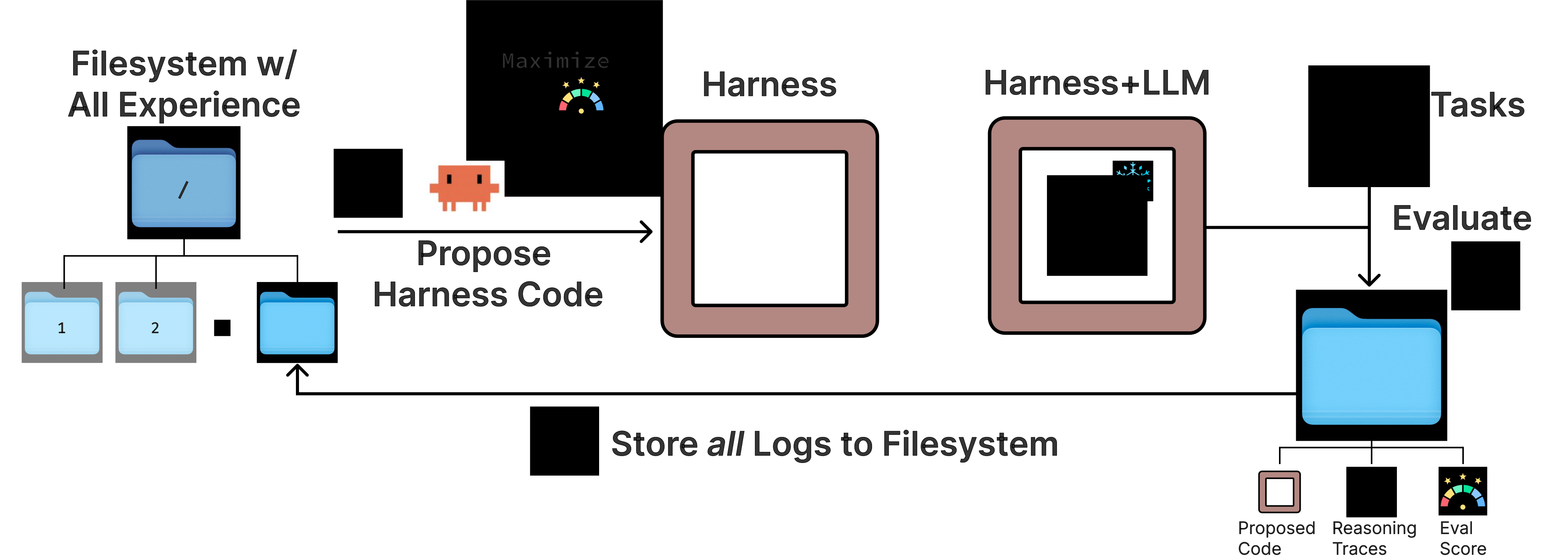
Meta-Harness: End-to-End Optimization of Model Harnesses
A research paper and framework demonstrating automated optimization of model harnesses - the scaffolding code that determines what AI models store, retrieve.
Why it mattersHarness engineering, automated: this optimizes the scaffolding around a model — what it stores, retrieves, and feeds back — rather than the weights.
repoYoonho Lee
Thariq@trq212
An update to Claude Code's /usage view, shaped by how differently people manage sessions, and what the move to a one-million-token context changes about when to start a new one.
Why it mattersPractical guidance on the new /usage view, session management, and actually living with a 1M-token context window. Read it to stop guessing where your context budget goes and to plan long Claude Code sessions.

AlphaSignal@AlphaSignalAI
Garry Tan open-sourced his production personal knowledge layer: 17,888 pages, 4,383 people dossiers, 723 companies and 21 autonomous cron jobs built in twelve days. This walks through the architecture and how to wire it into your own agents.
Why it mattersA teardown of Garry Tan's open-sourced production knowledge infrastructure — 17k+ pages, thousands of dossiers — and how to wire that pattern into your own agents. Concrete architecture from a real, large deployment.

Kevin Gu@kevingu
An open source library that uses a meta-agent to autonomously improve task agents by experimenting with prompts, tools, and orchestration until performance climbs. Achieved #1 scores on SpreadsheetBench and TerminalBench through fully automated optimization over 24+ hours.
Why it mattersAn open-source meta-agent that tunes task agents — prompts, tools, orchestration — until performance climbs, no human in the loop. A working reference if you want auto-optimization implemented rather than just described.

Manthan Gupta@manthanguptaa
Applying Karpathy's autoresearch idea to inference optimisation, and showing the graveyard of failed settings behind the headline speedup, including the ones that improved throughput by quietly degrading the model.
Why it mattersMost optimization demos show you the win and hide the search; this one shows the search. An honest walkthrough of applying Karpathy's autoresearch idea to LLM inference — read it for the method and the dead ends, not a tidy result.

Akshay 🚀@akshay_pachaar
A comprehensive guide explaining how to configure Claude Code's .claude folder, including CLAUDE.md instructions, custom commands, permissions, and project setup. Helps developers optimize their AI coding assistant for team workflows.
Why it mattersThe reference for everything that lives in .claude — CLAUDE.md, custom commands, permissions, project setup — in one place. The fastest way to turn a default Claude Code install into one tuned to how you actually work.

Zack Shapiro@zackbshapiro
An educational article teaching advanced prompt engineering techniques for AI models, emphasizing detailed 2000+ word prompts over simple instructions. Written by an AI-native law firm managing partner sharing professional-grade prompting strategies.
Why it mattersA case for treating prompts as a real input layer — detailed, 2000+ word specs over one-liners — and why that flips output quality. Provocative if you still think shorter prompts are always better; read it before you dismiss the idea.

eric zakariasson@ericzakariasson
A comprehensive guide on how to design command-line interfaces that work effectively with AI agents. Provides practical patterns for making CLIs non-interactive, agent-friendly, and robust for automated use.
Why it mattersDesign patterns for CLIs that agents can actually drive — non-interactive, predictable, machine-readable output. Essential if you are exposing tools to agents and wondering why they keep getting stuck on your prompts.
An index of the vibe-coding frontier. Corrections welcome.