Intel
Page 118
Alibaba's Qwen3.8 Max is available on OpenRouter with 2.4T total and 95B active parameters, aimed at long-horizon coding and multimodal agents. Qwen reports large benchmark gains over its prior Max model, and open weights are promised within a week.
Why it mattersQwen3.8 Max is callable now on OpenRouter, and open weights are promised for the following week, which would be the first for a Qwen Max-class model.
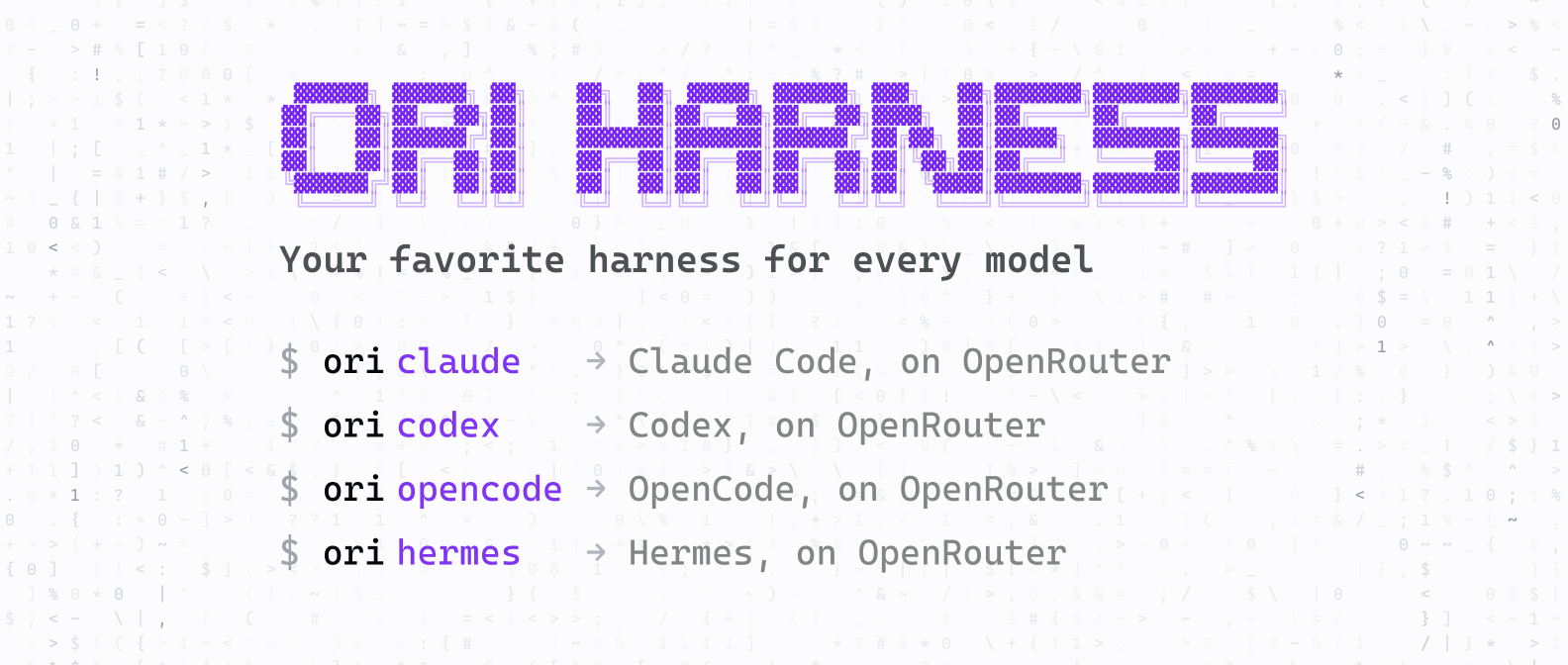
Ori Harness
A CLI that boots Claude Code, Codex, OpenCode, or Hermes against OpenRouter with the right configuration per model.
Why it mattersRunning Claude Code through a gateway silently loses tool search, which costs roughly half the system prompt in tokens and changes how many turns the agent takes. The ori CLI sets that and the rest of the env matrix per model automatically.

What is CDP (Chrome DevTools Protocol)?
This explainer traces Chrome DevTools Protocol from its origins as WebKit's remote debugging plumbing to its role as the JSON-over-WebSocket interface that tools like Puppeteer, Playwright, and browser agents use to control Chromium.
Why it mattersExplains how Chrome DevTools Protocol works under the hood and shows how to drive a browser via raw WebSocket messages, giving agent builders the low-level knowledge needed to debug or extend tools like Puppeteer, Playwright.

Introducing Director: Web Automation for Everyone
Director lets non-developers automate web tasks by describing them in natural language.
Why it mattersIt lets non-technical users describe a web task in plain language and get a reusable automation script running on cloud browser infrastructure, lowering the barrier to browser automation without touching code.

What is Firecracker?
A technical explainer on AWS's Firecracker microVM technology, contrasting Linux container isolation (namespaces, cgroups, seccomp) with full VM isolation.
Why it mattersFirecracker strips legacy hardware emulation to get container-speed boot times with real VM-grade kernel isolation, which is exactly the tradeoff engineers building sandboxed code-execution environments for AI agents need to understand.

What is an MCP server?
This explainer defines the Model Context Protocol as an open standard (introduced by Anthropic in late 2024) that lets AI models call tools, read resources.
Why it mattersExplains how MCP's client-server protocol works (STDIO vs Streamable HTTP transports) and shows a concrete hosted browser MCP server example, useful grounding for engineers building their first agent tool integrations.
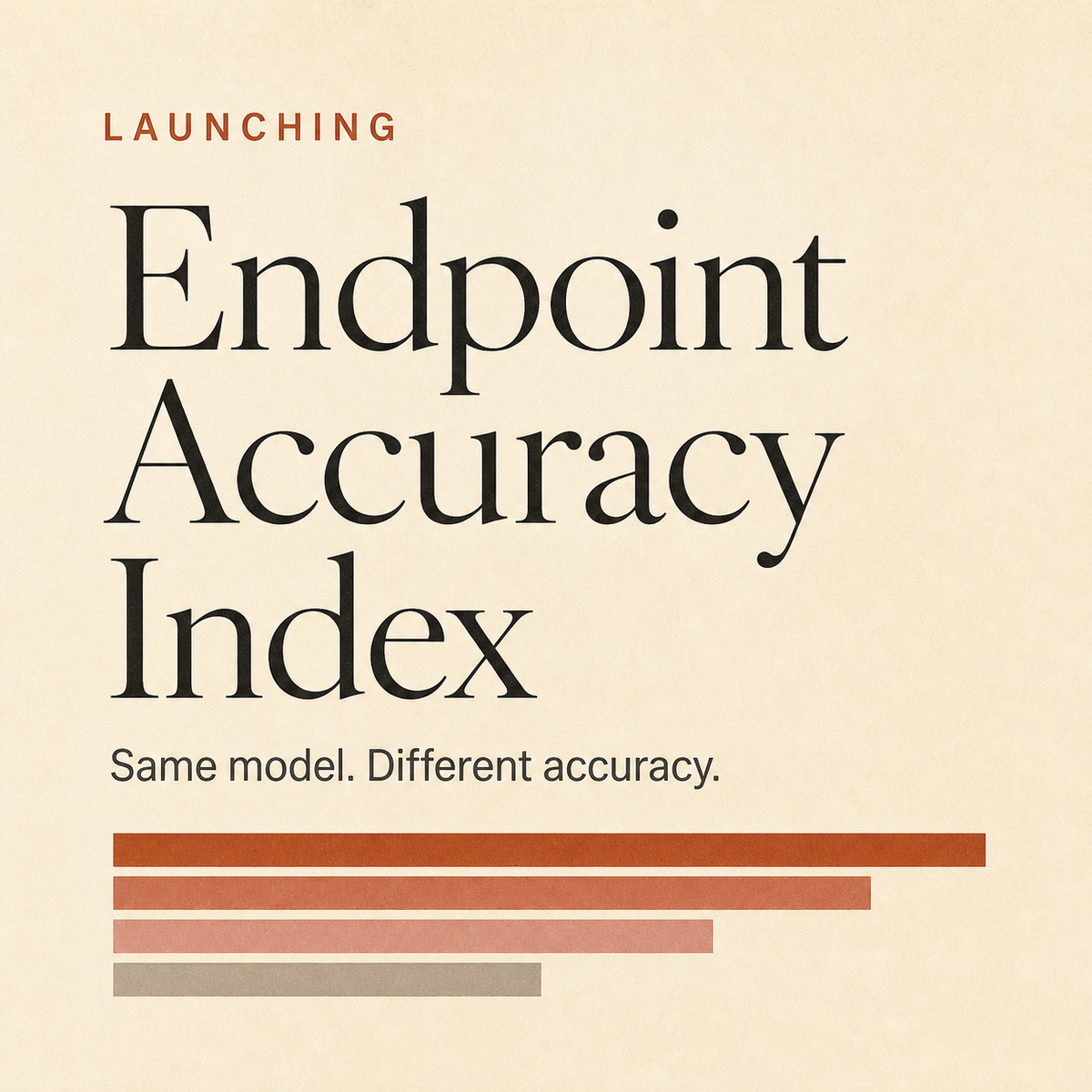
Endpoint Accuracy Index
Artificial Analysis launches the Endpoint Accuracy Index, comparing serverless endpoints to a self-hosted reference on tool calling, reasoning and long context for GLM-5.2, gpt-oss-120b and DeepSeek V4 Pro.
Why it mattersThe same open model can score half as well or worse depending on the provider, due to output token limits and tool call handling, so choose endpoints on accuracy and not only price and speed.

What's the Big Deal About Computer Use?
A Browserbase engineering blog post tracing the history of neural networks from the 1957 Perceptron through reinforcement learning to modern multimodal models.
Why it mattersTraces how advances in vision-language models enable agents to perceive and act on screens directly, framing why API-free 'computer use' automation is now viable — useful context for anyone building browser or desktop agents.

The Browserbase Free Plan: Build Browser Agents for Free
Browserbase launched a free tier offering 60 minutes of browser automation sessions per month.
Why it mattersDevelopers can now test browser automation agents (e.g. via Stagehand) with 60 free minutes per month instead of a limited 10-session trial, lowering the barrier to prototyping before committing to a paid plan.
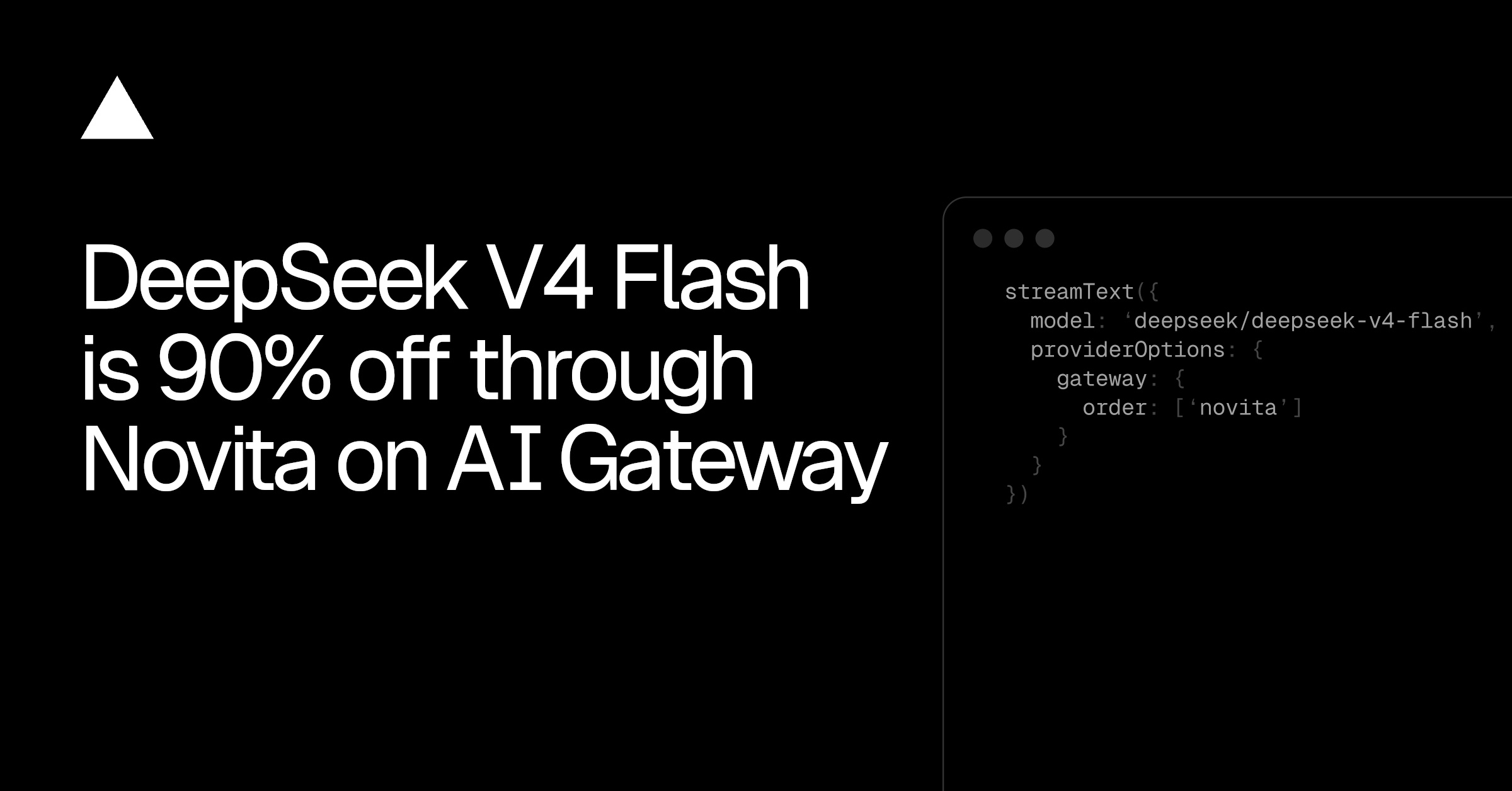
DeepSeek V4 Flash 90% Off via Novita on Vercel AI Gateway
Vercel announces a temporary 90% price cut on DeepSeek V4 Flash when routed through Novita on its AI Gateway, available to Pro customers through August 11.
Why it mattersVercel is offering a 90% discount on DeepSeek V4 Flash through Novita on its AI Gateway until August 11 for Pro users who set the model to deepseek/deepseek-v4-flash and pin Novita first in the provider order.
Introducing Browserbase Agents: One Prompt, One API Call
Browserbase now runs managed browser agents.
Why it mattersReplaces per-site scraping scripts with a natural-language goal run through one API call, on managed browser infrastructure with session replay and traces for when the agent takes a wrong turn.
The Inference Engineering Masterclass
A long-form technical interview with Baseten's Philip Kiely and Ali Taha covering how production LLM inference actually works.
Why it mattersOffers a rare practitioner-level walkthrough of how production LLM inference actually works today — cache-aware routing, disaggregated prefill/decode, quantization error cancellation, and speculative decoding.

A Claude Code team member notes that Claude Connectors such as Gmail, Calendar, and Slack carry over to Claude Code and Artifacts once connected. Agent sessions inherit those integrations, which widens both workflow options and the data access to review.
Why it mattersConnectors you authorize in Claude are also available to Claude Code and Artifacts, so one authorization grants agent access to email, calendar, and chat data.

Smaller, faster, safer: running Kimi and GLM at scale
A Cloudflare engineering blog post detailing techniques used to serve large open models like Kimi and GLM more efficiently on Workers AI, including quantizing KV caches and compressing model weights to reduce GPU memory pressure.
Why it mattersIf you're serving large open-weight models like Kimi or GLM yourself, this breaks down practical levers — KV cache quantization and weight compression — for cutting GPU memory pressure without silently degrading output quality.

OpenAI rebuilt its voice stack for GPT-Live, which can listen while it speaks. Audio runs on a dedicated fast path while deeper reasoning and tool use proceed asynchronously, and session startup dropped from six network round trips to one.
Why it mattersSeparating the audio path from reasoning and tool calls lets a voice agent keep talking while it thinks. Cutting session setup to one round trip lowers time to first audio, a pattern builders of realtime voice agents can copy.

Cursor released plugins that give its agents direct access to Gmail, Google Drive, Calendar, Docs and Sheets. Agents can read, write and act in those apps, extending Cursor beyond code editing. The post does not detail permissions or setup.
Why it mattersCursor agents can now read, write and act across Gmail, Drive, Calendar, Docs and Sheets through plugins. Engineers can automate workspace tasks from the same agent they code with.

Google Workspace Plugins for Cursor
Cursor added a set of plugins that let its coding agents read and act on Google Workspace data directly from the editor.
Why it mattersIf you're already working in Cursor, these plugins let your coding agent triage email, pull calendar context, or edit docs/sheets without switching apps, reducing context-switching friction during agentic workflows.

Kimi K3: The Manos, The Mythos, The Legendos
A SemiAnalysis technical deep-dive into Kimi K3's architecture, tracing Kimi Delta Attention (KDA) from linear attention through DeltaNet and Gated DeltaNet.
Why it mattersIf you're building or serving hybrid linear/full-attention models, this explains the FLOP and memory-traffic tradeoffs of Kimi Delta Attention and why linear attention complicates prefix caching in engines like vLLM.

How Stripe Built Kai, its Company-Wide AI Agent, on Deep Agents
A LangChain case study describing how Stripe's AI platform team built Kai, an internal 'Knowledge AI Platform' agent used by every employee, on top of LangChain's open-source Deep Agents harness.
Why it mattersShows a concrete, evidence-based blueprint for standing up a company-wide AI agent in a week by building on an open-source harness instead of a bespoke stack — useful reference architecture for teams facing the same build-vs-adopt decision.
OpenAI says an internal version of its next major model produced 10 new results on open problems in mathematics and theoretical computer science for roughly $2,000 in tokens, including non-sofic groups and better sphere packing bounds. Only the announcement thread was readable; the technical write-u
Why it mattersOpenAI reports an unreleased model produced 10 new results on open math problems for about $2,000 in API tokens. That is a concrete data point on frontier research capability and its cost, though the proofs were not available to check.

Automating cross-repo documentation with GitHub Agentic Workflows
The GitHub Aspire team built an agentic workflow that automatically converts merged product code changes into scoped, permissioned documentation pull requests across repos, routed for subject-matter-expert review.
Why it mattersGives engineering teams a validated pattern and real success metrics for closing the code-to-docs gap using agentic workflows, rather than a speculative pitch.

Fireside Chat: Simon Eskildsen on Building Turbopuffer
A recorded conversation between Gergely Orosz and Turbopuffer co-founder Simon Eskildsen covering his path from competitive programming and being recruited by Shopify as a teenager to scaling its infrastructure from 1K to 1M RPS, and eventually building Turbopuffer, a vector/full-text database built on top of S3.
Why it mattersGives engineers building on vector/full-text search systems concrete insight into how a production S3-backed database handles durability tradeoffs and pricing economics, straight from the person who designed it.
GEM Training: How Meta Doubled the Efficiency of Its LLM-Scale Ads Foundation Model
Meta's ads foundation model now trains on thousands of GPUs at LLM scale, and getting there required rebuilding the stack.
Why it mattersLLM training recipes — kernels, parallelism, low-precision schemes — don't transfer cleanly to recommendation workloads.

Why Smarter AI Models Could Drive Up Compute Prices 10x

Vercel WAF for Blob is now generally available
Vercel's Web Application Firewall now protects Blob storage on all pricing plans.
Why it mattersIf you serve AI-generated media or user uploads from Vercel Blob, you can now block or rate-limit abusive traffic at the edge before it hits your store or your bandwidth bill, using the same WAF rules already available for your app.
Cursor reports its cloud agents now use 20-30% fewer tokens on typical runs and 80% fewer on runs involving computer use, after reworking how they handle MCP connections, skills and computer-use actions. Figures are self-reported.
Why it mattersLower token use per cloud-agent run means the same budget covers longer, more ambitious delegated tasks, especially those involving computer use. The figures are Cursor's own and the benchmark method is not disclosed.

How to Run Isolated Tenant Kubernetes Clusters on Shared GPU Infrastructure
An NVIDIA technical blog post examining why a single shared Kubernetes cluster becomes hard to manage as more teams onboard, citing conflicting CRD versions, overlapping RBAC policies, and the lack of a clean mechanism to partition GPU capacity into team-level budgets.
Why it mattersIf you're running shared GPU clusters across multiple teams, this walks through the concrete tradeoffs — CRD conflicts, RBAC scoping, and GPU budget partitioning.
OpenRouter's Ori Eval runs inside a coding agent, finds model calls in a codebase, asks what you optimize for, writes an eval, and ranks candidate models. Assertions cover tools called, tools avoided and completion, with LLM-as-judge for open-ended answers.
Why it mattersChoosing a model per task usually relies on guesswork. This tool generates evals from the model calls already in your repo and ranks candidates on your criteria, and its bug-to-failing-test flow keeps regressions in CI.

Devtools must be open source
Simon Willison argues that LLMs like Claude and Codex have made the classic open-source promise of user-modifiable software newly practical.
Why it mattersIt reframes why open-source access matters in an era where LLMs can read, explain, and modify unfamiliar codebases on demand—useful for practitioners deciding how much they should value source availability when picking tools.
Building Voice Agents with Google ADK, Gemini Live, and LangSmith Tracing
A demo of adding LangSmith tracing to a Google ADK voice agent running on Gemini Live.
Why it mattersShows how to trace a speech-to-speech voice agent, including capturing the audio the user actually heard after an interruption. This gives you replayable turns, tool-call latency and audio token cost for debugging and evals.
AI Agents Intensive with Google
A free Kaggle course developed with Google that guided 353,000 learners through building and deploying AI agents, covering both conceptual foundations and hands-on implementation.
Why it mattersA structured, no-cost curriculum covering both conceptual foundations and hands-on implementation of AI agents, backed by Google and validated at massive scale (353k learners).
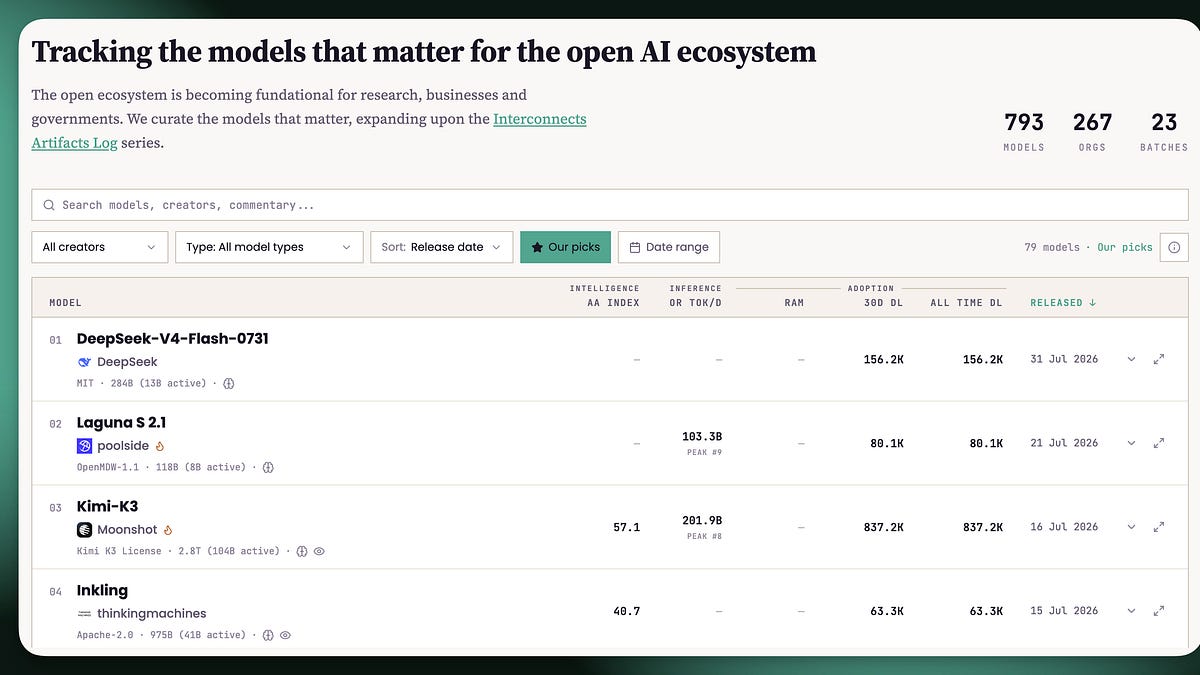
Introducing our Artifacts Hub and Adoption Dashboard
Two free companion resources from Interconnects.
Why it mattersIt gives engineers a single place to see which open models are actually gaining real-world traction (downloads, derivatives, inference volume) rather than just benchmark scores.
Claude Opus 5 Debugging Benchmark: Does More Reasoning Actually Fix More Bugs?
AlphaSignal ran Claude Opus 5 through 260 debugging attempts across four effort levels (Low, Medium, High, XHigh) and found that raising effort from Low to XHigh improved resolve rate by only 4.7 points (93.8% to 98.5%) while increasing cost per fix by 477% and token use by 635%.
Why it mattersIf you're tuning reasoning-effort settings for coding agents, this benchmark shows Medium effort captures nearly all the resolve-rate gains at a fraction of the cost of XHigh.

Workers RPC now works across Python and JavaScript
Cloudflare Workers RPC now supports calls between Python Workers and JavaScript Workers.
Why it mattersIf you're building multi-language serverless services (e.g. Python for AI/data logic, JS for edge routing), this lets the two sides call each other's methods and pass live objects directly, eliminating the usual API/schema/serialization glue code.

Qwen3-Max Hands-On Testing
A hands-on video review that puts the Qwen3-Max model through a range of practical tasks.
Why it mattersIf you're deciding whether Qwen3-Max is worth adopting for coding or multimodal work, this gives task-by-task evidence (games, CAD, frontend, writing) plus real cost figures rather than marketing claims.
Minimax H3 Open Source
MiniMax open-sources H3, an omni-modal generative system built as three stages.
Why it mattersAn open-weights video model that generates up to 15 seconds at 2K with native stereo audio, accepting mixed image/video/audio references, is a self-hostable option where comparable quality has been API-only.

Your agent needs a computer, not a container — introducing @cloudflare/computer
Cloudflare's new agent runtime dynamically switches between lightweight isolates and full Linux containers depending on what an AI agent's task requires, aiming to give each agent an environment that scales like a real computer rather than a static container.
Why it mattersIf you're running AI agents that need to burst from cheap sandboxed execution to full-fledged compute (e.g. code execution, browser automation, long-running tasks), this runtime automatically escalates the environment instead of forcing you to pre-provision heavy containers for every agent or hit walls with isolate-only sandboxes.

Introducing the Billable Usage API: programmatic cost visibility for Cloudflare
A new REST endpoint from Cloudflare that returns account-level usage and cost data broken down by product and billing period.
Why it mattersIf you're building agents that provision Cloudflare resources autonomously, this gives you a single programmatic endpoint for FOCUS-standardized cost data across Workers, R2, D1, Workers AI, Vectorize, Images.

Cloudflare Workers and Containers now support inbound TCP connections and gRPC
Cloudflare Workers can now accept inbound TCP connections via a new connect() handler and Spectrum ingress proxy, routing raw sockets to Durable Objects and Containers for full-duplex protocols like gRPC.
Why it mattersIf you're building low-latency voice AI or need to run existing gRPC services without spinning up dedicated servers, this lets you terminate raw TCP and full-duplex gRPC directly at Cloudflare's edge.

Tnik Ipf Phase2a
Insilico's TNIK inhibitor ISM001-055, designed with generative AI, showed a dose-dependent lung-function improvement and good tolerability in a 71-patient Phase IIa trial for pulmonary fibrosis.
Why it mattersA generative-AI-designed drug candidate cleared a randomized Phase IIa trial with measurable efficacy, concrete evidence that AI-driven target and molecule design can produce clinically active compounds, not just faster screening.
ECLoop: Evidence-Conditioned Execution Layer for Coding Agents
ECLoop is a research system that sits between an LLM coding agent and the repository, compiling task-specific evidence conditions from the issue description and codebase that the agent must satisfy before editing code or submitting a patch.
Why it mattersIf you're building or evaluating coding agents, this identifies a specific failure mode—agents editing or submitting patches before gathering sufficient evidence.
Validation Evidence in LLM Repair Agents: How Much of What Passes Actually Tests the Bug?
This paper introduces BSG-VA, a method that replays each validation command an LLM repair agent runs against the original buggy code, the candidate fix.
Why it mattersIf you're building or relying on autonomous code-repair agents, this shows nearly half of the passing tests agents cite as proof of a fix don't actually discriminate a correct fix from a no-op.
DragonCrawl: A Generative, Intent-Based Framework for Scalable Mobile End-to-End Testing
This paper presents an AI-driven mobile end-to-end testing system that evolved from embedding-based similarity matching to GPT-4o-powered generative intent reasoning, validating specific user flows on every code change to block breaking commits.
Why it mattersShows a validated production path for replacing brittle UI-selector mobile tests with GPT-4o-driven intent reasoning, with real numbers on pass rates and engineering time saved that practitioners can benchmark against.
Stateful Knowledge Learning (SKL)
Argues that reflection-based agent memory captures hindsight about one trajectory rather than reusable foresight.
Why it mattersReframes agent experience-learning from post-hoc trajectory summaries to explicit predictions anchored to state, which generalizes better and lets accumulated knowledge bootstrap rather than encode one lucky path.
OurArk
An architecture for persistent personal agents built on an owned, versioned software body holding code, prompts, tools, policies and tests.
Why it mattersPuts the artifacts that determine an agent's future behavior under versioned human custody: self-edits arrive as validated candidate changes for review, and forking an agent creates a descendant with its own identity and private state.
Building a Process-Modeling Tool using Agentic AI: An Experience Report on PM4Py-UCM
An analysis of the full development record of an open-source process-mining tool built largely by Claude Code across 18 sessions, 374 human turns and 151 commits, finding fixes outnumbered features 2.3 to 1 and 18% of human turns went to correcting the agent.
Why it mattersIf you're deciding how much to trust an AI coding agent for real modeling/tooling work, this gives you actual measured overhead numbers (fix-to-feature ratio, error-correction turn rate) instead of anecdote.
Are the Financial Reasoning from LLMs Credible? A Real World Test over Long-Horizon Statements
A benchmark over uncropped, 32K-token statements testing whether long-context numeric reasoning is structural or memorized.
Why it mattersModels that ace isolated derivations regress badly once they must produce a multi-metric, multi-period table, and memorized formulas evaporate without hints — a concrete warning for any pipeline doing long-context numeric work.
From C to Idiomatic Rust: A Ship-of-Theseus Agentic Translation
This paper presents a two-phase methodology for migrating C codebases to Rust.
Why it mattersIf you're migrating C codebases to Rust with AI agents, this proposes a staged workflow — get a safe-but-ugly baseline first, then iteratively idiomatic-ize with compile/test validation at each step.
Chain-of-Models: Cross-Model Auditing for Bias-Robust LLM Judges
This paper studies a technique where a second LLM audits a first LLM's reasoning trace before finalizing a judgment, aiming to reduce cognitive biases like bandwagon, authority, sycophancy, and distraction effects in LLM-as-judge setups.
Why it mattersIf you're building LLM-as-judge pipelines, this shows that picking the right auditor model per bias type—not just the most 'unbiased' model overall.
An Ontology-Guided, Deduplication-Aware Extraction Layer for Knowledge Graph Construction from Heterogeneous Documents
LLMs extract entities fluently and inconsistently.
Why it mattersInjecting only the relevant ontology slice per document cuts prompt catalog overhead ~94% while pushing search recall from about 70% to 95%.
An index of the vibe-coding frontier. Corrections welcome.