Intel
Page 117
SAFE Guidelines for Agentic AI Cybersecurity
The Linux Foundation and the Open Secure AI Alliance, a coalition of 120+ organizations including NVIDIA, Cisco, CrowdStrike.
Why it mattersThe SAFE RFC proposes a confidential mechanism to share agentic AI security incidents and publish evidence-based control recommendations, and surfaces open source tools across identity, harnessing, vulnerability scanning.
How we built a software factory to drive Astro’s GitHub issue count to zero
Cloudflare on assembling agents into a pipeline that drove the Astro project's open GitHub issue count to zero.
Why it mattersOne of the few software-factory claims backed by a measured outcome on a real open-source repo, including what it took to make the loop actually work.
The Agent Development Lifecycle has arrived on Cloudflare
AI made implementation the fast step of the software development lifecycle, which leaves the surrounding phases as the constraint.
Why it mattersGives engineers a concrete framework for where agents belong beyond code generation, and names the downstream bottlenecks that heavy agent use actually creates.
Your agent can now debug Workers with local tracing
Cloudflare now captures OpenTelemetry traces for local Worker invocations automatically in wrangler dev and vite dev.
Why it mattersCoding agents can now get structured runtime telemetry from a local dev server before anything is deployed, closing a major feedback gap in agent debugging loops.
Introducing: Cloudflare Agents
Cloudflare launches hosted agents on its developer platform, starting with observability, on the argument that agents need model access, a durable runtime, orchestration, sandboxed execution and storage, all of which it already runs.
Why it mattersAgent-level cost and tool-call tracing is the missing instrument for anyone operating agents in production rather than demoing them.
Run CI/CD for millions of repos — on your platform, on Cloudflare
Cloudflare stitches Artifacts, the CI SDK and Workflows together so a push event triggers a continuous integration pipeline running entirely on its own platform, aimed at millions of repositories.
Why it mattersShows a working pattern for CI defined in code with a self-healing agent in the loop, aimed at platforms running code on behalf of many tenants.
Announcing Cloudflare Wallets: the programmable wallet for the agentic Internet
Agents cannot easily try a new API because they have no stable identifier to sign up with and no native way to pay.
Why it mattersAgent identity and pay-per-call API access are becoming a real primitive, and x402 is the protocol builders will have to reckon with.
How Cloudflare enforces engineering standards using AI
Cloudflare's AI code reviewer flagged nearly a quarter of a million deviations from internal engineering standards and blocked 16,000 merges in four months.
Why it mattersA concrete, measured blueprint for making engineering standards machine-enforceable so AI reviewers apply them consistently at scale.

Best Open Weight Models That Matter In 2026
Compares Kimi K3, DeepSeek V4 Pro and Flash, GLM 5.2, and MiniMax M3 for coding on reported Terminal Bench 2.1 scores, API pricing, and total versus active parameters.
Why it mattersPuts Terminal Bench 2.1 scores, per-token pricing, and total vs active parameters for Kimi K3, GLM 5.2, DeepSeek V4 and MiniMax M3 side by side, so you can pick an open-weight coding model on cost and capability.

Introducing Shieldstral.
Guardrail models usually bake harm categories into their weights, so a new deployment context means retraining.
Why it mattersShieldstral takes moderation policies as plain-language input at inference time instead of a fixed harm taxonomy, so you can retarget guardrails per product without retraining.

Fable 5 & Qwen 27B – Traycer Multi-Agent Hands-On Test!
A hands-on test of Traycer running multi-agent collaboration between Fable 5 and a local Qwen 27B, including each model scoring the other's work and a solo run for comparison.
Why it mattersShows concretely how well a frontier model and a small local model actually collaborate under a shared-context orchestrator, and whether that orchestration beats the local model working alone.

A speech recognition preview built on Hy3's language model rather than a standalone acoustic stack, which Tencent credits for context awareness and dialect robustness on messy real-world audio. The headline self-reported figure is roughly 3% multilingual word error rate.
Why it mattersAn LLM-grounded ASR preview reporting roughly 3% multilingual WER is worth benchmarking against your current transcription path, especially on accented or noisy audio where acoustic-only models degrade.

Qwen3.8-Max, better and cheaper. Try it out. 👀 https://t.co/zHXKtgZRci
Why it mattersA new Qwen flagship that is cheaper and stronger changes the cost/quality calculus for anyone routing agent workloads to non-frontier or open-weight-adjacent models.
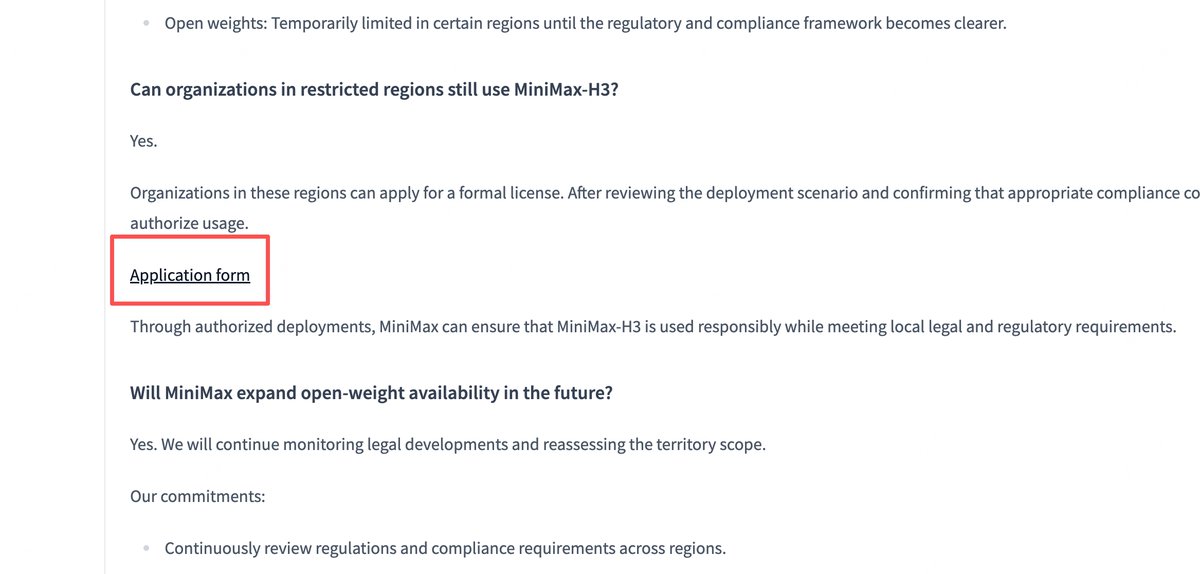
MiniMax H3 open weights: how licensing and regional access work
MiniMax says H3 open weights can be licensed for deployment in the US, EU, UK and South Korea through a formal request.
Why it mattersIf you plan to self-host H3, the open-weight license is scoped by territory and requires a formal request in the listed regions. The API is global, so deployment location decides whether you need a license or can call the hosted API.

AgentMemBench
A reproducible benchmark comparing five long-term memory strategies for conversational AI agents (in-context windowing, external key-value store, graph-based episodic memory, compression summarisation, web-augmented memory) across three datasets.
Why it mattersAgentMemBench shows external key-value retrieval substantially outperforms in-context windowing, graph-based episodic memory, summarization, and web-augmented approaches on long-range recall tasks, at the cost of memory footprint.

JouleShare: Request-Level Energy Attribution for Batched LLM Serving
Batched serving makes GPU power telemetry aggregate, so per-request energy is guessed at.
Why it mattersIf you bill, chargeback or report energy per request, the token-proportional rule most systems use is substantially wrong under batching.

Cost-Effective Automated Judging of Natural-Language Mathematical Proofs
A research study finds that cheap open-weight LLMs (GPT-OSS 120B, DeepSeek-V4 Flash, Gemma-4 31B) can judge natural-language math proofs as reliably as expensive frontier models like Claude Opus 4.7 and Gemini 3.1 Pro, at up to 100x lower cost.
Why it mattersIf replicated, this means math-reasoning evaluation pipelines can swap expensive frontier judges for a cheap three-model unanimous-vote ensemble at up to 100x lower cost without losing reliability.

Skill packs are now available on skills.sh
Agent skills get a packaging layer.
Why it mattersTeams can now pin and update a whole set of agent skills as one versioned unit via a single CLI command, instead of syncing individual skills across projects by hand.

Role Steering of Language Models for Social Simulations
This paper introduces an activation-steering screening workflow that extracts role-specific directions from language models and sweeps steering coefficients to validate role-conditioned agent behavior before deployment in social simulations.
Why it mattersThe paper shows role-specific activation steering beats persona-vector control (63.2 vs 41.1 alignment) for controlling agent personas in social simulations, but flags that ~14% of roles degrade regardless of steering strength.

Memory Reward Inflation in Self-Improving LLM Agents
This paper identifies the 'Echo Gap,' a failure mode in memory-based self-improving LLM agents where self-graded episode scores inflate confidence in incorrect past actions, causing agents to preferentially reuse their own mistakes.
Why it mattersSelf-graded episodic memory in agents can inflate confidence in bad past actions, causing agents to repeat their own mistakes.

Cross-Benchmark Generalization in Long-Horizon Agents
This paper post-trains an open-weight mixture-of-experts model (Qwen3.5-122B-A10B) on 363 long-horizon MCP tool-use tasks using a two-stage SFT-then-RL pipeline, then tests whether skills transfer to unrelated external benchmarks.
Why it mattersIt provides evidence that long-horizon tool-use post-training produces transferable agent behaviors (goal tracking, repair stability, verification) rather than benchmark-specific overfitting.
Faster Deploys for ISR Pages on Vercel
Vercel deploys are now up to 33% faster for apps using Incremental Static Regeneration, achieved by shipping routing metadata for prerendered pages in a single upload instead of splitting it into a separate one when it grows large.
Why it mattersVercel now bundles routing metadata for prerendered pages into a single upload instead of splitting it, cutting deploy times up to 33% for large ISR/PPR apps automatically with no config changes required.
RubricReviewer: From Direct Critique to Objective and Comprehensive Rubric-Driven Peer Review
A framework for LLM-based peer review that first generates paper-adaptive rubrics as an explicit intermediate step, then combines a training-free evidence-gathering agent (Scout) with a human-aligned trained judgment model (Aligner).
Why it mattersIt tackles a specific failure mode in LLM peer review — reviewers being gamed by adversarial prompts hidden in papers — with an explicit rubric-then-judgment pipeline rather than a single opaque judge call.

Capability-Driven Multimodal Scaling Law
This research paper introduces a framework predicting vision-language model performance from a low-dimensional textual capability score derived via PCA, using over 150 trained VLMs across 34 LLM backbones and 7 model families.
Why it mattersThe paper shows a low-dimensional textual capability score (via PCA) predicts multimodal performance across model families and scales up to 72B.

Obshazard-bench
A benchmark for evaluating multimodal foundation models on real-time disaster intelligence, using raw satellite sounding streams, ground observations.
Why it mattersIt exposes a concrete failure mode.

Source Code Authorship Attribution Does Not Generalize from Competitions to Classrooms
This paper fine-tunes CodeBERT for source code authorship attribution and finds it achieves 92.6% Top-1 accuracy on Google Code Jam competition data but drops to near-chance levels (0.2% and 0.06% Top-1) on real university coursework datasets.
Why it mattersFine-tuned CodeBERT models that hit 92.6% Top-1 accuracy on Google Code Jam authorship attribution drop to 0.2% and 0.06% on real university coursework, and the gap holds across model families.

LoopsBench: From Harness Engineering to Loop Engineering in Benchmarking Coding Agent
Coding agent evaluation is shifting from harness engineering to loop engineering.
Why it mattersIt gives agentic engineers a hard number for how badly current coding-agent loops degrade over sustained, multi-step work, and an open benchmark to test their own harness against.

SLMs as Multi-Agent Routers: A Progressive SFT and Reinforcement Learning Approach
A small language model trained with supervised fine-tuning then reinforcement learning picks the right specialized retrieval agent and generates its tool-call parameters, rewarded on actual retrieval relevance rather than inferred intent.
Why it mattersShows that training a small router model with RL against actual retrieval relevance—rather than inferring intent.

CASPER: Change-Aware Slice Prioritization for LLM Regression Testing
A regression-testing approach for LLM systems that works at an intermediate granularity.
Why it mattersChanging a prompt or model can silently regress specific behaviors while the aggregate score holds.

CoT-Core: Accelerating LLM Evaluation via CoT-Aware Coreset Selection
This paper introduces a training-free method for selecting a small representative subset of benchmark questions to evaluate LLMs cheaply, by clustering questions based on their zero-shot Chain-of-Thought reasoning trajectories rather than surface text similarity.
Why it mattersIt shows how clustering by chain-of-thought reasoning patterns—rather than surface text similarity.
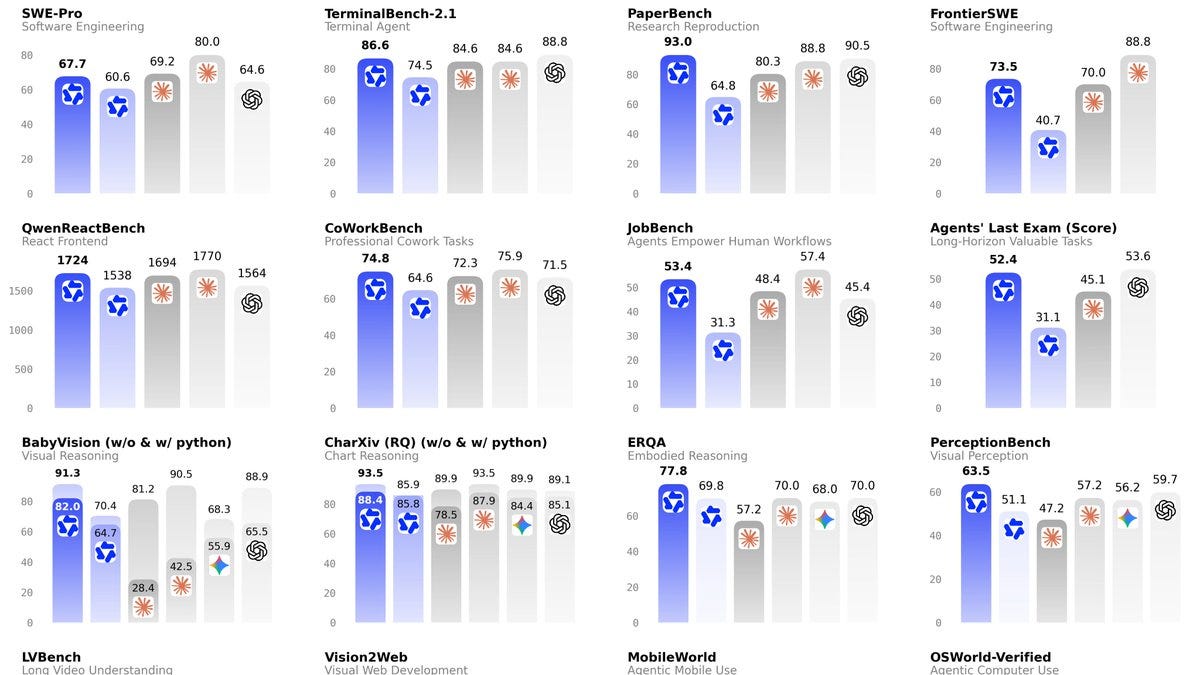
Qwen 3.8 Max: Alibaba's 2.4T Open-Weight Model for Coding and Cowork
Alibaba's Qwen team unveiled Qwen3.8-Max, a 2.4T-parameter sparse MoE model (roughly 95B active per token) aimed at long-horizon coding, agentic 'cowork', and multimodal reasoning.
Why it mattersAlibaba's Qwen3.8-Max is a 2.4T-parameter MoE model (95B active) posting strong coding/agentic benchmarks at lower API pricing than its predecessor, but its license reportedly restricts use in the US, EU, UK, and Korea.

The Shape of Things to Come
Steve Yegge recounts how his AI coding agent project 'Gas Town' — meant to be reusable.
Why it mattersYegge documents a specific model behavior — Opus 4.7 repeatedly wanting to add 'just two more things' instead of finishing.

Alibaba's Qwen3.8 Max is available on OpenRouter with 2.4T total and 95B active parameters, aimed at long-horizon coding and multimodal agents. Qwen reports large benchmark gains over its prior Max model, and open weights are promised within a week.
Why it mattersQwen3.8 Max is callable now on OpenRouter, and open weights are promised for the following week, which would be the first for a Qwen Max-class model.
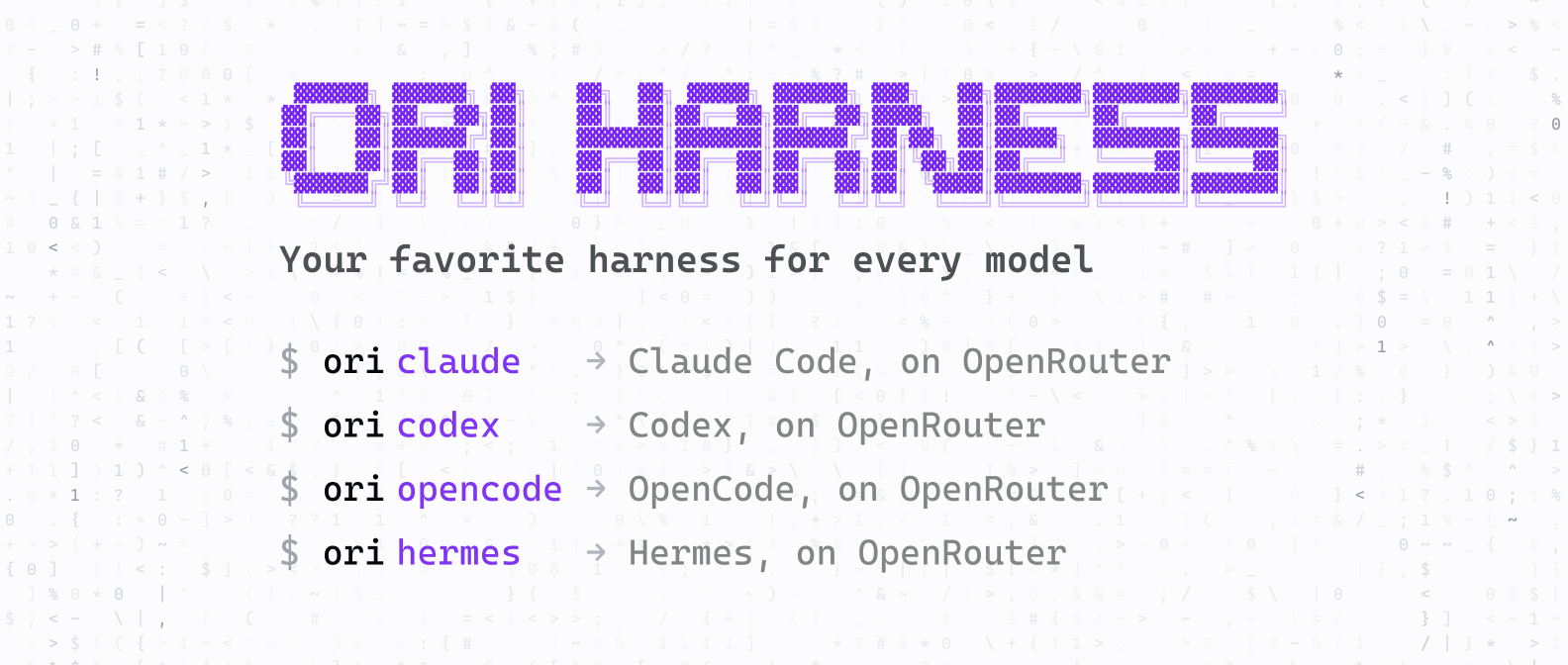
Ori Harness
A CLI that boots Claude Code, Codex, OpenCode, or Hermes against OpenRouter with the right configuration per model.
Why it mattersRunning Claude Code through a gateway silently loses tool search, which costs roughly half the system prompt in tokens and changes how many turns the agent takes. The ori CLI sets that and the rest of the env matrix per model automatically.

What is CDP (Chrome DevTools Protocol)?
This explainer traces Chrome DevTools Protocol from its origins as WebKit's remote debugging plumbing to its role as the JSON-over-WebSocket interface that tools like Puppeteer, Playwright, and browser agents use to control Chromium.
Why it mattersExplains how Chrome DevTools Protocol works under the hood and shows how to drive a browser via raw WebSocket messages, giving agent builders the low-level knowledge needed to debug or extend tools like Puppeteer, Playwright.

Introducing Director: Web Automation for Everyone
Director lets non-developers automate web tasks by describing them in natural language.
Why it mattersIt lets non-technical users describe a web task in plain language and get a reusable automation script running on cloud browser infrastructure, lowering the barrier to browser automation without touching code.

What is Firecracker?
A technical explainer on AWS's Firecracker microVM technology, contrasting Linux container isolation (namespaces, cgroups, seccomp) with full VM isolation.
Why it mattersFirecracker strips legacy hardware emulation to get container-speed boot times with real VM-grade kernel isolation, which is exactly the tradeoff engineers building sandboxed code-execution environments for AI agents need to understand.

What is an MCP server?
This explainer defines the Model Context Protocol as an open standard (introduced by Anthropic in late 2024) that lets AI models call tools, read resources.
Why it mattersExplains how MCP's client-server protocol works (STDIO vs Streamable HTTP transports) and shows a concrete hosted browser MCP server example, useful grounding for engineers building their first agent tool integrations.
Endpoint Accuracy Index
Artificial Analysis launches the Endpoint Accuracy Index, comparing serverless endpoints to a self-hosted reference on tool calling, reasoning and long context for GLM-5.2, gpt-oss-120b and DeepSeek V4 Pro.
Why it mattersThe same open model can score half as well or worse depending on the provider, due to output token limits and tool call handling, so choose endpoints on accuracy and not only price and speed.

What's the Big Deal About Computer Use?
A Browserbase engineering blog post tracing the history of neural networks from the 1957 Perceptron through reinforcement learning to modern multimodal models.
Why it mattersTraces how advances in vision-language models enable agents to perceive and act on screens directly, framing why API-free 'computer use' automation is now viable — useful context for anyone building browser or desktop agents.

The Browserbase Free Plan: Build Browser Agents for Free
Browserbase launched a free tier offering 60 minutes of browser automation sessions per month.
Why it mattersDevelopers can now test browser automation agents (e.g. via Stagehand) with 60 free minutes per month instead of a limited 10-session trial, lowering the barrier to prototyping before committing to a paid plan.
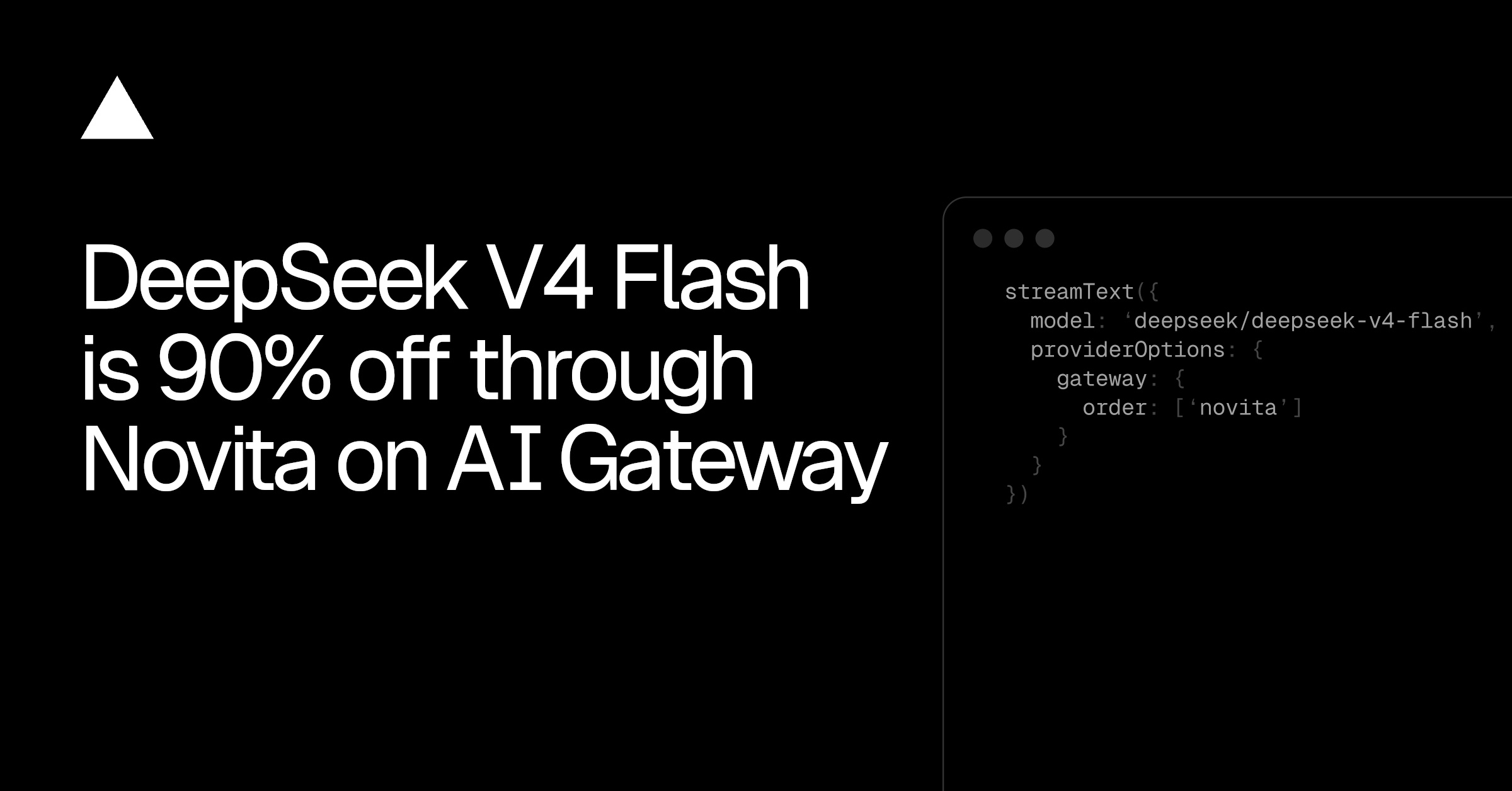
DeepSeek V4 Flash 90% Off via Novita on Vercel AI Gateway
Vercel announces a temporary 90% price cut on DeepSeek V4 Flash when routed through Novita on its AI Gateway, available to Pro customers through August 11.
Why it mattersVercel is offering a 90% discount on DeepSeek V4 Flash through Novita on its AI Gateway until August 11 for Pro users who set the model to deepseek/deepseek-v4-flash and pin Novita first in the provider order.
Introducing Browserbase Agents: One Prompt, One API Call
Browserbase now runs managed browser agents.
Why it mattersReplaces per-site scraping scripts with a natural-language goal run through one API call, on managed browser infrastructure with session replay and traces for when the agent takes a wrong turn.
The Inference Engineering Masterclass
A long-form technical interview with Baseten's Philip Kiely and Ali Taha covering how production LLM inference actually works.
Why it mattersOffers a rare practitioner-level walkthrough of how production LLM inference actually works today — cache-aware routing, disaggregated prefill/decode, quantization error cancellation, and speculative decoding.

A Claude Code team member notes that Claude Connectors such as Gmail, Calendar, and Slack carry over to Claude Code and Artifacts once connected. Agent sessions inherit those integrations, which widens both workflow options and the data access to review.
Why it mattersConnectors you authorize in Claude are also available to Claude Code and Artifacts, so one authorization grants agent access to email, calendar, and chat data.

Smaller, faster, safer: running Kimi and GLM at scale
A Cloudflare engineering blog post detailing techniques used to serve large open models like Kimi and GLM more efficiently on Workers AI, including quantizing KV caches and compressing model weights to reduce GPU memory pressure.
Why it mattersIf you're serving large open-weight models like Kimi or GLM yourself, this breaks down practical levers — KV cache quantization and weight compression — for cutting GPU memory pressure without silently degrading output quality.

OpenAI rebuilt its voice stack for GPT-Live, which can listen while it speaks. Audio runs on a dedicated fast path while deeper reasoning and tool use proceed asynchronously, and session startup dropped from six network round trips to one.
Why it mattersSeparating the audio path from reasoning and tool calls lets a voice agent keep talking while it thinks. Cutting session setup to one round trip lowers time to first audio, a pattern builders of realtime voice agents can copy.

Cursor released plugins that give its agents direct access to Gmail, Google Drive, Calendar, Docs and Sheets. Agents can read, write and act in those apps, extending Cursor beyond code editing. The post does not detail permissions or setup.
Why it mattersCursor agents can now read, write and act across Gmail, Drive, Calendar, Docs and Sheets through plugins. Engineers can automate workspace tasks from the same agent they code with.

Google Workspace Plugins for Cursor
Cursor added a set of plugins that let its coding agents read and act on Google Workspace data directly from the editor.
Why it mattersIf you're already working in Cursor, these plugins let your coding agent triage email, pull calendar context, or edit docs/sheets without switching apps, reducing context-switching friction during agentic workflows.

Kimi K3: The Manos, The Mythos, The Legendos
A SemiAnalysis technical deep-dive into Kimi K3's architecture, tracing Kimi Delta Attention (KDA) from linear attention through DeltaNet and Gated DeltaNet.
Why it mattersIf you're building or serving hybrid linear/full-attention models, this explains the FLOP and memory-traffic tradeoffs of Kimi Delta Attention and why linear attention complicates prefix caching in engines like vLLM.
An index of the vibe-coding frontier. Corrections welcome.