Intel
Page 116
Artificial Analysis introduces the Endpoint Accuracy Index, comparing serverless endpoints to a self-hosted reference on tool calling, scientific reasoning and long-context recall. Early results show output limits, tool-call parsing and context caps cause large accuracy gaps.
Why it mattersThe same open-weights model can score very differently by provider because of tool-call parsing, output limits and context truncation. This lets you pick an endpoint on measured accuracy, not just price and speed.

Black Forest Labs' FLUX 3 is live on OpenRouter's video API: one jointly trained family spanning video, audio, image, and action prediction, with text-to-video, multi-keyframe image-to-video, video continuation, and native audio including lipsync and ambience.
Why it mattersVideo generation with native synced audio becomes reachable through the same OpenRouter key and billing already used for text models, including continuation that carries framing and motion forward.

Using Local Sandboxing (GitHub Copilot CLI)
GitHub's guide to Copilot CLI local sandboxing.
Why it mattersCopilot CLI can run agent commands inside an OS sandbox that limits writes to the working directory and replaces Git and API credentials with placeholders, so a runaway agent cannot read secrets. Approved bypasses skip that masking.

Black Forest Labs released FLUX 3 Video with native audio, text-to-video, multi-keyframe image-to-video, continuation and multilingual dialogue, up to 20 seconds at 1080p. A draft mode previews at $0.06 per second before a full render. 2K, 4K and open weights are listed as coming.
Why it mattersA draft-then-final pricing model ($0.06 per second preview, from $0.17 per second final) lets you iterate on prompts cheaply before paying for full-quality renders through the API.

SemiAnalysis measured tool-call rates across 2.27M collected Claude responses. Opus models trend downward from 4.6 to 4.8, while Fable 5 averages 1.00 calls per response versus 0.76 for Opus 4.8 and 0.79 for Opus 5. Sampling method is not described in the collected text.
Why it mattersTool-call frequency differs measurably between Claude models: Fable 5 averages 1.00 calls per response against 0.76 for Opus 4.8. Agent builders can use this to anticipate cost, latency, and behavior when switching models.

Introducing Shieldstral
Shieldstral is a 3B-parameter open-weights multimodal safety classifier from Mistral AI that frames content moderation as policy-adaptive question answering, accepting plain-language policies at inference time instead of requiring retraining for new harm taxonomies.
Why it mattersIt lets engineers moderate text and images with a single small model by simply writing new policies in plain language at inference time, instead of retraining or maintaining separate classifiers for each harm taxonomy.
Shieldstral
Shieldstral is a 3-billion-parameter policy-adaptive multimodal safety classifier that matches or beats models nearly 7x larger on text safety benchmarks and sets a new state of the art on multimodal moderation.
Why it mattersShieldstral lets trust & safety teams run a small, fast classifier that adapts to different moderation policies at inference time instead of retraining or deploying a much larger model, cutting compute cost while matching SOTA multimodal moderation accuracy.

Why Kimi K3's Architecture Is a Masterclass in AI Efficiency
An analysis of Moonshot AI's Kimi K3, a 2.8-trillion-parameter multimodal MoE model with only ~104B active parameters per token and a 1M-token context window.
Why it mattersExplains how Moonshot AI keeps a 2.8T-parameter model deployable via LatentMoE compression, a KV-cache-capping hybrid attention scheme, and aggressive quantization down to community 1-2 bit GGUF.

Our hope is that this lowers the barrier to AI research, so more labs can train
Our hope is that this lowers the barrier to AI research, so more labs can train models efficiently. Here's how we built it: https://t.co/EaC2z7Mw3a
Why it mattersAn open, deterministic MoE training kernel with published speedups lowers the cost floor for teams training their own models rather than only consuming APIs.
OpenWiki: a CLI that writes and maintains agent documentation for your codebase
OpenWiki is a CLI tool that uses a Deep Agents documentation agent to read a codebase or personal knowledge sources and generate a self-updating, linked Markdown wiki.
Why it mattersIt turns stale docs into a living, auto-updating wiki pulled from your codebase, Notion, Slack, or Gmail, with support across twelve model providers and a node-graph explorer for navigating the result.
OpenRouter's Agent SDK added lifecycle hooks in the callModel loop to block destructive commands, redact secrets, track cost, or rewrite tool arguments. Async tools add background and deferred modes, so a webhook or human review can resume a run later, with a task tool for status and cancel.
Why it mattersHooks let you enforce guardrails such as blocking destructive commands or redacting secrets at fixed points in the agent loop. Deferred async tools let a run pause for human review or a webhook and resume hours later in another process.
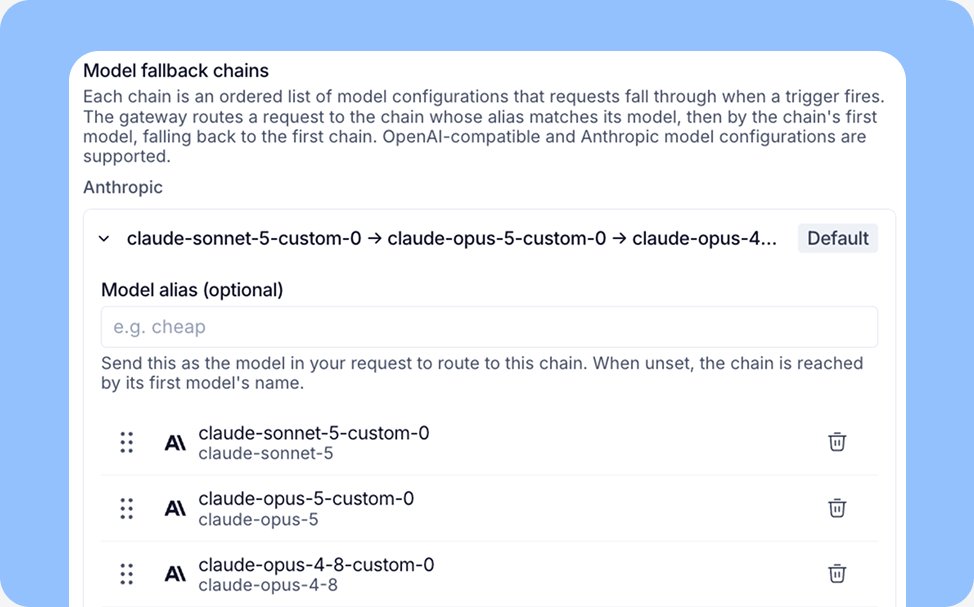
Model Fallbacks with LangSmith LLM Gateway
LangSmith LLM Gateway enters public beta as a governance layer between agents and model providers.
Why it mattersFallback rules, spend caps and rate limits are defined once at the gateway instead of coded into each agent, so a provider outage or retry loop is handled across all agents. Works with Claude Code and Codex by changing base_url.

Ant Ling released open weights for Ling-3.0-flash in official BF16 and FP8-quantized versions on Hugging Face and ModelScope, with SGLang and vLLM deployment support acknowledged. The thread invites self-hosted evaluation and use in agentic workflows but gives no benchmark data.
Why it mattersOpen BF16 and FP8 weights let you run your own evals and self-host the model in agent pipelines instead of depending on a hosted endpoint. Hardware needs and quality are not covered in the thread, so test before relying on it.

NVIDIA Alpamayo 2 Super, the Frontier Open Model for Robotaxis and Autonomous Vehicles, Now Available for Commercial Use
An open, commercially licensed foundation model for autonomous vehicles that produces trajectories, chain-of-causation reasoning traces, meta-actions.
Why it mattersIt offers AV developers a 30B-parameter open model with visible reasoning traces for each driving decision, useful both for building autonomous systems and for auto-labeling fleet footage to speed up training data pipelines.

Liquid AI released LFM2.5-2.6B, an open-weight on-device agent model with 128K context, trained on about 34T tokens. Post-training ends with GRPO-based agentic RL in sandboxed harness rollouts. Runs on llama.cpp, MLX, vLLM, SGLang and ONNX, with vendor-reported tool-use benchmark gains.
Why it mattersA small open-weight model trained with agentic RL inside Pi, Hermes Agent and OpenClaw can run tool-calling loops locally behind an OpenAI-compatible endpoint.

Deploy local agents everywhere with LFM2.5-2.6B
Liquid AI's 2.6B-parameter language model is trained specifically for on-device agentic use, supporting tool calling and multi-step workflows while running at up to 220 tokens/s on consumer CPUs and GPUs.
Why it mattersIt lets developers run capable tool-calling agents fully on-device (phones/laptops) at up to 220 tokens/s while matching or beating models 4x larger on agentic benchmarks, cutting cloud dependency and latency for agent workflows.

SAFE Guidelines for Agentic AI Cybersecurity
The Linux Foundation and the Open Secure AI Alliance, a coalition of 120+ organizations including NVIDIA, Cisco, CrowdStrike.
Why it mattersThe SAFE RFC proposes a confidential mechanism to share agentic AI security incidents and publish evidence-based control recommendations, and surfaces open source tools across identity, harnessing, vulnerability scanning.
How we built a software factory to drive Astro’s GitHub issue count to zero
Cloudflare on assembling agents into a pipeline that drove the Astro project's open GitHub issue count to zero.
Why it mattersOne of the few software-factory claims backed by a measured outcome on a real open-source repo, including what it took to make the loop actually work.
The Agent Development Lifecycle has arrived on Cloudflare
AI made implementation the fast step of the software development lifecycle, which leaves the surrounding phases as the constraint.
Why it mattersGives engineers a concrete framework for where agents belong beyond code generation, and names the downstream bottlenecks that heavy agent use actually creates.
Your agent can now debug Workers with local tracing
Cloudflare now captures OpenTelemetry traces for local Worker invocations automatically in wrangler dev and vite dev.
Why it mattersCoding agents can now get structured runtime telemetry from a local dev server before anything is deployed, closing a major feedback gap in agent debugging loops.
Introducing: Cloudflare Agents
Cloudflare launches hosted agents on its developer platform, starting with observability, on the argument that agents need model access, a durable runtime, orchestration, sandboxed execution and storage, all of which it already runs.
Why it mattersAgent-level cost and tool-call tracing is the missing instrument for anyone operating agents in production rather than demoing them.
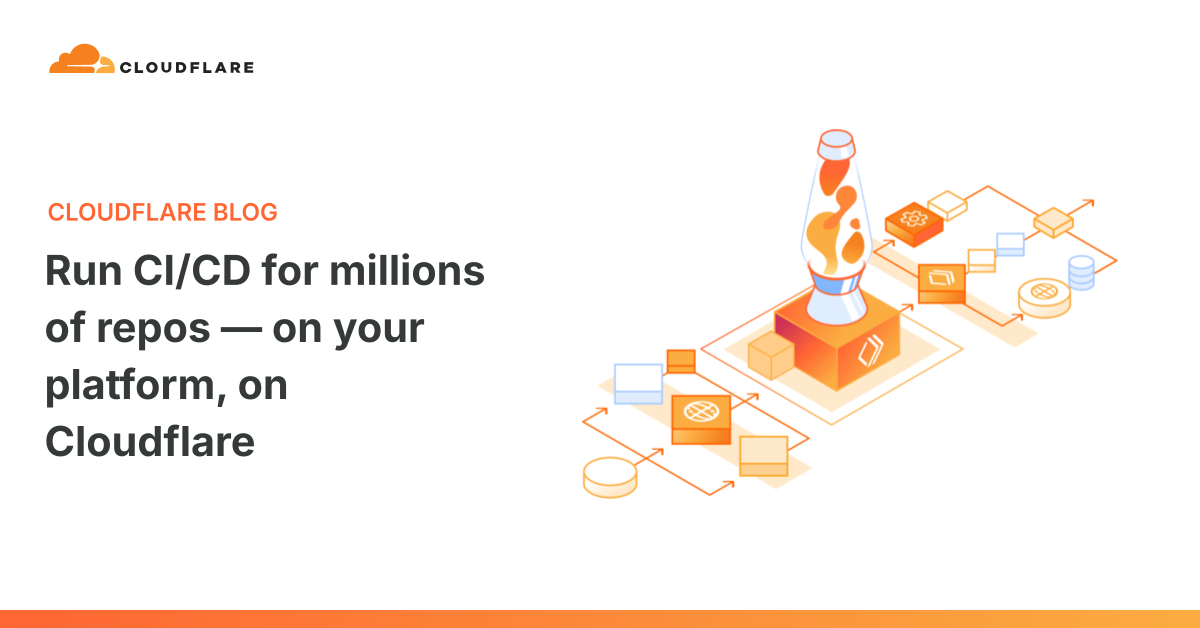
Run CI/CD for millions of repos — on your platform, on Cloudflare
Cloudflare stitches Artifacts, the CI SDK and Workflows together so a push event triggers a continuous integration pipeline running entirely on its own platform, aimed at millions of repositories.
Why it mattersShows a working pattern for CI defined in code with a self-healing agent in the loop, aimed at platforms running code on behalf of many tenants.
Announcing Cloudflare Wallets: the programmable wallet for the agentic Internet
Agents cannot easily try a new API because they have no stable identifier to sign up with and no native way to pay.
Why it mattersAgent identity and pay-per-call API access are becoming a real primitive, and x402 is the protocol builders will have to reckon with.
How Cloudflare enforces engineering standards using AI
Cloudflare's AI code reviewer flagged nearly a quarter of a million deviations from internal engineering standards and blocked 16,000 merges in four months.
Why it mattersA concrete, measured blueprint for making engineering standards machine-enforceable so AI reviewers apply them consistently at scale.

Best Open Weight Models That Matter In 2026
Compares Kimi K3, DeepSeek V4 Pro and Flash, GLM 5.2, and MiniMax M3 for coding on reported Terminal Bench 2.1 scores, API pricing, and total versus active parameters.
Why it mattersPuts Terminal Bench 2.1 scores, per-token pricing, and total vs active parameters for Kimi K3, GLM 5.2, DeepSeek V4 and MiniMax M3 side by side, so you can pick an open-weight coding model on cost and capability.

Introducing Shieldstral.
Guardrail models usually bake harm categories into their weights, so a new deployment context means retraining.
Why it mattersShieldstral takes moderation policies as plain-language input at inference time instead of a fixed harm taxonomy, so you can retarget guardrails per product without retraining.

Fable 5 & Qwen 27B – Traycer Multi-Agent Hands-On Test!
A hands-on test of Traycer running multi-agent collaboration between Fable 5 and a local Qwen 27B, including each model scoring the other's work and a solo run for comparison.
Why it mattersShows concretely how well a frontier model and a small local model actually collaborate under a shared-context orchestrator, and whether that orchestration beats the local model working alone.

A speech recognition preview built on Hy3's language model rather than a standalone acoustic stack, which Tencent credits for context awareness and dialect robustness on messy real-world audio. The headline self-reported figure is roughly 3% multilingual word error rate.
Why it mattersAn LLM-grounded ASR preview reporting roughly 3% multilingual WER is worth benchmarking against your current transcription path, especially on accented or noisy audio where acoustic-only models degrade.

Qwen3.8-Max, better and cheaper. Try it out. 👀 https://t.co/zHXKtgZRci
Why it mattersA new Qwen flagship that is cheaper and stronger changes the cost/quality calculus for anyone routing agent workloads to non-frontier or open-weight-adjacent models.
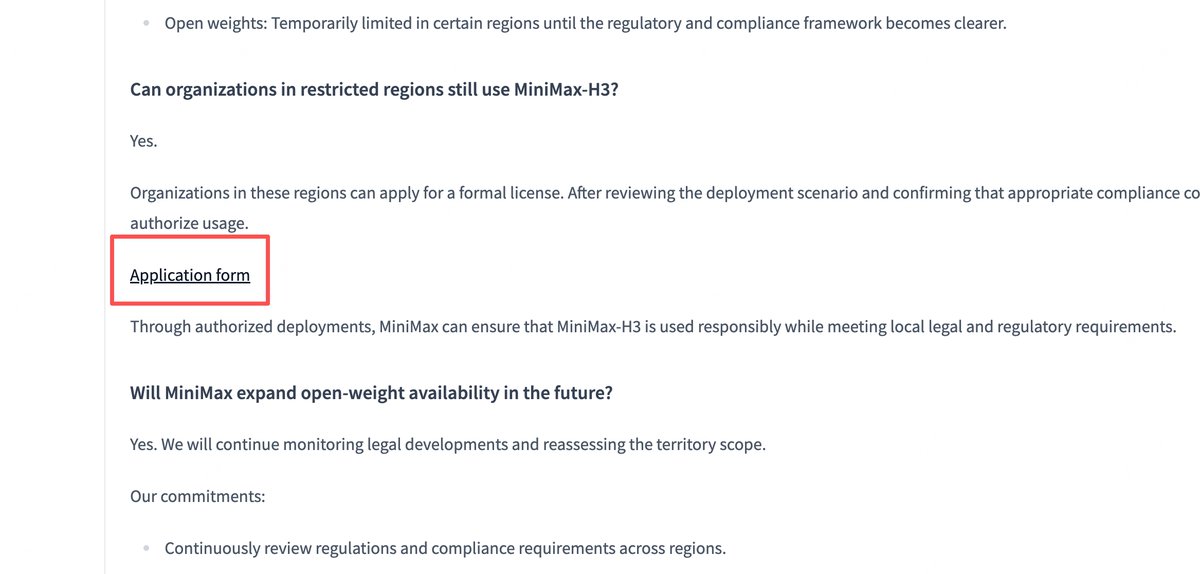
MiniMax H3 open weights: how licensing and regional access work
MiniMax says H3 open weights can be licensed for deployment in the US, EU, UK and South Korea through a formal request.
Why it mattersIf you plan to self-host H3, the open-weight license is scoped by territory and requires a formal request in the listed regions. The API is global, so deployment location decides whether you need a license or can call the hosted API.

AgentMemBench
A reproducible benchmark comparing five long-term memory strategies for conversational AI agents (in-context windowing, external key-value store, graph-based episodic memory, compression summarisation, web-augmented memory) across three datasets.
Why it mattersAgentMemBench shows external key-value retrieval substantially outperforms in-context windowing, graph-based episodic memory, summarization, and web-augmented approaches on long-range recall tasks, at the cost of memory footprint.

JouleShare: Request-Level Energy Attribution for Batched LLM Serving
Batched serving makes GPU power telemetry aggregate, so per-request energy is guessed at.
Why it mattersIf you bill, chargeback or report energy per request, the token-proportional rule most systems use is substantially wrong under batching.

Cost-Effective Automated Judging of Natural-Language Mathematical Proofs
A research study finds that cheap open-weight LLMs (GPT-OSS 120B, DeepSeek-V4 Flash, Gemma-4 31B) can judge natural-language math proofs as reliably as expensive frontier models like Claude Opus 4.7 and Gemini 3.1 Pro, at up to 100x lower cost.
Why it mattersIf replicated, this means math-reasoning evaluation pipelines can swap expensive frontier judges for a cheap three-model unanimous-vote ensemble at up to 100x lower cost without losing reliability.

Skill packs are now available on skills.sh
Agent skills get a packaging layer.
Why it mattersTeams can now pin and update a whole set of agent skills as one versioned unit via a single CLI command, instead of syncing individual skills across projects by hand.

Role Steering of Language Models for Social Simulations
This paper introduces an activation-steering screening workflow that extracts role-specific directions from language models and sweeps steering coefficients to validate role-conditioned agent behavior before deployment in social simulations.
Why it mattersThe paper shows role-specific activation steering beats persona-vector control (63.2 vs 41.1 alignment) for controlling agent personas in social simulations, but flags that ~14% of roles degrade regardless of steering strength.

Memory Reward Inflation in Self-Improving LLM Agents
This paper identifies the 'Echo Gap,' a failure mode in memory-based self-improving LLM agents where self-graded episode scores inflate confidence in incorrect past actions, causing agents to preferentially reuse their own mistakes.
Why it mattersSelf-graded episodic memory in agents can inflate confidence in bad past actions, causing agents to repeat their own mistakes.

Cross-Benchmark Generalization in Long-Horizon Agents
This paper post-trains an open-weight mixture-of-experts model (Qwen3.5-122B-A10B) on 363 long-horizon MCP tool-use tasks using a two-stage SFT-then-RL pipeline, then tests whether skills transfer to unrelated external benchmarks.
Why it mattersIt provides evidence that long-horizon tool-use post-training produces transferable agent behaviors (goal tracking, repair stability, verification) rather than benchmark-specific overfitting.
Faster Deploys for ISR Pages on Vercel
Vercel deploys are now up to 33% faster for apps using Incremental Static Regeneration, achieved by shipping routing metadata for prerendered pages in a single upload instead of splitting it into a separate one when it grows large.
Why it mattersVercel now bundles routing metadata for prerendered pages into a single upload instead of splitting it, cutting deploy times up to 33% for large ISR/PPR apps automatically with no config changes required.
RubricReviewer: From Direct Critique to Objective and Comprehensive Rubric-Driven Peer Review
A framework for LLM-based peer review that first generates paper-adaptive rubrics as an explicit intermediate step, then combines a training-free evidence-gathering agent (Scout) with a human-aligned trained judgment model (Aligner).
Why it mattersIt tackles a specific failure mode in LLM peer review — reviewers being gamed by adversarial prompts hidden in papers — with an explicit rubric-then-judgment pipeline rather than a single opaque judge call.

Capability-Driven Multimodal Scaling Law
This research paper introduces a framework predicting vision-language model performance from a low-dimensional textual capability score derived via PCA, using over 150 trained VLMs across 34 LLM backbones and 7 model families.
Why it mattersThe paper shows a low-dimensional textual capability score (via PCA) predicts multimodal performance across model families and scales up to 72B.

Obshazard-bench
A benchmark for evaluating multimodal foundation models on real-time disaster intelligence, using raw satellite sounding streams, ground observations.
Why it mattersIt exposes a concrete failure mode.

Source Code Authorship Attribution Does Not Generalize from Competitions to Classrooms
This paper fine-tunes CodeBERT for source code authorship attribution and finds it achieves 92.6% Top-1 accuracy on Google Code Jam competition data but drops to near-chance levels (0.2% and 0.06% Top-1) on real university coursework datasets.
Why it mattersFine-tuned CodeBERT models that hit 92.6% Top-1 accuracy on Google Code Jam authorship attribution drop to 0.2% and 0.06% on real university coursework, and the gap holds across model families.

LoopsBench: From Harness Engineering to Loop Engineering in Benchmarking Coding Agent
Coding agent evaluation is shifting from harness engineering to loop engineering.
Why it mattersIt gives agentic engineers a hard number for how badly current coding-agent loops degrade over sustained, multi-step work, and an open benchmark to test their own harness against.

SLMs as Multi-Agent Routers: A Progressive SFT and Reinforcement Learning Approach
A small language model trained with supervised fine-tuning then reinforcement learning picks the right specialized retrieval agent and generates its tool-call parameters, rewarded on actual retrieval relevance rather than inferred intent.
Why it mattersShows that training a small router model with RL against actual retrieval relevance—rather than inferring intent.

CASPER: Change-Aware Slice Prioritization for LLM Regression Testing
A regression-testing approach for LLM systems that works at an intermediate granularity.
Why it mattersChanging a prompt or model can silently regress specific behaviors while the aggregate score holds.

CoT-Core: Accelerating LLM Evaluation via CoT-Aware Coreset Selection
This paper introduces a training-free method for selecting a small representative subset of benchmark questions to evaluate LLMs cheaply, by clustering questions based on their zero-shot Chain-of-Thought reasoning trajectories rather than surface text similarity.
Why it mattersIt shows how clustering by chain-of-thought reasoning patterns—rather than surface text similarity.
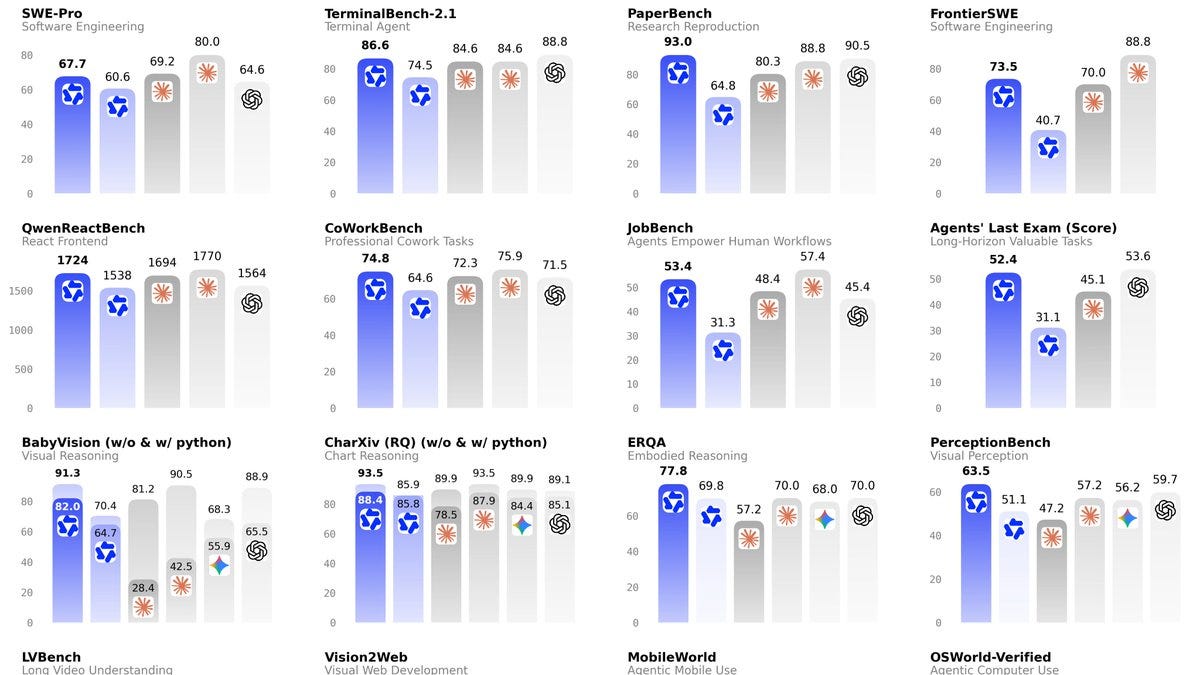
Qwen 3.8 Max: Alibaba's 2.4T Open-Weight Model for Coding and Cowork
Alibaba's Qwen team unveiled Qwen3.8-Max, a 2.4T-parameter sparse MoE model (roughly 95B active per token) aimed at long-horizon coding, agentic 'cowork', and multimodal reasoning.
Why it mattersAlibaba's Qwen3.8-Max is a 2.4T-parameter MoE model (95B active) posting strong coding/agentic benchmarks at lower API pricing than its predecessor, but its license reportedly restricts use in the US, EU, UK, and Korea.

The Shape of Things to Come
Steve Yegge recounts how his AI coding agent project 'Gas Town' — meant to be reusable.
Why it mattersYegge documents a specific model behavior — Opus 4.7 repeatedly wanting to add 'just two more things' instead of finishing.
Alibaba's Qwen3.8 Max is available on OpenRouter with 2.4T total and 95B active parameters, aimed at long-horizon coding and multimodal agents. Qwen reports large benchmark gains over its prior Max model, and open weights are promised within a week.
Why it mattersQwen3.8 Max is callable now on OpenRouter, and open weights are promised for the following week, which would be the first for a Qwen Max-class model.
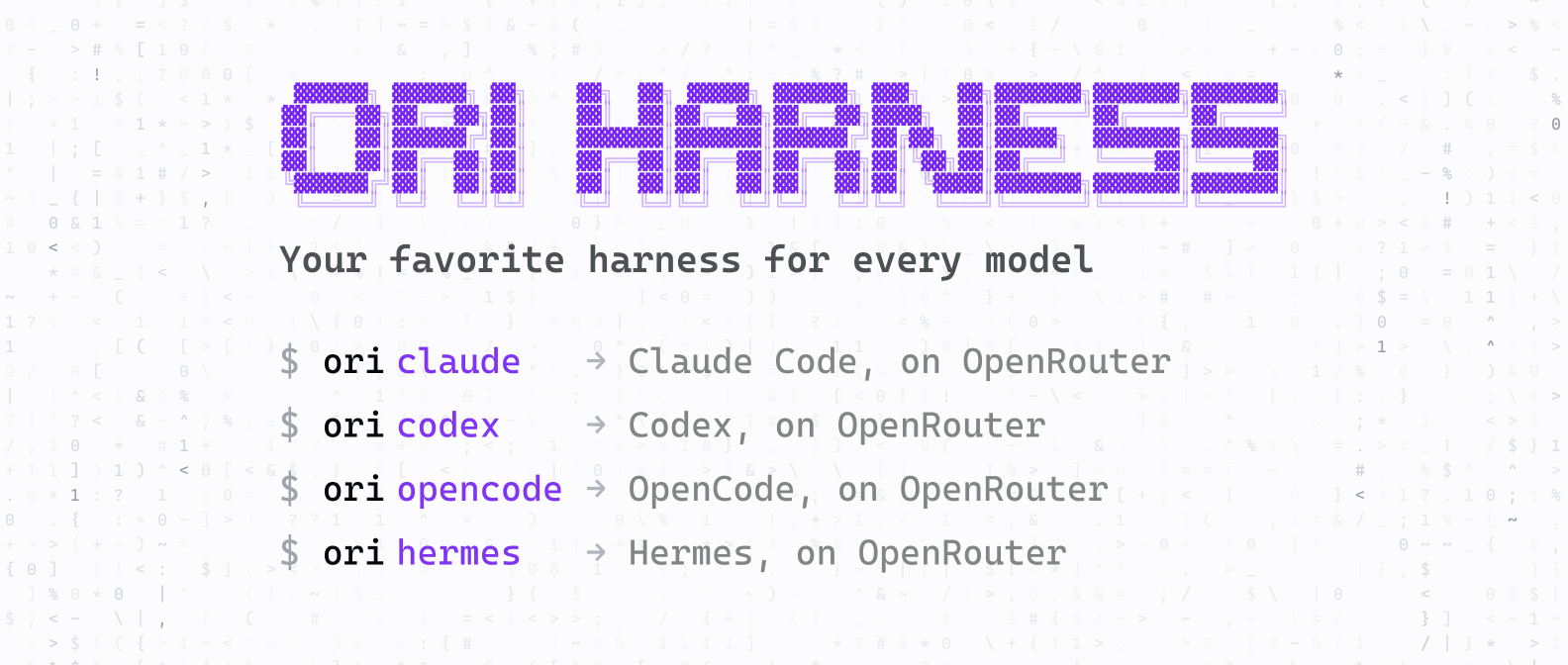
Ori Harness
A CLI that boots Claude Code, Codex, OpenCode, or Hermes against OpenRouter with the right configuration per model.
Why it mattersRunning Claude Code through a gateway silently loses tool search, which costs roughly half the system prompt in tokens and changes how many turns the agent takes. The ori CLI sets that and the rest of the env matrix per model automatically.
An index of the vibe-coding frontier. Corrections welcome.